Choose timezone
Your profile timezone:
THE 2026 AfAS CONFERENCE
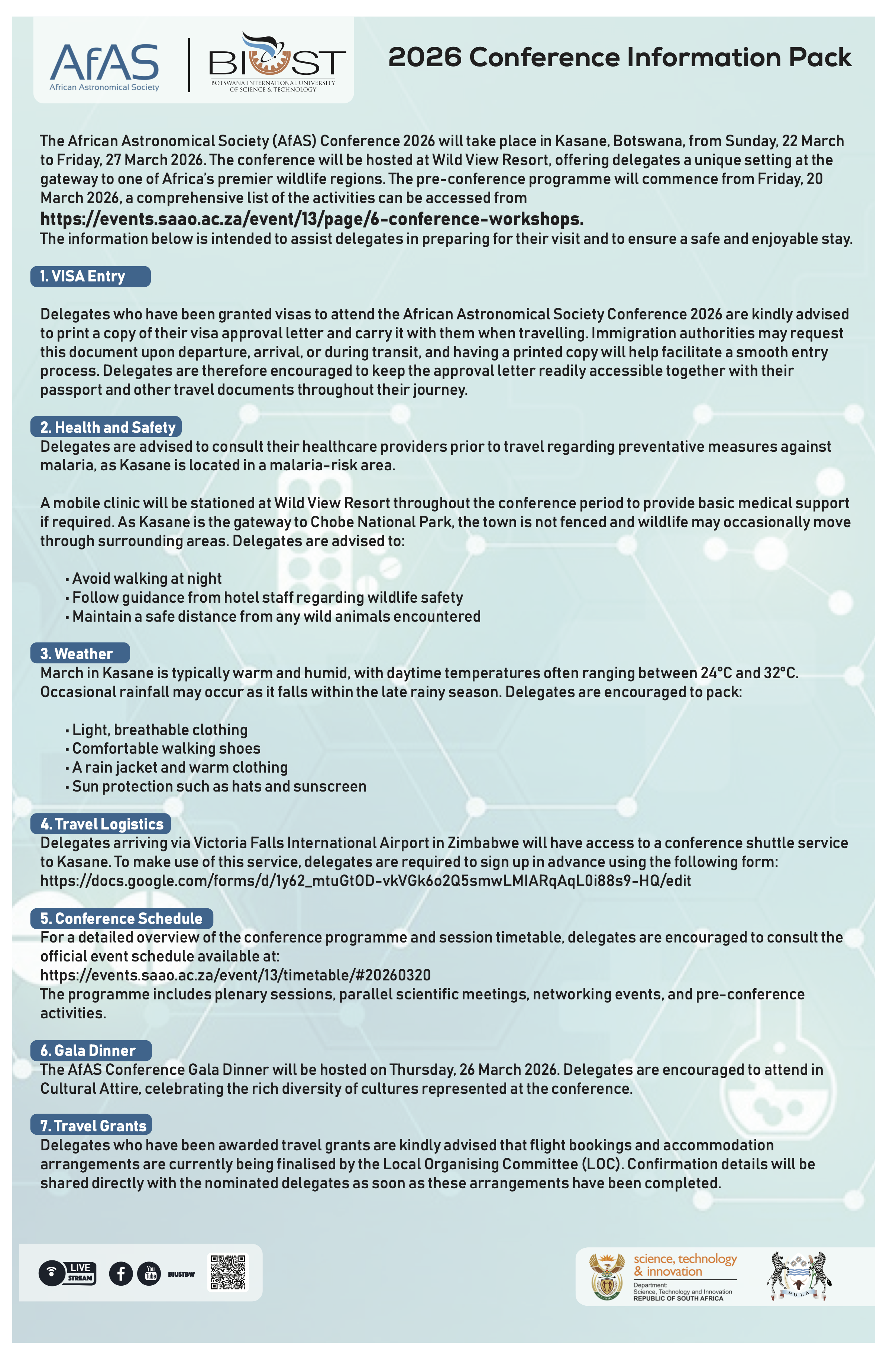
We warmly invite you to submit your abstract and register for the 2026 African Astronomical Society (AfAS) Conference, scheduled for March 22–27, 2026, at the Wild View Resorts in Kasane, Botswana. This landmark event will bring together Africa’s astronomy and space science community alongside global collaborators, to create an exceptional platform for networking, collaboration, and knowledge exchange. Delegates can look forward to insightful discussions that bridge research, innovation, policy, and community engagement, driving forward Africa’s role in the global astronomical landscape.
This year’s conference celebrates Africa’s growing contribution to the global astronomical community, showcasing the continent’s scientific excellence and technological innovation. The program will feature thematic sessions on astronomy, engineering, and computer science, highlighting advances in instrumentation, data analysis, and multi-disciplinary research. Complementing the scientific program will be a vibrant science communication and outreach stream, designed to promote public understanding, inspire the next generation, and strengthen astronomy education across Africa.
Set in Kasane, a gateway to Chobe National Park and nestled along the Chobe River, the conference promises a unique blend of scientific and cultural immersion. Delegates will experience one of Africa’s premier wildlife and eco-tourism destinations, located at the quadripoint where Botswana meets Namibia, Zambia, and Zimbabwe, and within close proximity the magnificent Victoria Falls. The setting provides a perfect backdrop for exploring astro-tourism opportunities and celebrating Botswana’s status as a dark sky destination, where the beauty of the cosmos can be appreciated in pristine night skies.
Be part of this remarkable event — share your research, exchange ideas, and contribute to shaping the future of astronomy and space science in Africa. Submit your abstract and register today to secure your place at this unforgettable gathering in Kasane, Botswana.
This program is designed to equip researchers, students, professionals, and science communicators in astronomy and other basic sciences across BRICS and African countries with essential skills in science communication. The initiative aims to strengthen participants’ ability to effectively convey scientific knowledge, engage the public, and inspire greater interest in astronomy, basic sciences, and all the sciences.
The workshop will feature expert speakers or trainers with academic and practical experience in relevant topics. The program also seeks to bridge the gap between academia and practice, addressing the current divide in science communication.
This program is designed to equip researchers, students, professionals, and science communicators in astronomy and other basic sciences across BRICS and African countries with essential skills in science communication. The initiative aims to strengthen participants’ ability to effectively convey scientific knowledge, engage the public, and inspire greater interest in astronomy, basic sciences, and all the sciences.
The workshop will feature expert speakers or trainers with academic and practical experience in relevant topics. The program also seeks to bridge the gap between academia and practice, addressing the current divide in science communication.
This program is designed to equip researchers, students, professionals, and science communicators in astronomy and other basic sciences across BRICS and African countries with essential skills in science communication. The initiative aims to strengthen participants’ ability to effectively convey scientific knowledge, engage the public, and inspire greater interest in astronomy, basic sciences, and all the sciences.
The workshop will feature expert speakers or trainers with academic and practical experience in relevant topics. The program also seeks to bridge the gap between academia and practice, addressing the current divide in science communication.
This program is designed to equip researchers, students, professionals, and science communicators in astronomy and other basic sciences across BRICS and African countries with essential skills in science communication. The initiative aims to strengthen participants’ ability to effectively convey scientific knowledge, engage the public, and inspire greater interest in astronomy, basic sciences, and all the sciences.
The workshop will feature expert speakers or trainers with academic and practical experience in relevant topics. The program also seeks to bridge the gap between academia and practice, addressing the current divide in science communication.
This program is designed to equip researchers, students, professionals, and science communicators in astronomy and other basic sciences across BRICS and African countries with essential skills in science communication. The initiative aims to strengthen participants’ ability to effectively convey scientific knowledge, engage the public, and inspire greater interest in astronomy, basic sciences, and all the sciences.
The workshop will feature expert speakers or trainers with academic and practical experience in relevant topics. The program also seeks to bridge the gap between academia and practice, addressing the current divide in science communication.
This program is designed to equip researchers, students, professionals, and science communicators in astronomy and other basic sciences across BRICS and African countries with essential skills in science communication. The initiative aims to strengthen participants’ ability to effectively convey scientific knowledge, engage the public, and inspire greater interest in astronomy, basic sciences, and all the sciences.
The workshop will feature expert speakers or trainers with academic and practical experience in relevant topics. The program also seeks to bridge the gap between academia and practice, addressing the current divide in science communication.
This program is designed to equip researchers, students, professionals, and science communicators in astronomy and other basic sciences across BRICS and African countries with essential skills in science communication. The initiative aims to strengthen participants’ ability to effectively convey scientific knowledge, engage the public, and inspire greater interest in astronomy, basic sciences, and all the sciences.
The workshop will feature expert speakers or trainers with academic and practical experience in relevant topics. The program also seeks to bridge the gap between academia and practice, addressing the current divide in science communication.
This program is designed to equip researchers, students, professionals, and science communicators in astronomy and other basic sciences across BRICS and African countries with essential skills in science communication. The initiative aims to strengthen participants’ ability to effectively convey scientific knowledge, engage the public, and inspire greater interest in astronomy, basic sciences, and all the sciences.
The workshop will feature expert speakers or trainers with academic and practical experience in relevant topics. The program also seeks to bridge the gap between academia and practice, addressing the current divide in science communication.
This talk will provide an overall update on Breakthrough Listen activities and
discuss the program's future directions.
The Galactic Center hosts the highest stellar density in the Galaxy, and its line
of sight provides the largest integrated Galactic star count of any direction in
the sky. Breakthrough Listen is conducting one of the most extensive and
sensitive searches for technosignatures and pulsars toward the Galactic
Center. In this talk, I summarize technosignature searches conducted with the
Green Bank Telescope over the past six years and discuss the recent discovery
of a potential millisecond pulsar candidate near the Galactic Center (Perez et
al. 2026). I also present preliminary progress on interferometric imaging at the
Allen Telescope Array (ATA), which will enable technosignature searches in
the visibility (UV) plane for the first time with the ATA, with the Galactic
Center as a primary target.
The search for life in the Universe is crucially dependent on the ability of stars
to host life-bearing planets for sufficiently long to develop complex
civilisations. In this talk I will discuss how recent discoveries with widefield
and sensitive interferometers are now providing us with new insights into
stellar systems and how their natural magnetic emission processes inform our
technosignature searches.
By simulating Earth's most powerful radio transmitters as observed from
nearby exoplanet system, Proxima Centauri, we place upper limits on
detectable technosignatures and map the current observational search space.
The TRON (Transient Radio Observations for Newbies) pipeline is designed to image radio interferometric data at raw correlator time resolution, and to
conduct automatic searches for transient and variable radio sources. These
techniques pave the way towards technosignature searches using the full field
of view of an interferometer, given future narrowband correlators. At the
coarser frequency resolution of existing correlators, the same technique can
yield a motherlode of astrophysical discoveries, motivating a systematic
data-mining effort with TRON across the entire MeerKAT archive. This talk will
discuss the imaging and transient search techniques employed by TRON and
highlight some of the astrophysical discoveries made.
Observations of redshifted 21-cm emission from neutral hydrogen over a wide range of radio frequencies allow us to access redshifts that encompass a vast comoving volume, including the era of dark energy. In this talk, I will present the Hydrogen Intensity Mapping and Real time Analysis eXperiment (HIRAX) project, on behalf of the HIRAX collaboration, which is a proposed 21cm intensity mapping experiment operating at 400-800 MHz that will measure the evolution of dark energy over the redshift range z=0.8-2.5 by using the characteristic baryonic acoustic oscillation scale as a standard ruler. The HIRAX radio telescope array will be sited in the radio-quiet Karoo astronomy reserve in South Africa, and will ultimately comprise 1024 dishes, each six metres in diameter, placed in a compact configuration. I will discuss the design and status of HIRAX and its scientific prospects. This includes dark energy constraints and interesting cosmological cross-correlations with other southern sky surveys. HIRAX will also discover a large number of pulsars and transients, including fast radio bursts (FRBs). I will describe our programme to localise these FRBs using HIRAX outriggers in African partner countries.
SALT is the largest single optical telescope in the southern hemisphere and has been in routine operations for 15 years. It is an international collaboration with eight shareholder partners based in four continents. The partnership has evolved over the years, and I will highlight current opportunities for African astronomers to become operations partners in SALT. SALT is a fully queue observed, general purpose telescope which is ideally suited for time domain or survey observations. An example of this is my program to get high resolution spectra, and determine abundances of RR Lyrae stars. This survey of variable stars has led to a rich array of studies on the calibration of RR Lyrae stars as distance indicators and the structure of our Milky Way galaxy and its nearby satellite galaxies.
The talk will provide feedback on a mapping exercise conducted to understand the landscape of astronomy engagement and outreach across Africa. This includes identifying who the role players are, where they are located, the types of activities they conduct, the challenges they face, and the success factors or lessons learned from their experience.
This work was carried out with the aim of building more connected and coordinated engagement efforts across the continent, efforts that are informed by the conditions of the countries and stakeholders involved, ensuring that interventions are flexible and context-specific. It has become evident that for outreach efforts to be truly impactful, interventions must be tailored to address the specific needs, challenges, and contexts of each region. Such initiatives should serve as context-specific responses rather than a uniform, one-size-fits-all approach.
The study received 184 responses from 30 countries across Africa and provides an overview of the experiences of these individuals, offering a glimpse into the current landscape. This allows AfAS and the broader African astronomy community to make more informed decisions and implement targeted interventions that support the advancement of astronomy on the continent, beginning at the grassroots level, where the public is meaningfully engaged in the science and its developments and given the opportunity to be included and to participate actively.
Previous studies of galaxy formation have shown that only 10 per cent of the cosmic baryons are in stars and galaxies, while 90 per cent of them are missing. In this talk, I will present three observational studies that coherently find significant evidences of the missing baryons. The first is the cross-correlation between the kinetic Sunyaev-Zeldovich maps from Planck with the linear reconstructed velocity field. The second measurement is the cross-correlation between the thermal Sunyaev-Zeldovich effect with gravitational lensing map and we detect the cross-correlation for 13 sigma with RCSLenS and Planck data. The third study is to stack the cosmic voids to have a direct detection of warm hot gas inside the voids. These detections coherently brings a picture of how baryons distribute in the cosmic web. But the question is, at what level we can say we have found all missing baryons? I will briefly describe the critical way to solve this problem, what new data (Simons Observatory and LSST) can bring to us.
This study investigates the formation of non-linear ion-acoustic solitary structures (IASSs) in magnetized plasmas consisting of inertial cold ions, superthermal electrons, and positrons. The reductive perturbation method was employed to derive the Korteweg-de Vries (KdV) equation, and the steady state solution of the KdV equation was obtained, providing a framework for exploring the solitary structures based on empirically observed ranges in space and astrophysical plasmas for various parameter such as superthermal electrons, (κe = 2, 4, 50), unperturbed positron to electron density ratio (p = np0/ne0), ion-to-electron temperature ratio (δ = Ti/Te ), electron-to-positron temperature ratio, (σ = Tp/Te ) and oblique propagation angles (θ = 0, π/10, π/4). From the expression KdV equation, the coefficient P represents the nonlinear effects, whereas Q describes the dispersive properties of the medium, together governing the formation and characteristics of solitary wave
structures in the plasma. The derived solitary wave (soliton) profile, whose functional form follows the square of the hyperbolic secant (sech2-type), reveals how these parameters modulate the amplitude, width, and polarity of electrostatic solitary waves. The numerical results show that the solution of the non-linear equation allows only compressive (positive) soliton structures to exist. The results further demonstrate that soliton properties are susceptible to plasma parameters; increasing superthermality or positron concentration leads to reduced amplitude and broadened profiles, temperature ratios (σ, δ), and obliqueness angle (θ) also significantly modulate the nonlinear and dispersive behavior of the solitary waves. Our study of IASSs provides critical information on theoretical understanding and practical technologies across various plasma applications in laboratory and astrophysical settings.
Gravitational lensing provides a powerful probe of the global mass properties of galaxies, which are best tested using observations at extremely high angular resolution. In addition, through detailed observations of the lensed images, it is possible to place tight constraints on the nature of dark matter through measuring the abundance and properties of low mass haloes via their subtle gravitational lensing signal. Here, we first present new observations with the Very Large Array (VLA) and High Sensitivity Array (HSA) to better understand the source of so-called flux-ratio anomalies in four image gravitational lenses, which historically provided the first constraints on CDM using lensing studies. Next, we will present the analysis of the mass properties of ten massive elliptical galaxies at intermediate redshifts, by combining gravitational lensing and the sensitivity and resolving power of the Atacama Large Millimetre Array (ALMA) and global Very Long Baseline Interferometry (radio VLBI). Using imaging at 25 to a few milli-arcsecond resolution, we find that complex mass models with angular structure are strongly favoured by the data. In addition, such observations are sensitive to small-scale structure either in the lens or along the line-of-sight to the background source. From such an analysis of the data from global VLBI observations, we detect of a low mass (million solar mass) dark object, whose properties are inconsistent with a dark matter halo from either cold or warm dark matter models, but may be in agreement with more exotic models, like self-interacting dark matter. Finally, we present a brief overview of future studies using a likely African VLBI facility.
Interacting Dark Energy (IDE) models, where dark matter and dark energy interact through a non-gravitational coupling, have recently regained attention as late-time cosmic tensions persist and new datasets hint at possible dynamical dark energy and deviations from ΛCDM.
In this talk, we will present observational constraints on a broad class of linear and non-linear IDE models using some of the newest late-time datasets: DESI DR2 BAO, Pantheon+ supernovae, Cosmic Clocks, and BBN. These IDE models, each of which admits exact analytical solutions for the Hubble parameter H(z), allow us to directly explore features such as the possible direction of energy transfer, the presence of negative energy densities, and effective phantom-crossing behaviour.
We show that several IDE models provide improved fits to the combined DESI and Pantheon+ data compared to ΛCDM, even after accounting for the additional model parameters. A consistent pattern emerges across many models: the data mildly prefer a small but non-zero energy transfer in the dark sector, typically from dark matter to dark energy at early times, with a possible switch in the direction of energy transfer at later epochs. Furthermore, for all interactions considered, where possible, we find a phantom-divide crossing for the effective equation of state of dark energy, with the density of dark energy decreasing at present and at low redshift, while increasing in the past at high redshift.
However, these results must be interpreted with caution, as many models predict negative energy densities in the past or future, or exhibit early-time instabilities at the perturbation level, which may be unphysical. A complete assessment requires the inclusion of CMB and other early-universe probes, as well as a dedicated stability analysis, which will be considered in future work.
We study cosmic magnification beyond lensing in a late-time universe dominated by quintessence and cold dark matter. The cosmic magnification angular power spectrum, especially going beyond the well-known lensing effect, provides an independent avenue for investigating the properties of quintessence, and hence, dark energy. By analysing the magnification power spectrum at different redshifts, it is possible to extract new information about the large-scale imprint of dark energy, including whether we are able to disentangle different models from one another. Using three well-known quintessence models, we analyse the cosmic magnification angular power spectrum while taking relativistic corrections into account. We found that it will be difficult to distinguish between quintessence models, and quintessence from the cosmological constant, in lensing magnification angular power spectrum on large scales, at redshifts $z \,{\leq}\, 1$; whereas, when relativistic corrections are incorporated, the total magnification angular power spectrum holds the potential to distinguish between the models, at the given $z$. At $z \,{\geq}\, 3$, the lensing magnification angular power spectrum can be a reasonable approximation of the total magnification angular power spectrum. We also found that both the total relativistic and the Doppler magnification signals, respectively, surpass cosmic variance at $z \,{\leq}\, 0.5$: hence the effect may be detectable at the given $z$. On the other hand, the ISW and the time-delay magnification signals, respectively, are surpassed by cosmic variance on all scales, at epochs up to $z \,{=}\, 4.5$, with the gravitational-potential magnification signal being zero.
The redshifted 21 cm line is a powerful probe of the epoch when the first stars and galaxies were born and, consequently, reionized the intergalactic medium. In this talk I will present upper limits on the redshifted 21 cm line obtained through observations with the Hydrogen Epoch of Reionization Array showing that the intergalacticm medium was heated above the adiabatic limit before z ~ 8. I will also present constrained on the 21 cm signal obtained from absorptioin against bright quasars, ruling out the presence of pockets of cold, neutral Hydrogen at the end of cosmic reionization.
Doing science is one thing, a satisfactory thing for a researcher, but communicating science with the public is another requirement for mutual benefit of both the researcher and the people for whom the science cases present potential solutions. In this presentation, we report the potential impediments to a successful science engagement in Africa and in most African research institutions. Science outreach in Africa faces distinguishable challenges compounded by structural, cultural, and resource-based challenges. We have evaluated issues relating to insufficient budgets, inadequate STEM infrastructure, digital divide, geographical barriers and lack of policy support among other causes. We have further dwelt on proposing potential remedies that would help to achieve or strike a balance between scientific investigations and outcome communication.
Over the past year, the Copperbelt University (CBU) in Zambia, in collaboration with the Fast4Future Initiative and the Southern African Regional Office of Astronomy for Development (SAROAD), has delivered a series of innovative astronomy outreach programs to strengthen STEM engagement among young learners. These initiatives incorporated hands-on telescope assembly, virtual sky explorations using Stellarium, Celestia and other astronomy outreach tools for safe solar-viewing activities, and guided night-sky observations that brought astronomy to life for students and teachers across multiple communities. Flagship events—including the Astronomy Outreach Conference and World Space Week 2025—attracted significant participation from schools, educators, and community leaders, fostering a vibrant environment for science communication and experiential learning. The outreach activities also integrated debate competitions, science exhibitions themed “Viability of Living in Space,” and recognition awards for outstanding student achievements. These engagements not only improved scientific literacy and observational skills but also promoted teamwork, creativity, and long-term interest in space science. This paper presents the outcomes, challenges, and broader educational impact of these programs, highlighting how coordinated efforts between universities and development-oriented organisations can support inclusive STEM education and inspire the next generation of African scientists. Ultimately, the work underscores astronomy’s potential as a transformative tool for education, empowerment, and sustainable development.
In this talk, I will describe two large scale projects organised by the Science Communication, Public Outreach, and Education (SCOPE) Section of the Indian Institute of Astrophysics (IIA), both of which utilise the Cascade Model as a core strategy. The first is an ongoing program where, in partnership with the Government of the Karnataka State, we are promoting astronomy and low cost hands-on activities across rural Karnataka through their 5,888 rural libraries that serve as community centres - via training workshops, activity sheets, naked eye astronomy, online talks, and in-person events. This has already shown considerable response from the rural communities.
The second is a recently concluded campaign for the 7 September 2025 Total Lunar Eclipse, where we organised training workshops for local science communicators, enabled 50,000 posters in Tamil to be put up in public places, organised multiple school talks against superstitions, and information in many languages to every school in three States, formed state-wide platforms of astronomy outreach groups, made livestreams available for national and international media, and facilitated a national information flow through press conferences.
I will discuss the strategies for both these projects, the impact they have had in terms of increased awareness of the science versus pseudo-science in these topics, and capacity building of local science communicators in the process. I will also discuss how the two projects use the Library Supervisors and local science communicators respectively in the Cascade Model framework. I will end with some learnings that might be relevant in the African context.
Communicating astronomy to underserved communities is an adventure that requires collaborative efforts among stakeholders to ensure its goals are achieved. In Nigeria, our project team has conducted several outreach programmes and workshops to advance astronomy development in underserved communities and achieve the SDGs. These underserved communities include the rural regions, correctional facilities (prisons), and special needs. This project adopted the cascade approach for scalability and knowledge diffusion. From 2024 to date, this project has organised seven educator training workshops and twelve outreaches. The project team has visited four correctional facilities in Enugu and Anambra States, reaching over 350 inmates. To ensure inclusivity for students with special needs, the project team has organised workshops at selected tertiary, secondary, and primary institutions. The target audience determines the learning goals, approach and workshop activities. The project lecture and hands-on activities (including tactile and Braille) are centred on the pale-blue dot, the observable universe, the birth and death of stars, solar system planets, the working principles of telescopes, stargazing, cultural astronomy, and astronomy for mental health. This initiative has reached a total of 2,450 participants with a gender ratio of 55% female and 45% male. The project impacts were assessed using quantitative and qualitative methods. Adopting the use of pre- and post-assessment methods, there has been a significant 50.2% increase in understanding about astronomy post workshops and outreaches. The average post-assessment of the project activities showed a 76.2% interest in STEM among participants. The overall assessment of the objectives of the project has shown 79.6% success. There is a need to cover more geopolitical regions across Nigeria. The development of astronomy in these underserved communities is vital to fostering a greater understanding of the universe and inspiring future generations of scientists.
Ethiopia possesses exceptional natural conditions for astronomical observation, including clear skies, high-altitude terrains, low light pollution, and a geographic position that enables visibility of both celestial hemispheres. These advantages uniquely position the country to promote astronomy and strengthen STEM education. However, persistent economic, political, social, and institutional challenges continue to affect educational quality and limit student engagement in scientific fields. As a result, a significant gap remains between Ethiopia’s astronomical potential and the integration of astronomy within its formal education system.
Stargazing events have emerged as effective tools for motivating and inspiring students by providing practical, hands-on learning experiences outside the classroom. Through direct observation of celestial objects, students are able to connect theoretical concepts with observable phenomena, making science more tangible and engaging. School-based astronomy clubs and initiatives such as the SciGirls program—supported by the Ethiopian Space Science Society—demonstrate particular promise in promoting gender equity by encouraging girls and young women to pursue STEM pathways.
Evidence suggests that participation in stargazing activities increases students’ awareness, engagement, and confidence in STEM subjects, especially when instruction is delivered in local languages and integrates cultural perspectives that make scientific concepts relatable. These events also foster collaboration among teachers, researchers, and community organizations, extending outreach to underserved regions and strengthening family involvement in students’ scientific development.
While long-term impacts require further study, early findings indicate that stargazing initiatives contribute positively to building a scientifically literate and innovative society in Ethiopia. Future efforts should focus on sustaining and expanding inclusive astronomy programs, leveraging digital tools for broader access, and cultivating international partnerships—particularly with neighboring African countries—to organize bilateral stargazing events and share best practices. Such initiatives hold significant potential not only to enhance individual learning outcomes but also to support national goals related to scientific literacy, technological advancement, and socio-economic development.
The constancy of fundamental natural constants (FNCs), such as the fine-structure constant (α), the gravitational constant (G), and the speed of light (c), is a foundational pillar of modern physics. However, persistent observational anomalies—most notably the > 5σ Hubble Tension between early- and late-universe measurements of the Hubble constant—increasingly challenge this paradigm. While theoretical frameworks such as scalar-tensor gravity and string theory naturally suggest temporal or spatial variation of constants, a unified, self-consistent model capable of simultaneously varying α,G, and c within a single geometric framework remains absent.This research proposes to develop a novel cosmological framework grounded in generalization of the Friedmann-Lemaitre-Robertson-Walker (FLRW) metric, incorporating spatial time-flow anisotropy through a new metric ansatz. Within this geometry, FNCs are treated as dynamical fields, evolving with both cosmic time and spatial position. A key postulate of the model is the invariance of the Planck length, which imposes a necessary constraint linking variations of G,ℏand c, ensuring theoretical consistency and testability. The primary aim is to investigate whether such variations can resolve the Hubble Tension and other cosmological anomalies, including the lithium problem and reported spatial variations in α. The methodology involves deriving modified Friedmann equations,vimplementing numerical simulations, and employing advanced statistical and machine learning techniques to constrain the model against premier datasets from Planck, SH0ES, and quasar absorption spectra.
We present a new cosmological model that we have coined the---Eternal Universe Model (EU-model). At a prima facie level, this model resembles the traditional Friedmann Universe model (also known as the FLRW model, Lambda-CDM model, or Concordance Model) but eliminates the assumption of temporal homogeneity. Specifically, we subtly modify the FLRW metric by allowing the rate at which time progresses---represented by the 00-component of the spacetime metric tensor---to vary systematically across different spatial locations within the infinite expanse of the Universe. This alteration in the temporal structure introduces intriguing concepts such as the continuous creation of matter and the variation of Fundamental Natural Constants (FNCs). Within this framework, non-ponderable negative matter is allowed, providing a natural explanation for darkmatter and darkenergy. Furthermore, the variation of FNCs sheds light on the Hubble Tension and the Cosmological Axis of Evil (CAoE). Ultimately, the resulting model depicts a temporally and spatially infinite Universe that is globally unchanging and eternal, with no beginning nor end---hence the term \textit{eternal}. Additionally, this Universe features a fixed and absolute spatial center from which all motion can be referenced in an absolute manner.
The Zambia Ground Receiving Station (GRS) is the country’s first satellite data acquisition facility, established on a 7.3-m antenna platform to strengthen national infrastructure for Earth observation. The system is engineered to track and receive data from low-Earth-orbit satellites, including TERRA/AQUA, MODIS, Landsat 8, and Landsat 9, through dedicated S-band and X-band subsystems. The S-band operates at 2025–2120 MHz with selectable LHCP/RHCP polarization, while the X-band subsystem (7450–9000 MHz) provides simultaneous dual-polarization capability for high-throughput data reception. The station supports multiple tracking auto-monopulse, manual, and program tracking-ensuring robust and reliable satellite acquisition.
Leveraging these technical capabilities, we developed comprehensive documentation and operational data-acquisition protocols that now guide the National Remote Sensing Centre (NRSC) in procuring, processing, and applying satellite imagery for national use. The establishment of this station significantly enhances Zambia’s Earth observation capacity, enabling timely access to remote-sensing data crucial for environmental monitoring, resource management, and national development planning.
One of the most effective observational instruments for understanding the universe's formation, composition, and evolution is the Cosmic Microwave Background (CMB). However, increasing data volumes, complex noise structures, and the need for high-precision cosmological inference present growing challenges for conventional CMB processing methods. The goal of this project is to develop an AI-driven framework that enhances the processing, reconstruction, and interpretation of CMB temperature and polarization data. The work will focus on improving noise suppression, foreground removal, feature extraction, and cosmological parameter estimation using machine learning and deep learning techniques. The proposed approach aims to combine data-driven methodologies with physics-informed models to produce an analysis that is faster, more accurate, and more reliable than traditional methods. Ultimately, this work seeks to contribute to next-generation CMB research and deepen our understanding of the early Universe by evaluating performance gains and demonstrating the potential of AI to advance cosmology through the application of the developed tools to existing datasets such as Planck, WMAP, ACT, or simulated CMB maps.
Intensity mapping for the 21 cm line is a promising route to map large-scale structure, but the cosmological HI signal is buried beneath Galactic and extragalactic foregrounds orders of magnitude brighter. We implement the Generalized Needlet Internal Linear Combination (GNILC) method to clean foregrounds from simulated MeerKAT single-dish observations in the UHF band (z ≈ 0.4–1.4). Simulations include a Gaussian-realization HI signal, spatially correlated Galactic synchrotron, and extragalactic point sources; the initial data cube was compressed from 252 to 20 channels and analysed at HEALPix nside = 256, probing multipoles ℓ ≈ 30–300. GNILC operates in needlet (wavelet) space, using a localized covariance comparison with a prior HI covariance to identify the HI subspace and apply a constrained ILC reconstruction. In tests excluding bright point sources, the recovered map shows high accuracy, matching the true signal (pixel-space correlation rp = 0.956) with rms residual ≈ 0.26 K, demonstrating GNILC’s effectiveness for diffuse foregrounds. Inclusion of extragalactic point sources degrades recovery, indicating that point-source needs masking or preprocessing and beam–frequency modelling to reach comparable performance on realistic data. We present validation in pixel and harmonic space, discuss limitations introduced by non-Gaussian small-scale contaminants, and outline steps to adapt GNILC for MeerKLASS single-dish analyses. These results support GNILC as a promising foreground-removal tool for upcoming HI intensity-mapping surveys.
Atmospheric turbulence (seeing) degrades the quality of ground based astronomical observations by blurring stellar images. This study presents the first measurement of astronomical seeing at the Ileret observatory in Kenya to assess its suitability for optical observations. R-band observations of variable stars BV Aqr and RX Eri taken at Ileret during September 2024 and January 2025 were used. Images were calibrated using standard methods (bias subtraction, flat-field correction) and the calibrated images were analyzed by fitting 2D Gaussian Point Source Function (PSF) to extract full width at half maximum (FWHM) values as the seeing in arcseconds. Results show a median seeing of 2.66”, with 75% of observations being below 2.66” and 10% above 3.0”. These measurements show that Ileret is a site with consistent moderate seeing conditions suitable for optical observations. This is part of a larger site testing project of which the next stage is using meteorological data to add to these findings
Abstract : Modern astronomy demands ever increasing performance from its instrument
A major obstacle for ground-based observations is the micro-fluctuations of temperature in the atmosphere which, modifying the refractive index of the air, randomly scramble the propagation of optical waves and cause a loss of information. The choice of a site for a future observatory is crucial for the long-term development of national astronomy.
Thus, the image quality or seeing has become one of the criteria retained in the final decision making for the choice of sites.
The prediction of atmospheric and turbulence conditions is of great interest for the astronomical community, However the use of a numerical approach becomes crucial for the characterization of atmospheric and optical turbulence conditions.
In this study, a numerical approach based on the Weather Research and Forecasting (WRF) of meteorological parameters (temperature, relative humidity, wind speed and direction) as well as the optical turbulence conditions ( 𝐶𝑛2 ) of the forecast model for all three target sites in
Senegal. We also present the seeing obtained for each site and other integrated parameters of the vertical profiles of atmospheric turbulence.
Keywords: Atmospheric turbulence, Seeing, Weather Research and Forecasting
The quest for dark matter detection remains one of modern physics' greatest challenges, with indirect methods gaining prominence.
While gamma-ray observations have led the way in searches for Weakly Interacting Massive Particles (WIMPs), radio astronomy opens exciting new possibilities for detecting their annihilation or decay signatures.
The Local Group dwarf galaxies are pristine laboratories for such searches. Leveraging MeerKAT's exceptional sensitivity and resolution, we explore detecting synchrotron emission from WIMP produced secondary electron-positrons.
Radio astronomy is complementary to other searches and sensitive to lower frequencies that corresponds to the lower WIMP masses. More dishes, longer frequency bands, and extended observations enable detection of the smallest structures and faintest emissions from dark matter. This makes it a very promising arena as upcoming interferometers feature more dishes and higher speed surveys, dramatically enhancing our capability to probe signatures of dark matter.
We present upper limits on the annihilation cross-section and mass of the WIMPs for two MeerKAT observed dwarf galaxies: the irregular LMC and the spheroidal Reticulum II. Both Milky Way satellites with different characteristics (gaseous with an extended HI disk and gas-void with no recent star formation, respectively) and are well-studied dark matter dominated objects.
Our results demonstrate the the compelling potential in radio interferometers in advancing our understanding of dark matter and the significance of the dwarfs of the Local Group as prime targets for such searches.
This study aims to validate the initial performance of the Single Star SCIDAR (SSS) instrument recently deployed at the Oukaimeden Observatory in Morocco. The primary objectives are twofold: (i) to assess its capability to retrieve real-time vertical profiles of the refractive index structure constant, Cn2(h), up to an altitude of 22 km, and (ii) to establish the reliability of the SSS system for real-time turbulence profiling, thereby confirming its suitability for prospective applications in adaptive optics. The (SSS) retrieves these profiles by analyzing single-star scintillation through a modified power spectrum of atmospheric speckles. An objective function is derived and minimized using the Active-Set optimization algorithm, enabling accurate and real-time reconstruction of Cn2(h) profiles. A total of 34 h of data were collected from August 25 to 29, 2024. The reconstructed profiles and integrated seeing values are in good agreement with independent measurements from the Cyclope seeing monitor, confirming the reliability of the (SSS) system. Beyond site characterization, these results highlight the practical significance of real-time turbulence profile extraction, which allows adaptive-optics systems of next-generation 4 m-class telescopes to be adjusted more effectively to the prevailing atmospheric conditions. In addition, the compact and autonomous design of the (SSS) makes it particularly suitable for deployment at remote observatories with limited infrastructure.
The formation and evolution of the Universe’s large-scale structure (LSS) are strongly influenced by the statistical properties of primordial density fluctuations. While cosmological hydrodynamical simulations, such as Simba-C, have become indispensable tools for modeling galaxy formation and cosmic web morphology, they generally adopt a fixed concordance $\Lambda$CDM initial power spectrum. This assumption limits exploration of how early-universe physics imprints itself on present-day structures. In this work, we systematically vary key parameters of the primordial spectrum—including the baryon density ($\Omega_b$) and dark matter density ($\Omega_{dm}$), and will vary the amplitude ($A_s$), spectral index ($n_s$)—to probe their impact on the evolution of halos, voids, filaments, and clustering statistics. We generate the linear matter power spectra using CLASS (Cosmic Linear Anisotropy Solving System), and initialize density fields with MUSIC (MUlti-Scale Initial Conditions) for Simba-C simulations. We will utilize a set of modified runs to analyze the resultant differences in the matter power spectrum, halo mass function, two-point correlation function, and cosmic web topology, with aims to quantify the sensitivity of LSS formation to inflationary features and non-standard cosmologies.
The 21 cm transition from neutral hydrogen is one of the most promising probes of the Epoch of Reionization (EoR). Precise measurements from this era can better constrain cosmological parameters, shedding light on the evolution of galaxies across cosmic time. The new generation of low-frequency radio interferometric arrays, including the Hydrogen Epoch of Reionization Array (HERA), have been built specifically to probe this period.
The main challenge in detecting the 21 cm signal lies in the presence of bright foregrounds, which require accurate interferometric calibration. However, the non-smooth instrumental response of antenna caused in part by mutual coupling which introduces non-smooth calibration errors. These are further compounded by the use of incomplete sky models during. The combination of instrumental effects and incomplete models can significantly compromise 21 cm detection.
In this work, we investigate the use of fringe-rate filters to mitigate calibration errors arising from mutual coupling and incomplete sky models. We present the first results from applying these filters to actual HERA observations, demonstrating significant improvements in calibration quality.
Abstract
Gravitational lensing has become one of the most powerful probes of both astrophysics and cosmology,providing insights into dark matter, cosmic structure formation, and the accelerated expansion of the6 Universe. While the deflection of light by matter is well established within General Relativity, the role of the cosmological constant (Λ) in lensing remains debated (M. Ishak & W. Rindler 2010a; M. Sereno 2020). In this work, we revisit the effect of Λ on gravitational lensing within the standard ΛCDM framework, employing a simplified refractive-index formulation of the Schwarzschild–de Sitter metric. We derive a modified lens equation incorporating both matter and Λ contributions, showing that Λ induces a systematic reduction in the bending angle. Applying this formalism to Einstein ring systems from the CASTLES survey, we find that the Λ correction contributes at the ≈ 2% level—comparable to current measurement uncertainties but significant for high-precision lensing cosmology. Our results, consistent with previous theoretical studies (M. Bartelmann 2010; M. Oguri 2019), highlight that even small Λ-induced effects must be accounted for in the era of Euclid, LSST, and SKA, where percent-level precision in lensing measurements will be required.
Hubble tension remains a major problem in modern cosmology due to the fact that it challenges $\Lambda$CDM model. The solution to this puzzle has been found to revolve around dynamical dark energy. K-essence is one of the numerous dark energy models first developed to explain inflation, then the accelerated expansion of the Universe. Unlike $\Lambda$CDM model, k-essence is an effective scalar field theory described by a pressure Lagrangian with a non-canonical kinetic term, and a freely evolving equation-of-state parameter. We examine two k-essence models, dilaton and tachyon. We constrain the parameters: $\{H_0,\, \Omega_{b}h^2,\, \Omega_ch^2\}$ with $\lambda$ and $A_0$ for dilaton model; and $\alpha$ and $A_0$ for tachyon field k-essence using Markov Chain Monte Carlo method. Data used include Planck 2018 data and Pantheon+SH0ES from SH0ES collaboration. We find $H_0\,=\, 68.48\,\pm\,0.72\, \text{km/s/Mpc}$ in dilaton model and $70.00\,\pm\,0.63\text{km/s/Mpc}$ in tachyon model using Planck data alone, showing a mild $3.60\sigma$ and $2.50\sigma$ tensions, respectively, with SH0ES measurement. Using Pantheon+SH0ES dataset, the tension with Planck data reduces from $8.80\sigma$ using $\Lambda$CDM model to $5.41\sigma$ and $3.85\sigma$ using dilaton and tachyon models, respectively. Although the tension still exists between CMB and the local measurement datasets, k-essence dark energy promises better results than $\Lambda$CDM in the context of Hubble tension.
We study the observational signature of non-gravitational interaction between
the dark components of the cosmic fluids. We explore a phenomenological models
of interacting dark energy and dark matter, characterised by a linear and non-linear
coupling term Q. These form of interactions naturally interpolates between linear
regimes at early and late times, while avoiding divergences in the energy exchange
term. We derive the background cosmological evolution equations and analyse
the impact of the interaction on key observables. Using recent observational data sets including Cosmic Chronometer, Type Ia supernovae(Pantheon Plus &SH0ES), and DESI-BAO datasets, we constrain the interaction parameter and assess
the model’s potential to alleviate cosmological tensions.
Low Noise Amplifiers are devices suitable for detecting and amplifying low power radio signals without changing the electromagnetic properties of the signals. In order to achieve this, design requirements are such that these devices must be characterized by high performance parameters such ultra-low noise figures, high gain, high dynamic range, high sensitivity and stability in order to minimize signal quality loss during reception stage. Furthermore, device system temperature has to be controlled for high sensitivity requirements. Therefore, this poster presents a comprehensive review of different amplifier technologies and design techniques available for low noise amplifiers, specifically for radio astronomy applications. Furthermore, the poster gives an in-depth analysis of various design methodologies along with available device technologies, together with their advantages and disadvantages. In conclusion, the poster provides proper results simulations from existing related designs in order to solidify the choices to be made for the low noise amplifier design of the Two Antenna Radio Interferometry.
Precision calibration is fundamental in radio astronomy, as the accurate conversion of instrumental signals into physical units underpins reliable measurements of celestial radio sources. Among the available calibration strategies, internal noise diodes provide a stable and repeatable reference for determining receiver gain, system temperature, and flux density scaling.
In this study, we present a comprehensive noise diode–based calibration analysis for precise flux density measurements of the radio galaxy Virgo A (M87) observed at 6.75 GHz with the 32 m Ghana Radio Telescope. A standard three-state calibration sequence—comprising zero-signal, cold-sky, and noise-diode reference levels—was implemented to derive the system temperature ($T_\mathrm{sys}$), calibration temperature ($T_\mathrm{cal}$), and source antenna temperature ($T_\mathrm{source}$) for both left and right circular polarizations (LCP and RCP). The measured noise diode temperatures were 4.79 K (LCP) and 4.99 K (RCP), corresponding to conversion factors of $4\times10^{-6}$ K count$^{-1}$ and $6\times10^{-6}$ K count$^{-1}$, respectively. System temperatures of 80.55 K (LCP) and 85.88 K (RCP), averaging 83 K, indicate stable receiver performance.
Drift-scan observations of Virgo A produced peak antenna temperatures of 4.06 K (LCP) and 4.24 K (RCP). Using the telescope’s effective collecting area of 619.3 m² and an aperture efficiency of 0.77, the corresponding flux densities were $18.09\pm0.15$ Jy (LCP) and $18.92\pm0.22$ Jy (RCP), giving a total flux of $37.01\pm0.27$ Jy at 6.75 GHz. The low polarization fraction of 2.2 % indicates minimal instrumental or intrinsic polarization.
These results demonstrate that the Ghana 32 m telescope achieves calibration precision at the ∼1 % level, comparable to leading international facilities. The consistency with standard flux scales validates the noise diode calibration method and establishes a robust framework for future continuum, polarization, and variability studies of active galactic nuclei within the African VLBI Network (AVN) and the broader SKA ecosystem.
This multiphase, ongoing study offers a data-driven theoretical analysis of the Earth flyby anomaly using the Azimuthally Symmetric Theory of Gravitation (ASTG). We create minute-resolved trajectories for seven flybys and calculate the asymptotic velocity change predicted by ASTG using high-resolution Horizons ephemerides combined with IERS Earth orientation characteristics. The possibility for ASTG is expressed as $\Phi(r,\theta) = -{GM/r}\left[1+\sum_{\ell=1}^{\infty}\lambda_\ell\left(R_s/2r\right)^\ell P_\ell(\cos\theta)\right]$, producing a noncentral polar acceleration component $a_\theta$ that breaks spherical symmetry. Starting from the Poisson equation $\nabla^2\Phi=4\pi G\rho$ we retain the leading polar perturbation $\ell=1$ and derive the modified equations of motion. Retaining the leading $\ell=1$ term yields the approximation $\Delta v_\infty/v_\infty\approx (R_s/\ell)(\cos\delta_{\rm in}-\cos\delta_{\rm out})$, which reproduces Anderson et al.'s empirical formula $\Delta v_\infty/v_\infty=\kappa_A(\cos\delta_{\rm in}-\cos\delta_{\rm out})$ and links $\kappa_A$ to ASTG parameters via $\kappa_A=\lambda_1(R_s/\ell)$. Using a least-squares method and bootstrap error estimates, we fit the limited model using flyby Doppler data that has been archived in order to evaluate the robustness of the parameters.
The findings indicate that the ASTG-derived expression predicts a small extra perihelion precession ~1 mas $cy^{-1}$ for planetary orbits, while matching the sign and amount of measured asymptotic variations within observational error for several examples. We discuss consistency with Pioneer deceleration bounds, noting the reported value $a_P\approx(8.74\pm1.33)\times10^{-10} \mathrm{ms^{-2}}$ and delineate allowed $\lambda_1$ ranges that satisfy both spacecraft and planetary constraints.
Within a spin-dependent modified gravity framework, this study offers a tangible physical foundation for Anderson's empirical rule and suggests precise observational testing, such as high-precision planetary ephemeris analysis and targeted flyby geometry selection.
Key references:
1. Anderson, et. al, 2008. Anomalous orbital-energy changes observed during spacecraft flybys of Earth. Physical Review Letters, 100(9), p.091102.;
2. Nyambuya, 2010. Azimuthally symmetric theory of gravitation–I. On the perihelion precession of planetary orbits. Monthly Notices of the Royal Astronomical Society, 403(3), pp.1381-1391.
The persistent discrepancies between early and late universe cosmological measurements of the Hubble parameter ($H_0$) and the matter clustering parameter ($S_8$) pose significant challenges to current physics. In this study, we take into account such discrepancies to solve through the modified theory of gravity known as $f(Q)$ gravity (a symmetric teleparallel) framework where gravity is described by non-metricity $Q$, which offers a promising alternative to resolve these tensions. Furthermore, we will investigate the viability of $f(Q)$ gravity confronting the theory with recent cosmological data sets from both early and late measurements. Our analysis will determine whether $f(Q)$ gravity can simultaneously reconcile the tensions of the $H_0$ and $S_8$ parameters while providing a theoretically compelling alternative to the $\Lambda$CDM model. The results provide crucial insights into modified gravity's capacity to address fundamental challenges in modern cosmology.
The history of the expansion of the universe encodes critical information about its composition and the underlying physics that governs cosmic evolution. In this work, we investigate the role that viscous cosmic fluids may play in setting the background dynamics of the universe within the FLRW framework. By extending the standard model of cosmology to include bulk viscosity in the cosmic fluid, we discuss how dissipative effects can modify the Hubble expansion rate $H(z)$, the deceleration parameter $q(z)$, and the effective equation of state. We analyze two models in parallel: (i) the standard non-viscous $\Lambda$CDM case and (ii) a viscous fluid model whose evolution follows the causal Israel-Stewart formalism, which guarantees thermodynamic consistency and stability of the models. We constrain both models using a combined dataset consisting of Cosmic Chronometers (CC), Baryon Acoustic Oscillations (BAO), Type Ia Supernovae (Pantheon+), and Planck 2018 CMB distance priors. Our analysis shows that viscosity can contribute significantly to the alleviation of late-time cosmic tension, such as the $H_0$ and $\sigma_8$ discrepancies, while it naturally gives rise to an accelerated expansion without relying on a cosmological constant. Comparative statistical analyses using $\chi^2$ minimization and information criteria indicate that the viscous scenario can offer a competitive or even better fit to current observations. These results indicate that bulk viscosity can potentially offer a unified description of cosmic acceleration that is consistent with observational bounds.
While Dark Matter (DM) is treated as a single substance in contemporary astrophysics and cosmology research, the process whereby the DM paradigm has been established is a complex one, involving both theoretical contributions and astronomical observations. In defining this paradigm, we divide the DM epistemic terrain into an observational region, a theoretical region and an experimental region. Each region is characterised by a set of selected seminal works, with the observational region containing works reporting discoveries of gravitational anomalies which support the existence of DM and the theoretical region comprised of works postulating models which are candidate explanations for the DM phenomena. We consider here the relevant works for the Weakly Interacting Massive Particle (WIMP), axion, sterile neutrino, and Modified Newtonian Dynamics (MOND) hypotheses. The experimental region is further sub-divided into the seminal works announcing the results of i) Collider searches, ii) Experiments to directly detect DM, and iii) Multi-messenger indirect DM searches. For each of the three regions, we chart the growth in the number of citations since publication of the relevant seminal works, accounting for the growing interest in the axion hypothesis, the relative decline in interest in the WIMP hypothesis, and the continuing interest in MOND despite its inability to account for most anomalous observations. We comparatively analyse trends in the citation data for the seminal works and find strong correlations between different regions of the epistemic terrain. We also briefly discuss the potential of multi-messenger astronomy, using next generation telescopes, to further define the DM paradigm.
This session will provide an overview of recent progress across the Square Kilometre Array Observatory (SKAO), with updates from both SKA-Mid in South Africa and SKA-Low in Australia. Speakers will highlight developments in telescope construction, system integration, commissioning and preparations for early science operations, illustrating how the Observatory is advancing toward becoming one of the world’s most powerful radio astronomy facilities.
In addition to technical and operational updates, the session will explore emerging thinking around the role of Very Long Baseline Interferometry (VLBI) within the SKA era. Particular attention will be given to VLBI collaboration and training initiatives in Africa, also highlighting efforts to build scientific capacity, strengthen regional networks, and enable greater participation by African researchers in global radio astronomy programmes.
African astronomy is rising, yet its light has not reached all corners of the continent. While nations with established hubs flourish, a significant portion of the continent,nearly 80% of African countries exist on the periphery with no access to the transformative power of astronomy. This talk issues a bold call for a strategic pivot. It is time for AfAS to champion a truly pan-African vision that actively bridges this gap. The absence of a dedicated, strategic outreach budget and follow-through on past initiatives has left potential partnerships and budding interest unfulfilled. We will outline a multi-pronged strategy and identify geographic and linguistic blocs within our continent to work in priority and present a compelling, actionable framework for outreach, targeted missions, strategic seed-funding, and robust partnerships, designed to ignite astronomical interest and capacity. By empowering those "unreached" nations, we do not merely expand our community; we unlock new scientific potential, foster sustainable development through STEM, and truly fulfill the pan-African promise of AfAS. Let us ensure that the next decade of African astronomy is defined not by isolated excellence, but by intentionally inclusive, continent-wide growth. The future is bright, but only if it shines for all.
Utilizing the transformative capabilities of JWST, Euclid, and other recent ground- and space-based observatories and results, I will discuss the origins of the first stars, the emergence of early black holes, and the rapid assembly of galaxies during the first few billion years of cosmic history. By integrating deep multi-wavelength imaging and spectroscopy, I will present a comprehensive census of thousands of galaxies across the Epoch of Reionization and beyond (6.5 < z < 15), including new results from the Euclid Space Telescope. This includes the discovery of "Little Red Dots" (LRDs) — compact, red objects that represent a surprising population of early obscured AGN or extremely dense stellar systems. I will discuss how these populations, alongside newly identified galaxies at z > 10, reveal a complex interplay between internal star formation and hierarchical assembly. A central focus of the talk will be how we can now quantify the mass assembly in galaxies through the merger process, which our data indicates is responsible for up to 50% of the stellar mass assembly in these early systems. I will conclude by discussing the implications of these early black hole and galaxy populations for current theoretical models and what this new census reveals about the broader history of structure formation within the dominant cosmology framework.
The Pan-African Citizen Science e-Laboratory (PACS e-Lab) is a nonprofit, education- and research-focused platform dedicated to advancing astronomy/Space Science, citizen science, and STEM education across Africa, with the slogan “Bringing the Stars to Your Doorsteps. We run several programs, including asteroid hunting in collaboration with the International Astronomical Search Collaboration (IASC), exoplanet photometry with NASA’s Exoplanet Watch, astrophotography, double-star astrometry with the Institute for Student Astronomical Research, and ISS radio contacts with astronauts through Amateur Radio on the International Space Station (ARISS). We also support telescope distribution in partnership with Jean-Pierre Grootaerd and the African Astronomical Society (AfAS), as well as public astronomy lectures with Free AstroScience. For observations, we use 0.4-meter Las Cumbres Observatory telescopes, Slooh, and MicroObservatory. Since our founding in December 2020, PACS e-Lab has reached tens of thousands of people across 50 of Africa’s 54 countries and beyond. Our scientific contributions include the detection of over 90 asteroids, the publication of more than 15 peer-reviewed papers on double stars, exoplanets, and our citizen-science activities, and the generation of numerous exoplanet photometric light curves. We have also distributed 10 telescopes to 10 countries across Africa.
PACS e-Lab is one of a kind on the continent and is growing rapidly. During the conference, we will highlight these efforts and our achievements."
A new method for optimizing the layout of radio telescope antenna arrays will be presented. These methods are are based on the SVD of the telescope operator, and provide a flexible method for choosing optimal antenna positions. The method is applied to choosed antenna positions for the TART telescope, and this has led to the latest spiral antenna designs used in the African TART telescopes in Botswana, Ghana, Kenya, Mauritius, Namibia and Zambia.
Since 1907, a lot of valuable and important scientific research work has been done using the 30-inch Reynolds refractor at Helwan, and Kottamia 74-inch telescope in Egypt. Kottamia telescope is the only one at its size in the Middle East and the second in Africa.
In my talk, the Egyptian current observatory facilities will be presented. The talk will be somewhat technical and is related to the refurbishment of the 1.9-m Kottamia telescope which is the main telescope at the Kottamia Astronomical Observatory (KAO). The refurbishment includes both of the optical system as well as the 45-years old control system. In addition, the talk will show the upgrade implemented to the aluminizing plant which is currently running with the SIMENS Programmable Logic Control (PLC). The talk will also give enough information about the current observing instrument attached to the Cassegrain focus of the telescope which is the Kottamia Faint Object Imaging Spectro-Polarimeter (KFISP) and the problems been faced in getting the optimal performance of the instrument. The talk will additionally present the current running projects, science interests, and collaborations with the international groups. Finally, the talk will show the future plans and the progress related to the intention of the construction of a new 6.5-m telescope at Sinai Peninsula and the site testing campaign which started some months ago.
Small near-Earth asteroids (NEAs $<$ 150m) represent the most numerous yet least understood segment of potentially hazardous objects in our Solar System. Their rapid fading after discovery makes it challenging to obtain sufficient follow-up observations for characterisation studies, leaving a critical gap in our knowledge of their taxonomic distribution. We present results from a robotic follow-up program using the South African Astronomical Observatory’s Lesedi telescope. This system uses automated scripts to rapidly identify NEA discoveries reported to the Minor Planet Center (MPC) and execute follow-up observations within hours of detection. Using multi-filter photometry in the g, r, and i bands, we performed taxonomic classification of 59 small NEAs (with absoulute magnitudes H ranging from $22 \leq H < 29$ corresponding to approximates diameters of 97 - 240m and 3.8 to 9.4m respectively) assuming an albedo range of 0.05 to 0.30, representing the typical lower and upper bounds for the most common asteroid taxonomies based on photometric colours, using a trained machine-learning algorithm. Our results reveal that the composition of the small NEA population differs slightly from that of larger NEAs, suggesting size-dependent taxonomic variations relevant to impact hazard assessments. Specifically, we find an approximately 1:1 ratio between stony types (S+V+Q) and carbonaceous/metallic types (C+X), broadly consistent with earlier studies of larger NEAs. However, we identify a significantly higher fraction of X-type asteroids (almost a fourth of the observed sample) compared to previous taxonomic surveys of larger NEAs. This study provides a compositional analysis of sub-150-meter NEAs and suggests that the taxonomic distribution may vary with size, highlighting the importance of dedicated small-object characterisation programs to better understand the most abundant, and thus most likely source of Earth impactors.
The study emphasizes a switchable characteristic of narrow-band coupled resonators of a dual-band filter developed based on the reactance transformation method as a single filter structure. The filter is realized on Mercurywave 9350 multi-layer substrate. The substrate was chosen for various reasons, including its relatively constant permittivity over frequency. The designs feature a dual-path topology connected in parallel, known as transversal topology. In this topology, modifying any of the resonators negatively impact the filter's response across both frequency bands. The total number of resonators employed (eight for the dual-band filter) makes the modification of individual resonators practically unviable. As a result, a basic non-resonant transmission line pre-selection approach is employed to select the desired passband, thus preventing frequency response deterioration in the selected band while eliminating the unwanted band. This approach involves integrating a pre-selection circuit with a dual-band filter to enable band switching. The switchable filter operates between two frequency bands: 3.1 GHz to 3.3 GHz and 3.6 GHz to 3.8 GHz. The non-resonant pre-selection circuit was integrated on a Mercury wave substrate in the uppermost layer and comprises four Skyworks PIN diodes (SMP1345-079LF) for switching purposes. Through the reversed and forward biasing of the diodes, the non-resonant pre-selection circuit eliminates one band while selecting another (selects one passband at a time).
Keywords – Switchable filters, coupled resonators, reactance transform, dual band
MeerKLASS is a single dish HI intensity mapping survey of the MeerKAT Telescope. Probing the 21 cm signal is coupled with challenges from foregrounds and radio frequency interferences (RFI) which contaminates the data, and in turn our cosmological signal. The MeerKLASS collaboration has produced a detection of the HI cosmological signal using cross-correlations with galaxy surveys. However, low-lying RFI still remains. By removing these low lying RFI we expect to have reduced data loss due to aggressive flagging of RFI contaminants across channels to increase our S/N for an improved detection of the 21 cm signal. Low lying RFI lies below the noise measurement of single dish instruments and would require an algorithm that is able to boost the sensitivity and contrast the underlying RFI for flagging. In this presentation I will highlight the SSINS (Sky-Subtracted Incoherent Noise Spectrum) Algorithm (Wilensky et al, 2019 PASP 131 114507) that I have adapted to be applied to the MeerKLASS data to remove faint RFI signatures.
Computational methods underpin much of modern research, yet authors of these methods have not always received appropriate credit for their work, and locating reliable, reusable software can be challenging for both researchers and students. The Astrophysics Source Code Library (ASCL; ascl.net) addresses these issues by providing a free, curated registry of openly available software used in refereed research, with entries designed to be easily discoverable and citable. This presentation introduces the ASCL and demonstrates how to use it to find software, explore computational techniques for teaching and learning, cite research software effectively, and submit code for inclusion to increase its visibility and impact.
This study explores the role of joy, awe, and wonder in informal astronomy education experiences such as planetaria, public telescope viewings, and group viewings of celestial phenomena (solar eclipse). Attending a planetarium show or peering through an observatory telescope at Saturn’s rings for the first time can invoke feelings of inspiration, excitement, awe, spirituality or even disbelief. Awe, in particular, has an important role to play in learning settings as an epistemic and positive emotion (Keltner, 2023), with the power to motivate and engage learning, especially for those who may feel left out of traditional classroom settings. In addition to sparking curiosity in astronomy and science fields, emotions such as joy, wonder, and related emotions sustain human mental and physical well-being (e.g., Watkins et al. 2018). Building on and making connections to previous studies, such as the and the “Awe Experience Scale” (Yaden et al., 2019) authors have developed a mixed-methods adult and youth survey instrument to measure joy, wonder, and awe in informal astronomy experiences that includes Likert scales, emojis, and areas to draw.The creation and implementation of these survey instruments is supported by ASTRO ACCEL (an NSF-funded global network-of-networks connecting astronomy researchers and practitioners) and the International Planetarium Society’s 2026 Planetarium Education Research Fellowship. Results to date, which include some 1,500 responses from the Museum of Science Planetarium in Boston, reveal that awe is manifest emotionally (e.g. feelings of serenity or beauty) and physically (e.g. jaw dropping) across all age cohorts in planetarium and star party settings. Awe is also associated with an increased interest in science, and to a lesser extent, religion and spirituality. Further results from additional sites and analysis will allow for comparisons across demographic characteristics of country, culture, religious or spirituality, identity, gender, deepening our understanding of awe in planetarium and informal astronomy settings.
Mobile planetariums are essential in communicating astronomy with the public, students, enthusiasts, professionals, and non-professionals. In Nigeria, their role in fascinating and inspiring awe in visitors’ minds is undeniable. The West African Regional Office of Astronomy for Development, in collaboration with the project team, designed and executed mobile planetarium-based astronomy and space science educational sessions and outreaches for teachers, students, and the public. The project adopted a cross-sectional design, targeting the six geopolitical regions of Nigeria. The project has thus far organised six outreaches for students of all grades, two educational sessions for teachers, and two public events. The planetarium sessions have reached out to over 750 participants and covered topics on the observable universe, types of telescopes, the mysteries of the cosmos, the solar system, exoplanets, light pollution, and cultural astronomy. Post-session activities include astronomy DIYs, visual drawing, and the documentation of cultural stories related to astronomy. The significant effect of this project among visitors and host communities was measured using quantitative and qualitative methods. Quantitatively, pre- and post-assessment methods were adopted, while qualitatively, interviews, observations, and focus group discussions were used. The percentage cumulative ratio of female to male visitors was 58% and 42%, respectively. The participants’ learning outcomes and concept clarity significantly increased by 47%, while there was a 74% increased interest in STEM and related fields among students. Thematic analysis of the project showed it was fascinating and inspired awe among the participants. The general outcomes of this project showed that mobile planetariums are vital for effective astronomy and space outreach.
The "Madagascar Sous les étoiles" (Madagascar Under the Stars - MUSE) festival, coordinated by Haikintana astronomy association, is the first national astronomy festival in Madagascar, designed as a replicable model for developing scientific culture in low-resource African settings. Initially launched in 2023 as "Majunga sous les étoiles," the initiative progressively scaled its ambition, transitioning its name to MUSE as it expanded to a simultaneous multi-city program. This major expansion reached audiences in Mahajanga, Antananarivo, Antsirabe, and Antsiranana, successfully demonstrating a method for overcoming large geographical barriers that commonly restrict public engagement across the African continent.
The festival’s structure is built on strong Pan-African and international partnerships, including the African Initiative for Planetary and Space Sciences (AFIPS) and the Société Astronomique de France (SAF). Crucially, MUSE relies heavily on robust local collaborations: flagship events like 'Astromania' are co-produced with the Institut Français de Madagascar (IFM) and the national network of Alliances Françaises, ensuring cultural relevance and broad accessibility by leveraging established national infrastructure.
Over three days, the program combines public observing sessions, youth workshops, community-focused debates, and high-level scientific talks featuring intervenants from France and various African nations. The model is focused on reducing inequality by providing free, direct access to telescopes and scientific information for families from peri-urban and rural environments. By successfully executing a large-scale, high-impact astronomy event across multiple distant sites through local partnerships and shared resources, MUSE offers concrete lessons for launching and sustaining similar outreach initiatives elsewhere in Africa. We present the festival’s operational framework and partnership strategy, sharing successful practices for continental astronomy development.
Over the past three years, astronomy outreach in Madagascar has expanded significantly beyond the capital Antananarivo. Led by several associations and clubs, with the support of IAU Office for Astronomy Outreach - NOC Madagascar, activities such as stargazing sessions, school visits, and public sharing events have reached a growing number of towns including Antsirabe, Fianarantsoa, Mahajanga, and Antsiranana, as well as several rural districts previously without access to astronomy programs. This decentralization has broadened public engagement, increased participation among students and educators, and strengthened local capacity for STEM education. The presentation highlights key achievements and lessons from this nationwide expansion, demonstrating how inclusive regional outreach can enhance scientific literacy across Madagascar.
Astronomy plays an important role in society by inspiring young people and children to explore the beauty of the Universe, sparking their interest in science and thereby supporting education.
In Uganda, many rural schools face challenges such as high dropout rates and poor performance in science subjects, particularly among girls. In this talk, I will share insights into how, using astronomy, we are encouraging primary school children to stay engaged in their education and progress to the next levels and helping secondary school girls develop confidence and interest in science by demystifying it, ultimately promoting STEM careers.
Through school outreach programs featuring a variety of activities and the development of a curriculum that integrates astronomical robotics challenges, students from three primary and three secondary schools have been introduced to astronomy and inspired to develop a passion for science. A positive shift in attitudes towards subjects like Science, for primary school and Physics and Mathematics for secondary school has been observed, and ongoing efforts are being encouraged to ensure these impacts are measurable.
The Ethiopian Space Science Society (ESSS), established in 2004, is a leading non-governmental organization advancing space science and technology in Ethiopia through a four-pillar model: Education, Outreach, Research Infrastructure Development, and Advocacy. ESSS builds capacity from grassroots to professional levels by expanding access to learning, delivering nationwide outreach and citizen science programs, and developing technical skills through hands-on activities. The Society played a foundational role in the establishment of the national Space Science and Geospatial Institute and continues to strengthen research capabilities by developing new facilities in partnership with universities. Through its Advocacy work, ESSS supports policymakers in integrating space science into national development agendas. This presentation outlines ESSS’s model, major achievements, challenges faced along the way and its strategic direction for sustainable capacity development in Ethiopia.
Brightest cluster galaxies (BCGs) host powerful active galactic nuclei (AGN) that regulate the heating–cooling balance of the intracluster medium. We study AGN activity in 171 BCGs in Sunyaev–Zel’dovich selected clusters from the AdvACT survey over 0.3 < z < 0.8 using SALT spectroscopy, WISE mid-infrared photometry, ASKAP RACS radio data, and X-CIGALE SED modelling. We find that 26% of BCGs host radio-loud AGN, predominantly low-excitation radio galaxies (LERGs). The derived Eddington ratios indicate mainly radiatively inefficient accretion consistent with maintenance-mode feedback. Accretion efficiency increases modestly with redshift but shows little dependence on cluster halo mass, suggesting that AGN activity in BCGs is regulated primarily by gas supply in cluster cores rather than the global gravitational potential.
Developing affordable and scalable radio astronomy systems is essential for expanding research capacity in countries with emerging scientific infrastructure. A low-cost Software Defined Radio (SDR)–enhanced Radio JOVE telescope offers a practical pathway for strengthening radio astronomy capability in Nigeria through hands-on Jovian decametric (DAM) observations. This work presents the deployment and testing of such an SDR-enhanced Radio JOVE system at the Centre for Basic Space Science and Astronomy (CBSS) in Nsukka. The setup, comprising a dual-dipole antenna, coaxial feed lines, an SDRplay RSP1A, and a modern digital workflow (SDRConsole, SDRc2RSS, and Radio-Sky Spectrograph), enables broadband dynamic spectral acquisition with improved visualisation, flexible frequency coverage, and reliable long-duration digital recording. Three test observing sessions conducted between 22 and 24 May 2025 produced the first non-Io Jovian DAM detections reported from Nigeria: a non-Io B event showing strong broadband emissions from 22–24 MHz with bright L-burst–like structures (18:19–18:30 UTC); a non-Io A event featuring multi-structured, vertically streaked bursts and enhanced power near 19–20 MHz (18:10–18:45 UTC); and a non-Io C event characterized by low-intensity spectra with minor sweepers and radio frequency interference (RFI) spikes, consistent with quiet Jovian conditions. These initial results validate the sensitivity and scientific viability of the SDR-enhanced telescope and demonstrate SDR technology as an affordable, scalable platform for long-term planetary radio astronomy in Nigeria, supporting student training, workforce development, and broader participation in global low-frequency space science.
Radio interferometry techniques have been significantly improved in recent years with the construction of more sensitive radio telescopes such as MeerKAT and the future Square Kilometre Array (SKA), but the radio frequency interference (RFI) remains one of the main challenges limiting the sensitivity and calibration process. Harmonic RFI are produced by non-linearities in electronic equipment and communication systems, often contaminating wideband observations, whose spectral behaviour and temporal evolution are not fully understood.
This study aims to characterise RFI harmonics within the South African Radio Astronomy Observatory (SARAO) environment by using data science tools. We analyse the raw per-antenna voltage streams (at high time resolution) as measured by MeerKAT and SKAMPI prototype telescopes. We create a database of potential harmonics with their corresponding sources. We further provide the statistics of these harmonics and show their evolution around the MeerKAT site. This will allow us to better understand the impact of these RFIs on radio astronomy data, and can be used to support the development of automated RFI mitigation tools.
This project dealt with restricting the birth rate of stars in post-starburst galaxies. Post-starburst galaxies are transitioning between young and old galaxies. They have different markers for identifying recent starburst like balmer absorption and nebular emmissions. Here we used Type II supernovae because they result from relatively young stars. This was important in further refining the star birthrate of port-starburst galaxies. We cross matched datasets from the Sloan Digital SKy Survey poststarburst galaxies identified by Alatalo(2016) and Goto(2007) with Type II supernovae from the Zwicky Bright Transient Facility. We found star formation of about 0.06 solar masses per cubic megaparsec per year.
Radio galaxies, which emit significant radio-frequency radiation from their active cores, serve as powerful probes of supermassive black hole activity, galaxy evolution, and the physical conditions of their surrounding environments. The Africa Millimetre Telescope (AMT), which is upcoming and to be constructed in the Khomas Highlands of Namibia, will join the global Event Horizon Telescope (EHT) network, enabling improved angular resolution and the capability to produce colour movies of black hole dynamics. As a future continental pillar for millimetre/sub-millimetre astronomy, the AMT requires optimised observational strategies that fully exploit its scientific potential. This study focuses on developing a framework for estimating optimal observation times for monitoring radio galaxies with the AMT. Using flux-density information from the Leptohadronic multi-messenger modelling catalogue of 324 γ-ray blazars, the transient behaviour of target sources is analysed to determine favourable observing conditions. The methodology incorporates AMT-specific constraints such as zenith and elevation angles, atmospheric transparency, and signal-to-noise requirements to derive optimal integration periods and long-term monitoring schedules. By leveraging quantitative techniques, data-analysis tools, and theoretical models, this work aims to establish the relationship between flux density variability and practical observing parameters. The results will support the efficient use of telescope time, minimise atmospheric effects, improve tracking accuracy, and enhance coordination with the global EHT network. Ultimately, this study contributes to preparing robust observational strategies that will strengthen Africa’s role in high-resolution radio astronomy and advance our understanding of active galactic nuclei.
We explore the three-dimensional structure of the Milky Way by tracing neutral atomic hydrogen (H I) using MeerKAT Absorption Line Survey (MALS) data. We aim to map the Galaxy’s spiral arms and large-scale features both along the midplane and at higher Galactic latitudes. Employing a Bayesian framework, consistent with Reid et al. (2016), we infer robust distance estimates to HI clouds from their observed line-of-sight velocities, RA, and Dec. This approach allows us to construct a detailed 3D distribution of H I gas. We will summarise the project’s status and present results on spiral-arm structure, vertical neutral hydrogen distribution, and potential Galactic disk asymmetries.
The extended neutral hydrogen (HI) environments of spiral galaxies provide essential insights into galactic evolution but remain poorly characterised beyond optical boundaries. While star-forming regions define the visible galaxy extent, neutral hydrogen can extend far beyond as diffuse halos, tidal streams, and undetected gas-rich companions that significantly contribute to the total baryonic mass budget.
We present deep radio observations of three nearby spiral galaxies selected for their diverse morphological and environmental properties: NGC 7496 (barred spiral, Grus, ~18 Mpc), NGC 1512 (Horologium, ~12 Mpc), and NGC 4535 (Virgo cluster outskirts, ~16 Mpc). These systems span a range of stellar masses, star formation rates, and local environments, serving as ideal laboratories for understanding how galactic properties and external influences shape neutral hydrogen distribution.
Using low-resolution radio observations to maximise field of view and sensitivity, we reveal faint HI features invisible to previous surveys, including low surface brightness extensions, satellite galaxies below traditional detection thresholds, and diffuse circumgalactic gas clouds. Our statistical analysis quantifies both the diffuse HI component and contributions from previously undetected gas-rich companions, improving our understanding of the complete HI census around spiral galaxies and its implications for galaxy evolution models.
The Transient Array Radio Telescope (TART) project represents an innovative approach to low-cost, open-source radio astronomy, developed by an international collective of volunteers to enable educational radio astronomy interferometry. Operating at 1.575 GHz in the GPS L1 band, TART utilises 24 patch antennas in an aperture synthesis configuration, with installations currently operational in six African countries. This presentation introduces ongoing PhD research at Rhodes University (RU), which involves the design and analysis of a low-cost antenna element, as well as the analysis of antenna arrays. The proposed design achieves significant cost reduction compared to commercial GPS antennas while maintaining adequate electromagnetic performance for interferometric applications. This work aligns with the on going efforts to develop accessible, cost-effective radio astronomy infrastructure suitable for educational institutions across Africa and partner countries, contributing to capacity building in radio astronomy and space science on the continent.
Over the past decade, Ghana has emerged as a pivotal player in Africa’s evolving radio astronomy landscape. The conversion of a decommissioned 32-metre telecommunications antenna into the Ghana Radio Astronomy Observatory (GRAO) exemplifies a national strategy that blends infrastructure reuse, scientific capacity building, and grassroots outreach. As one of the first cohort of locally trained astronomers pursuing an Mphil in Astronomy funded through the DARA initiative, the author builds on national capacity-building efforts and the availability of Table Top Radio Telescopes (TTRTs) distributed across Ghanaian institutions.
This MPhil research investigates the development of a low-cost radio interferometer using existing and readily available radio telescopes, with a specific focus on the Table Top Radio Telescope (TTRT) deployed in Ghana through the Development in Africa with Radio Astronomy (DARA) initiative. To understand the current state of experimental radio astronomy instrumentation and educational arrays, a systematic literature review was conducted following the PRISMA 2020 framework. The search identified 78 records, from which 55 studies and technical reports met the eligibility criteria. The literature consistently highlights that hands-on, low-cost systems such as the TTRT and Transient Array Radio Telescope (TART) significantly enhance conceptual understanding, engineering competence, and student engagement, especially in emerging radio astronomy communities .
This project models and tests an interferometric system based on multiple TTRT units. The methodology includes beam simulation of a single TTRT horn antenna, fringe-pattern modelling for various baselines, exploratory signal analysis, and software correlation of observational data using open-source tools. Pilot observations of the Galactic H I line and strong continuum sources (e.g., the Sun or Jupiter) will be used to validate the system’s performance.
The expected outcome is a low-cost, replicable interferometer design suitable for Ghanaian and African institutions, supporting long-term capacity development in radio astronomy and instrumentation.
The dawn of the MeerKAT era and the approaching Square Kilometre Array (SKA) present unprecedented data challenges and opportunities for South African astronomy. To meet this demand, the ilifu cloud computing facility has been established as a critical, researcher-driven infrastructure. Operated by the Inter-University Institute for Data-Intensive Astronomy (IDIA), ilifu provides the foundational data-intensive platform that enables South African astronomers to lead in the era of big-data radio astronomy.
In this talk, I will detail how ilifu directly supports the radio astronomy community. It serves as the primary computational backbone for processing data from key MeerKAT Large Survey Projects, including MIGHTEE, LADUMA, ThunderKAT, and the MeerKAT Fornax Survey. Beyond these surveys, ilifu provides the essential data processing and analysis support for African VLBI science required for the expanding SKA network. ilifu offers a flexible, cloud-native environment where researchers can access scalable computing power and storage to run specialised workflows for calibration, imaging, and source finding. Beyond raw processing, the facility provides platforms for advanced post-processing, analytics, and multi-wavelength data fusion, facilitating collaboration across distributed teams.
By providing a unified research environment with federated access to web services, ilifu ensures efficient and equitable access to world-class cyberinfrastructure for South African researchers. This talk will highlight how ilifu is not only tackling the immediate data deluge from MeerKAT but is also developing the scalable, cloud-based systems that are foundational for future African leadership in the SKA era.
The South African Astronomical Observatory (NRF-SAAO) is now several years into the Intelligent Observatory (IO) initiative, a strategic program designed to modernise the observatory and its operations to meet the scientific demands of the astronomical community in the era of modern data-driven astronomy enabled by the Fourth Industrial Revolution. The IO project encompasses a broad suite of developments, including upgrades to hardware, software, and infrastructure that support remote observing and fully robotic operation across SAAO-owned telescopes. In parallel, the programme is actively exploring emerging technologies, e.g., LLMs with RAG and advanced telemetry monitoring using AI, to enhance operational efficiency, reliability, and scientific responsiveness.
This presentation will provide a high-level overview of the progress achieved to date. We will also highlight several science programmes that have already benefited directly from the IO framework, demonstrating how modernised systems have enabled rapid transient follow-up, improved scheduling flexibility, and more efficient observing modes. Together, these developments illustrate how the Intelligent Observatory initiative is positioning the SAAO for a future of agile, globally interconnected, and scientifically productive automated telescope networks.
In this talk, I will present our analysis of the dark matter halos of nearby LADUMA galaxies, using high-quality HI rotation curves combined with multi-band photometry to separate the contributions of stars, gas, and dark matter to the total mass. By fitting different halo models—including NFW, pseudo-isothermal, and the more flexible generalized NFW profile—I will show how allowing the inner density slope to vary provides a clearer and more physically realistic picture of galaxy mass distributions. I will also discuss how the stellar mass component, constrained through optical and infrared imaging, influences the inferred halo structure and helps us understand whether galaxies are cuspy or core-like in their centers. Together, these results offer new insight into how baryonic processes shape dark matter halos while remaining consistent with ΛCDM expectations.
The Square Kilometre Array (SKA) will transform radio astronomy by enabling the detection of large populations of faint, low-mass dwarf galaxies that are currently beyond the reach of existing facilities. As the most numerous galaxy population and highly sensitive to feedback and environmental processes, dwarf galaxies provide key laboratories for studying galaxy formation and evolution through neutral hydrogen (HI) observations. MeerKAT, an SKA precursor, offers exceptional surface-brightness sensitivity and UV coverage, enabling both cutting-edge HI science and technical training in SKA-relevant data analysis. This study uses MeerKAT L-band HI observations of the dwarf irregular galaxies Sextans A and Sextans B to investigate the distribution, extent, and kinematics of their neutral hydrogen. Their extended, low-column-density HI discs and complex velocity fields make them ideal test cases for recovering faint emissions and modelling gas dynamics in low-mass systems. The data will be reduced and calibrated using the CARACal pipeline, with HI source detection and masking performed using SoFiA. Three-dimensional kinematic modelling with 3DBarolo will be used to derive rotation curves and velocity fields directly from the HI data cubes. This project aims to provide improved constraints on the radial extent of HI, outer-disc surface-density profiles, and rotational behaviour of Sextans A and Sextans B, extending previous studies to lower column densities and larger galactocentric radii. The primary outcome of this project is the development and validation of a reproducible, SKA-ready HI analysis workflow, alongside improved constraints on the HI distribution and outer-disc kinematics of Sextans A and Sextans B.
Bent-tail radio galaxies provide important insights into the interaction between radio jets and their surrounding environments. In this work, we present the first detailed study of the peculiar bent-tail radio galaxy MKAT J131855.02−184708.00, only the second known source exhibiting a pronounced omega-shaped jet morphology. Using the high sensitivity of MeerKAT observations, we resolve the complex structure of this FR I wide-angle tail galaxy, revealing a gently curved northwestern jet and a double-bending southeastern jet that together form the distinctive omega shape.
We investigate the physical mechanisms responsible for this unusual morphology and find that the structure is consistent with the combined effects of ram pressure and an oblique shock acting on the jets. Spectral index mapping reveals a flat-spectrum core and relatively flat hotspots, accompanied by enhanced surface brightness at the jet termination regions, suggesting ongoing particle acceleration or a young population of relativistic electrons.
Spatially resolved spectral modelling using CI, JP, and KP ageing models indicates that the CI model best describes the electron population, yielding a spectral age of ∼75 Myr. These results highlight the importance of deep, high-resolution radio observations in uncovering rare jet morphologies and probing the physical processes shaping bent-tail radio galaxies.
The Narrow-Line Seyfert 1 Galaxy (NLS1) AGN, J1522+3934 was observed to study core-jet evolution, which is the observation of jets growing as frequency progresses. Core-jet evolution is important as it generates better understanding of the physics of jets that influence star formation through AGN feedback. Imaging and spectral analysis were performed in the X (8-12 GHz) and K (18-27 GHz) bands to study the morphology and mechanism of J1522+3934 with respect to frequency for three epochs, 28 April, 27 August and 29 September 2023. A compact and unresolved morphology was observed at the X, K and sub-bands for all epochs. The spectra were inverted, as result of absorption. Synchrotron-self and free-free absorption were plausible mechanisms at the stage of jet formation. Higher frequency and yearly-epoch observations are required to study significant effects in the formation and evolution of AGNs.
The presence of Active Galactic Nuclei (AGN) can significantly influence the morphological classification of galaxies, particularly at intermediate and high redshifts where observational limitations further complicate structural measurements. This study investigates how different levels of AGN contribution affect six widely used non-parametric morphological parameters under COSMOS-like conditions down to redshift z ≈ 2. We use a sample of more than 2000 local, non-active galaxies with reliable visual morphological classifications. To simulate the presence of an AGN, we add an unresolved central point source contributing between 5% and 75% of the total galaxy flux. The galaxies are then artificially shifted to fainter magnitudes to reproduce the observational depth, resolution, and noise typical of the COSMOS field. For each simulated image, we remeasure the morphological parameters and assess how they deviate from their original values. Our results show that the combined effect of increasing redshift, decreasing magnitude, and AGN contribution has the strongest impact on galaxy morphology, with spiral galaxies being noticeably more affected than early-type systems. All concentration-based parameters exhibit substantial changes when the AGN contributes more than 25% of the total flux and when galaxies appear fainter than magnitude 23. Among all parameters, the GINI coefficient proves to be the most stable against both AGN contamination and redshift degradation, followed by the moment of light (M20), the Conselice–Bershady concentration index (CCON), and finally the Abraham concentration index (CABR), which is the most sensitive. When using morphological parameters to classify high-redshift active galaxies, we find that a combination of CABR, CCON, and asymmetry provides the best discrimination between morphological types. A secondary but still effective combination is CABR with the GINI coefficient. These results provide insights into the reliability of morphological diagnostics in AGN host galaxies and offer guidance for future morphological studies in deep extragalactic surveys.
"The jets and extended lobes of extragalactic radio sources are known to play a key role in AGN feedback processes and the co-evolution of supermassive black holes and their host galaxies. However, although sufficient energy input is available from jets, both the regulation of feedback and the processes required to heat the intergalactic medium remain open questions. To resolve them, we need to quantify the mass, momentum and energy inputs from jets and map jet interactions with their environment. This research aims to develop high-resolution, high-sensitivity maps of the jets and lobes in 3C272 and to investigate their physical properties and energetics using multifrequency radio observations from the e-MERLIN jets legacy programme, with complementary data from the Very Large Array (VLA). The research seeks to build a model of the spectral energy distribution using ancillary data at other frequencies and/or wavelengths.
"
Very Long Baseline Interferometry (VLBI) plays a crucial role in resolving radio sources which are typically unresolved in large
area surveys, but tend to have variety of morphologies that include FR-II like radio sources. Such sources could be at an early stage of their evolution or alternatively, they may be at the end of their life-cycle and are small due to being frustrated by the host galaxy interstellar medium. Most studies to date have focused on either very young, compact radio sources or larger radio sources leaving the intermediate size scale radio sources poorly represented in the literature. in this paper we present a multi-frequency imaging of four FR-II-like sources with angular extents that are <3.4 kpc in size with the goal of determining their radio-spectral morphologies. We aim to understand whether the radio population in the mjive-20 survey contains a significant number of young
FR II precursors, or they are frustrated radio sources that would not evolve to become FR-IIs. We combine VLBI imaging, radio
spectral energy distributions, mid-infrared, and optical SDSS photometry to investigate the morphologies, spectral properties, and host galaxy environments of the four radio galaxies. This work highlights the importance of using high-resolution, multi-band imaging to probe the early evolution of these radio galaxies and constrain the physical conditions that shape the growth of these radio galaxies
Quasars have historically been classified into two distinct classes, radio-loud (RL) and radio-quiet (RQ), taking into account the presence and absence of relativistic radio jets, respectively. Although different attempts were made to unify these two classes, there is a long-standing open debate involving the possibility of a real physical dichotomy between RL and RQ quasars. To address this, we present new high S/N spectra of 11 extremely powerful quasars with radio to optical flux density ratio > 1000 that concomitantly cover the Mgii𝜆2800 and H𝛽 in the redshift range 0.35 < z < 1, observed at Calar Alto Observatory (Spain). We aim to quantify broad emission line differences between RL and RQ quasars by using the four dimensional eigenvector 1 (4DE1) parameter space and its Main Sequence (MS), and to check the effect of powerful radio ejection on the low ionization broad emission lines. Emission lines are analysed by doing two complementary approaches, a multicomponent non-linear fitting, and analysing the lines through parameters such as centroid shifts at different intensities, asymmetry and kurtosis indices. We found that broad emission lines show large redward asymmetry both in H𝛽 and Mgii2800A. The location of our RL sources in a UV plane looks similar to the optical one, with weak Feii emission and broad Mgii2800A. We supplement the 11 sources with large samples from previous work. Compared to RQ, our extreme RL quasars show larger median H𝛽 FWHM Feii emission, larger 𝑀BH, lower 𝐿bol/𝐿Edd, and a restricted space occupation in the optical and UV planes. The differences are more elusive when the comparison is carried out by restricting the RQ population to the region of the MS occupied by RL quasars, albeit an unbiased comparison matching 𝑀BH and 𝐿bol/𝐿Edd suggests that the most powerful RL quasars show the highest redward asymmetries in H𝛽.
One of the fundamental challenges in understanding dwarf irregular galaxies is determining how their HI structure and kinematics influence their star formation activity and dark matter distribution. The MHONGOOSE survey, using deep MeerKAT observations, provides an unprecedented opportunity to study these processes in detail. In this talk, I will present an analysis of the HI distribution, kinematics, and mass modeling of two MHONGOOSE dwarf galaxies: ESO444-G084 and [KKS2000]23. ESO444-G084 has a centrally concentrated HI profile, while [KKS2000]23 displays fragmented, high-density pockets. Using 3D kinematic modeling with PyFAT and TiRiFiC, we confirm disk-like rotation in both galaxies but find intriguing differences in their rotation curves: ESO444-G084 shows a kinematic warp and rapidly increasing rotation curve, suggesting a centrally concentrated dark matter halo, while [KKS2000]23 exhibits a more gradual rise, indicative of an extended dark matter distribution. In addition, I will discuss the gravitational stability of these galaxies using Toomre Q parameter maps and gas surface density thresholds, correlating these with H-alpha and FUV emission to explore star formation activity. ESO444-G084 appears globally stable yet supports localized star formation, whereas [KKS2000]23 is gravitationally unstable but lacks strong H-alpha emission, possibly due to turbulence, gas depletion, or past feedback. These findings provide new insights into how HI structure and kinematics shape dwarf galaxy evolution, setting the stage for future investigations with SKA and other next-generation radio surveys
Within the MIGHTEE deep continuum images, we discovered one of the rarest subpopulations of radio galaxies (RGs) called triple-double radio galaxies (TDRGs). They are characterised by three pairs of radio lobes, each pair of lobes representing an episode of nuclear activity. TDRGs are key tools to understand the duty cycle of RGs. In this work, we report the seventh known TDRG, J022248−060934. It is hosted by a field galaxy at a spectroscopic redshift of 𝑧≈ 0.94 and it has a total projected linear size of 1.5 Mpc. In total intensity, J022248−060934 has a bright core and triple-double, edge-brightened-like peaks of radio emission. The polarimetry of the source reveals an inhomogeneous hosting environment. The spectral index and curvature maps show an inverted core and a steepening of the spectrum towards the outer lobes. Such spectral features indicate current nuclear activity at the core and much older outer lobes. We also perform a spectral age study of the source, which is the first of such analyses for TDRGs. We found a lower limit for the total age of ∼18 Myr. We also derive a short inactive period between the active phases and a rapid duty cycle of 90 per cent for the first cycle of activity. Our spectral ageing analysis thus shows that the triple-double structure in TDRGs is not the product of long quiescent periods, as suggested by previous works based on kinematic ages.
Understanding the co-evolution of supermassive black holes and star formation remains a fundamental challenge in galaxy evolution studies. Radio emission in galaxies is often a complex mixture of star formation and Active Galactic Nuclei (AGN) activity, requiring milli-arcsecond resolution to disentangle. We present the first results from the VLBI Lockman Hole Survey, a deep wide-field observing campaign utilising the European VLBI Network (EVN) and e-MERLIN at 1.7 GHz. This survey targets 2,483 radio sources previously identified as unresolved by the International LOFAR Telescope (ILT) at 150 MHz within a 2-square-degree field.
The primary scientific goals are to trace the full life cycle of radio sources from young, compact jets to dying remnants and to quantify AGN feedback by unambiguously separating compact AGN cores from extended star-forming regions. We present the analysis of the first 18-hour observation visit, which yielded 14 high-confidence VLBI detections. Multi-frequency spectral analysis reveals a diverse population, including candidate restarted radio sources and young Gigahertz Peaked Spectrum objects.
With a projected yield of approximately 100s cm-VLBI detections upon completion, this project will constitute one of the largest deep wide-field VLBI surveys to date. These results establish a crucial benchmark for future high-resolution studies in the Southern Hemisphere, serving as a cornerstone for science cases with the African VLBI Network (AVN) and the Square Kilometre Array (SKA).
Understanding the origin and working modes of the cessation of star formation in galaxies that lead to the passively evolving population is vital in galaxy evolution studies. The environment of galaxies is a critical aspect of these investigations, as the fraction of star-forming galaxies is the lowest inside galaxy clusters. At the same time, the fraction of passive galaxies is the highest. Several physical mechanisms are responsible for quenching star formation at higher frequencies in clusters relative to the field. One of the main mechanisms is ram-pressure stripping (RPS), which occurs as galaxies fall and interact with the intracluster medium. Examples of galaxies transforming due to RPS are galaxies that exhibit long gaseous tails stripped from the galaxy disc. In this talk, I will discuss the largest sample of HI gas tails to date in diverse environments of clusters from the MeerKAT Galaxy Cluster Legacy Survey. The work to be presented attempts to study the physical conditions required to form such strongly ram-pressure-stripped galaxies, i.e., physical properties of the galaxies, infall speed and times, and physical properties of the surrounding ICM.
We present deep MeerKAT follow-up observations (16 hrs with the 32k correlator) of an extraordinary, extremely low column-density HI disk uncovered in the SARAO MeerKAT Galactic Plane Survey (SMGPS). MeerKAT reveals a vast, patchy, spiral-like structure dominated by exceptionally low column densities (10^18 – 10^20/cm^2). Despite its modest HI mass, the disk reaches an astonishing ~260 kpc—larger than Malin 1—and lies far off the established HI mass–diameter relation. The galaxy sits directly on the Galactic equator at ℓ = 325°, buried behind ~57 mag of extinction, rendering its HI disk the only observable component. The velocity field and enhanced outer dispersions point to past disturbance or large-scale gas redistribution. In this talk, we present the multi-scale morphology and kinematics from MeerKAT and explore possible formation pathways for this remarkable and puzzling low-mass HI giant.
Located at 2765 meters in the High Atlas Mountains of Morocco, the Oukaimeden Observatory has rapidly grown into a leading actor in African astronomy and an emerging hub for distance-learning innovation. This talk will present how the deployment of robotic telescopes, such as MOSS, TRAPPIST-North, and OWL-Net,Spectrophotometry of Variables stars, has enabled Oukaimeden to offer an open, accessible, and research-grade learning environment to students and educators worldwide.
By leveraging automated instrumentation and remote-control platforms, the observatory provides continuous access to real observational data, allowing learners to engage directly with the scientific process from any location. Through remote observing sessions, online interfaces, and project-based activities, participants gain experience in image processing, data interpretation, and modern astrophysical techniques opportunities that were previously out of reach for many institutions across Africa.
The talk will highlight the educational impact of this approach: strengthened scientific literacy, increased engagement, and the emergence of new scientific vocations in regions traditionally distant from research facilities. Importantly, this transformation is supported by international capacity-building initiatives, most notably the VLIR-UOS STELLAR project and its extension STELLAR-LINK, which have been instrumental in developing infrastructure, training educators, and fostering long-term international collaboration.
We will also discuss the operational challenges inherent to remote astronomical facilities network constraints, high-altitude maintenance, and multi-partner scheduling, and the strategies implemented to ensure reliability, accessibility, and sustainability. Finally, the presentation will outline future directions, including the expansion of the robotic telescope network, deeper integration of AI-driven educational tools, and the consolidation of Oukaimeden’s role as a pan-African center for astronomy education, capacity building, and outreach.
Astronomical research in East Africa is constrained by limited access to advanced observational facilities and structured hands-on training, posing a risk of exclusion from the global, data-rich discovery era led by big projects like the Vera C. Rubin Observatory (LSST). The Sharing the Sky Programme is a two-year collaborative initiative designed to address this by empowering a cohort of researchers from Kenya, Uganda, Tanzania and Rwanda.
The core innovation of this programme lies in its structured model: gradual short training sessions at regional centers are combined with longer periods of virtual guided practice using the global Las Cumbres Observatory (LCO) network. This approach is designed to build and sustain research skills from scratch.
To date, two intensive residential workshops (Nairobi (May 2025) and Kigali (December 2025)) have provided foundational training in LCO operations and advanced data science, including Python programming. This training is coupled with continuous, priority access to LCO’s robotic telescope network, enabling participants to conduct rapid response, time-domain observations. Early outcomes indicate strong skill transformation and the development of a cohesive regional research network.
Sharing the Sky Programme provides a scalable, proven blueprint for bridging the global astronomy infrastructure gap, positioning East African researchers as active contributors to the worldwide astronomical
enterprise.
Astronomy outreach in Sudan has grown steadily over the past decade despite significant economic and political challenges. Early efforts were led primarily by university departments and small volunteer groups, focusing on public lectures, school visits, and basic sky-watching events. These activities served not just as educational tools, but as a source of national pride and youth engagement in STEM. However, the onset of the conflict in April 2023 has severely impacted this landscape. The destruction of scientific infrastructure, the indefinite closure of universities, and the mass displacement of students and researchers have forced formal outreach activities to a near halt. However, ongoing conflicts, limited infrastructure, and shortages of equipment continue to restrict the growth of sustained, nationwide outreach programs. Despite these obstacles, Sudanese educators and volunteers remain committed to promoting astronomy as a pathway to scientific literacy and youth empowerment. This talk summarizes past achievements, assesses the critical challenges currently facing the community, and highlights the resilience of Sudanese astronomers. We aim to discuss how, even amidst conflict, astronomy continues to maintain its potential to support scientific literacy and offers hope for future development in the country.
Astronomy outreach in African contexts may struggle with sustained engagement when it relies on Western scientific frameworks and one-way knowledge transfer. This presentation explores how integrating indigenous and cultural astronomical knowledge has the potential to create more effective community engagement. Drawing on recent outreach training in Botswana and guide education programs in East Africa, I discuss the value of dialogue-based approaches that honour what communities already know about their night skies. When outreach meets people where they are, and builds on existing cultural knowledge rather than replacing it, astronomy becomes locally relevant and meaningful.
Blazars, a subclass of active galactic nuclei (AGN) with relativistic jets aligned close to our line of sight, dominate the extragalactic gamma-ray sky and are characterised by pronounced variability across the electromagnetic spectrum. Millimetre observations are particularly valuable as they probe emission regions close to the base of the jet, where high-energy activity is thought to originate. In this study, we investigate the variability properties of the blazar 3C 279 using long-term light curves from Metsähovi at 37 GHz and from ALMA Bands 3, 6, and 7 at millimetre and sub-millimetre wavelengths. A suite of time-series analysis techniques, including the Interpolated Cross-Correlation Function (ICCF), Z-transformed Discrete Correlation Function (ZDCF), JAVELIN, and PyROA, are applied to search for inter-band time delays. The results generally indicate frequency-dependent variability behaviour consistent with opacity effects in the jet, although indications of more complex emission processes are also present. Variability amplitudes are additionally characterised using the fractional variability parameter, which shows a systematic dependence on observing frequency. These findings underscore the importance of coordinated, multi-frequency millimetre monitoring for probing jet physics in blazars and highlight the potential contribution of the Africa Millimetre Telescope (AMT) to future long-term variability studies from the southern hemisphere.
The current ∧CDM model of hierarchical galaxy formation highlights the importance of galaxy
interactions and mergers in the evolution of galaxies. Galaxies undergo cycles of star forma-
tion and AGN activity induced by mergers and interactions as they evolve towards early-type
quiescent objects. However, this has not been observationally well supported. In this work, we
aim to go a step further in testing the connection between galaxy mergers, AGN activity, and
star formation in stellar mass-selected close galaxy pairs using unWISE data at low redshift
(z < 0.2). We selected galaxy pairs with mass ratio of 1:3 on average (major mergers) in
two volume-limited samples of mean mass log(M/M⊙) of 10.2 and 11.4 and at six projected
distance separations (0-20, 20-50, 50-100, 100-250, 250-500, 500-1000 kpc using thee standard
cosmology) and two velocity differences (0-500, and 500-1000 km/s). We measured the X-ray
and radio luminosities, W1-W2 colors, and optical emission lines ratios (BPT method) to study
AGN activity, and NUV-r colors to study star formation. We compare the effect of distance and
velocity separations on AGN activity and star formation. Results indicate no significant increase
in AGN fraction (selected in X-rays, radio, infrared, and optical) and a slight suppression of star
formation as pair separation decreases. We compared these results with the Illustris TNG300
simulations and obtained similar findings. This led to the conclusion that galaxy mergers and
interactions may not be the main trigger of AGN activity and may not lead to increased star
formation contrary to previous theoretical expectations.
I describe the cosmic evolution of galaxy discs from z~6 to the present using bars as a sign post of galaxy evolution. I will describe the observations and analysis from two fundamental surveys I have led, namely COSMOS and S4G which together form the foundational datasets for the study of galactic structure from high redshifts to the local Universe. We find that galaxy disk assembly and maturity is a strong function of the galaxy mass and shapes clear signs of galaxy downsizing in the formation of structure. I will also describe the many outstanding questions in this area of research and what we need to do next in using the next generation of telescopes to solve these questions.
We present a kinematic and mass-modelling analysis of the nearby late-type galaxy NGC 45 using high-quality HI observations from the IMAGINE survey, complemented by a stellar mass profile derived from Spitzer IRAC 1 (3.6 μm) imaging. From the well-resolved HI cube, we construct a rotation curve and decompose it into stellar, gaseous, and dark matter (DM) components. Mass models are fitted using two widely adopted halo parametrisations, the Navarro–Frenk–White (NFW) profile and the pseudo-isothermal (ISO) profile, exploring their parameter spaces with a Bayesian MCMC framework. Both halo models reproduce the observed rotation curve within uncertainties, and the present data do not allow a clear distinction between a cuspy (NFW) or cored (ISO) DM distribution.
The main aim of this work is to quantify how observational limitations impact the recovered galaxy dynamics and mass. By systematically degrading the spatial resolution and sensitivity of the HI cube, we isolate the effects of beam smearing and low S/N on the kinematic and mass-modelling outputs. With only approximately 3 beams across the disc, spatial resolution loss drives, systematic biases: rotation velocities are underestimated by ~15%, the inner rise is flattened by ~34%, velocity dispersions are artificially inflated by ~40%, and the gas surface density is reduced by ~21%, producing correspondingly biased DM halo parameters. Reducing the sensitivity from S/N ≈ 34 to ≈ 5 produces a different failure mode: the inner rise is flattened by ~53%, the outer rotation suppressed by ~20%, and the velocity dispersion severely underestimated (~82%), leading to 20–40% reductions in halo mass and artificially compact DM profiles. When both degradations are applied simultaneously, the biases compound, yielding large distortions in the kinematics and mass models and virial masses suppressed by up to ~75%.
These tests demonstrate that observational quality, critically governs the reliability of rotation curve decompositions.
Angular momentum is a fundamental property that shapes the evolution of disc galaxies, strongly influencing the internal mechanisms that regulate star formation. In an ideally closed system, angular momentum would be conserved; however, because galaxies continuously interact with their environments, their angular momentum content is expected to change over time. Despite extensive work, a clear correlation between the angular momentum content of disc galaxies and their environment remains uncertain.
In this talk, we examine how angular momentum varies across both observed and simulated galaxies, using samples drawn from the AMIGA catalogue and the TNG simulations. By probing a range of environments, our analysis offers new insight into the intrinsic impact of environmental processes on the angular momentum content of disc galaxies and discusses the implications of these findings for models of galaxy evolution.
The origin and impact of radio emission in radio-quiet quasars has remained ambiguous for decades, largely due to limitations of all-sky, low-resolution surveys. Leveraging new, sensitive sub-kpc–to–kpc scale radio imaging from the Quasar Feedback Survey (QFeedS), we are now resolving the structures that drive feedback at the heart of massive galaxies. Using e-MERLIN, we mapped radio emission on 10s–100s pc scales for 42 luminous (L[O III] > 10^42 erg s⁻¹; LAGN > 10^45 erg s⁻¹), mostly radio-quiet quasars at z < 0.2, detecting 37/42 and revealing a diverse range of compact radio morphologies, including weak unresolved cores, hotspots, sub-kpc jets, and irregular diffuse structures frequently missed by VLA-only imaging. Combining morphology and brightness-temperature diagnostics, 76% of these quasars host radio-AGN, significantly higher than the ∼57% identified at kpc-scales alone. Complementary new sub-arcsecond VLA imaging (1.4 and 6 GHz) of 29 lower-radio-power quasars (L1.4GHz = 10^22.6–10^23.45 W Hz⁻¹) further reveals widespread AGN-driven synchrotron activity: ∼31% show resolved structures on 0.1–10 kpc scales, ∼90% exhibit steep spectra (α ≲ −1), and ≥40% display AGN signatures inconsistent with star formation alone. Together, these ∼71 quasars span nearly five orders of magnitude in radio power. We establish that: i)compact jets and shocks are common well inside the “radio-quiet’’ regime; ii)these targets map abroad continuum of radio properties in optically-selected quasars; and iii)connect low-luminosity FR0-like AGN with the more extended radio populations, and show the diversity of radio output among radiatively-efficient quasars across several orders of magnitude in 𝐿1.4 GHz.
I will show how these new high-resolution observations, tracing feedback from ∼10 pc to ∼10 kpc scales, are transforming our understanding of quasar-driven galaxy evolution, and why sensitive, multi-scale radio imaging is essential for uncovering the true prevalence and impact of AGN feedback in the low-power radio regime.
The Square Kilometre Array Observatory (SKAO) and MeerKAT represent some of the most ambitious radio astronomy projects ever undertaken, with large-scale SKAO science operations and data production expected to accelerate only after 2030. Preparing for the scientific opportunities of the next 50+ years therefore requires more than training the next generation of researchers; it demands strategic investment in the next next generation who will inherit and sustain these facilities far into the future.
The Development and Outreach Office at the Inter-university Institute for Data-Intensive Astronomy (IDIA) has adopted a circular model that begins by inspiring communities and identifying potential future scientists and innovators. Individuals are then provided with targeted training and opportunities to develop essential skills, particularly in data-intensive fields. As they progress, they are empowered to inspire and mentor the next cohort, completing the cycle and reinforcing a sustainable ecosystem of scientific growth.
IDIA’s infrastructure supports this approach through advanced tools, training, and collaborative initiatives. The ilifu cloud computing facility enables researchers and students to process and analyse complex astronomy and bioinformatics datasets, supporting over a thousand users globally. IDIA also leads the development of global visualisation and analysis tools such as CARTA and iDaVIE, expanding access to cutting-edge data exploration environments and strengthening data science capacity on the continent.
Preparing for the next 50+ years of astronomy requires cultivating the next next generation of scientists who will sustain and advance projects like the SKAO and MeerKAT+. This talk will highlight IDIA’s circular approach to development and outreach, ensuring long-term impact by inspiring future scientists, equipping them with critical skills, and empowering them to mentor the next cohort. Through this model, IDIA aims to create sustainable pathways for scientific growth and innovation across generations.
Human capital development is essential to prepare expertise required for the 4th industrial revolution if Africa is to participate fully. The Pan-Africa Planetary Network for Space Science and Technology follows the path set by the successful project PAPSSN (Pan-Africa Planetary and Space Science Network), hence the legacy acronym PAP2SN that will sustain the brand created in the past 5 years. PAP2SN aims to support a mobility scheme for students, academic staff and support staff among partners from Ethiopia, Namibia, Nigeria, South Africa and Zambia within the thematic field: “Science, Technology, Engineering and Mathematics (STEM) and Information and Communications Technology (ICT)” with particular emphasis for Planetary and Space Sciences & Technology. PAP2SN aims at strengthening STEM in Africa Higher Education by promoting PSST for the sustainable growth and creation of jobs on a continent that is rapidly embracing the 4th industrial revolution. A crucial aspect of this mobility programme is to promote the standardization of PSST programmes throughout the consortium. This will, in turn, facilitate the internationalization of the partner HEIs. The PAP2SN will provide a critical venue to bridge the gap between countries with the same PSST agenda but different skills and infrastructure thereby delivering the most impactful HE in terms of economic, cultural and livelihood of the society. This project promotes a sustainable scientific and higher education strategy for developing PSST in Africa and attracts national and international funding for African research institutions through the development of new collaborations and the strengthening of existing ones.
Effectively engaging the public in astronomy is essential for fostering scientific literacy, inspiring curiosity, and building inclusive communities across Africa. However, the abstract nature of astronomical concepts and the geographic dispersion of audiences often pose significant challenges.
This presentation introduces an interactive online platform designed to bridge the gap between the African astronomical community and diverse audiences. The platform provides accessible educational resources, citizen science participation opportunities, and collaborative spaces for learners, educators, and researchers. Key features include AI-assisted content, real-time project tracking, discussion forums, and immersive digital activities, enabling users to actively contribute to astronomy initiatives regardless of location.
The platform prioritizes inclusivity, supporting learners from underserved and remote communities, and aligns with broader educational goals to reduce inequality and promote quality science education. Early testing and pilot implementations highlight its potential to foster curiosity, strengthen understanding, and build a sense of community engagement across Africa.
This talk reflects on the practical and ethical considerations of leveraging emerging technologies for science communication, emphasizing human-centered design, accessibility, and meaningful interaction. Attendees will gain insights into how digital platforms can enhance astronomy outreach, empower citizen scientists, and support sustainable public engagement strategies.
By showcasing innovative approaches to astronomy communication, this presentation demonstrates how interactive digital tools can transform public engagement, ensuring that the wonders of the cosmos are accessible, inspiring, and impactful across the African continent.
Across the African continent, astronomy and space science have long inspired curiosity, creativity, and scientific ambition. Yet, translating this inspiration into real entrepreneurial activity and scalable commercial ventures remains a significant challenge.
The Africa Earth Observation Challenge (AEOC), now in its 10th year, addresses this gap by functioning not only as an outreach programme but as a continental engine that transforms scientific potential into market-ready innovation.
This presentation showcases how AEOC’s five-stage innovation funnel spanning awareness and early inspiration, skills development, experimentation, incubation, and investment readiness has become a proven model for building Africa’s space entrepreneurship pipeline. By integrating community-level outreach, youth programming (AEOC Junior), partnerships with space agencies, academia, and industry, and practical business tools (Business Model Canvas, Value Proposition Canvas, and investor-readiness support), AEOC provides an end-to-end system that bridges astronomy-inspired curiosity with real economic opportunity.
The talk highlights practical examples from the past decade: innovators using Earth observation for agriculture, disaster risk, mining, and climate resilience; startups incubated into viable businesses; and how pan-African collaboration amplifies both reach and impact.
By positioning space science as a catalyst for economic transformation, AEOC demonstrates that continental outreach is not only about awareness, it is about designing pathways that empower African innovators to build commercially viable solutions grounded in astronomical and Earth observation data.
Abstract
As Africa advances into the Fourth Industrial Revolution (4IR), robotics education has emerged as a powerful catalyst for digital skills development, innovation, and inclusive participation in science, technology, engineering, and mathematics (STEM). This proposed Robotics Outreach and Training Programme—rooted in the South African Radio Astronomy Observatory’s (SARAO) long-standing Robotics Schools Programme—demonstrates how hands-on robotics learning can transform opportunities for youth and educators, particularly in rural and underserved regions. Such a programme successfully equips learners with practical skills in designing, coding, and programming robots, enabling them to compete nationally and ideally. These initiatives align with national priorities by strengthening digital literacy, fostering problem-solving and creativity, and narrowing the digital divide—often using equipment that functions effectively even in low-resource, non-connected environments.
Insights gained will inform future continental efforts and may support the potential establishment of an African Robotics Network to ensure sustained mentorship and growth. Ultimately, such an initiative serves as an entry point for co-creating a robust, scalable robotics ecosystem that equips Africa’s next generation of innovators, engineers, and scientists.
We present a self-contained re-analysis of the five frequency-band all sky observations from the Wilkinson Microwave Anisotropy Probe (WMAP) to investigate in detail the characteristics of Galactic synchrotron emission. The K, Ka, Q, V and W maps are homogenised in angular resolution and pixelisation, and are converted from thermodynamic temperature units to Rayleigh-Jeans (antenna) temperature, a transformation essential for modelling Galactic foregrounds that follow power-law spectra. Using fixed spectral indices for synchrotron, free-free and thermal dust emission, together with a frequency-independent CMB component, we perform pixel-by-pixel least-squares fitting to separate the principal microwave sky emissions without the use of external templates. An optional internal linear combination (ILC) stage is implemented to suppress CMB anisotropies prior to foreground fitting.
From the resulting component maps we extract the synchrotron amplitude at a reference frequency and analyse its variation with Galactic longitude and latitude, quantifying its distribution both along the Galactic plane and at high latitudes. Our procedure yields refined constraints on the morphology, spectral behaviour and large-scale structure of the Milky Way’s synchrotron emission, thereby providing new insight into the relativistic electron population and the Galactic magnetic field.
We investigate the dynamics and energetics of selected peculiar radio galaxies (bent-tailed, asymmetric, and disrupted sources). We take particular interest in the influence of the local environment on the morphology and properties of these radio galaxies by comparing the characteristics of the galaxies themselves with their cluster environment, sampling a variety of representative cluster conditions (core and periphery). This environmental study focuses on four Planck-selected galaxy clusters located within the LOFAR-MeerKAT overlapping zone. This project is made possible by leveraging the synergies between MeerKAT, LOFAR and the uGMRT to acquire the spectral coverage necessary for a fully-constrained spectral index and spectral ageing analysis, using new observations from MeerKAT (UHF band) and uGMRT (Band 3 and 5), which we have acquired as PI, complementing data from the LOFAR Two-metre Sky Survey (LoTSS) Data Release 2 (DR2). This talk will present MeerKAT and uGMRT imaging results, as well as the preliminary spectral index analysis results produced using LOFAR, uGMRT, and MeerKAT datasets. Thus far, we have achieved noise levels and resolution down to ~30 microJy/beam (12.8" X 12") and ~40 microJy/beam (6.5" X 6") for MeerKAT and uGMRT band 3, respectively.
Bent-tail radio galaxies (BTRGs) are a subclass of radio-loud active galactic nuclei (AGN) characterised by their distinctive curved radio lobes. They are mostly found in dense environments, which raises a question of how environmental effects such as ram pressure influence the peculiar morphology that they exhibit. It is also not clear whether their AGN duty cycle, which is the ratio of the time intervals during which the central AGN is active and quiescent, is mainly governed by the same external factors. We use archival radio data from the LoTSS DR2 survey at 144 MHz, FIRST at 1.4 GHz, and the VLASS at 3 GHz to conduct a comprehensive study of 87 wide angle tails, 39 narrow angle tails, and 4 Head-tails BTRGs. We derived their core and integrated spectral indices as well as core prominence to help determine their AGN activity. We used the SDSS spectroscopic redshifts of the optical host galaxy in order to derive the BTRG linear sizes and radio luminosities. We find that the majority of the BTRGs have an active radio core. We also noticed structural and flux density asymmetries between radio lobes, which may relate to environmental interactions. Further work will investigate these trends across the full sample to assess how host environments influence BTRG morphology and duty cycle.
We investigate whether radio emission primarily traces star formation in radio-quiet active galactic nuclei (RQ AGN). Our sample consists of 5223 galaxies detected by the MeerKAT International GHz Tiered Extragalactic Exploration (MIGHTEE) survey with multi-wavelength counterparts up to a z ≈ 6 limit. The radio sources were classified using the infrared-to-radio luminosity ratio (q$_{\rm IR}$), X-ray luminosity cuts, and mid-infrared colour cuts into RQ AGN, radio-loud AGN (RL AGN), and star-forming galaxies (SFGs). We calibrated the star formation rate (SFR)-1.4 GHz radio luminosity (L$_{\rm 1.4~GHz}$) relation for both RQ AGN and SFGs. We find that in both populations SFR correlates positively with L$_{\rm 1.4~GHz}$, with average Spearman’s rank correlation coefficients of 0.71 for RQ AGN and 0.76 for SFGs. The best-fit slope for RQ AGN is 0.795 ± 0.023, consistent with that of 0.755 ± 0.008 for SFGs. With these results, we conclude that radio continuum from RQ AGN primarily traces star formation. This implies that we trace free-free and synchrotron emission in star-forming regions of the host galaxy with the AGN jet component contributing less.
Active galactic nuclei (AGNi) are compact regions that emit throughout the electromagnetic spectrum. Blazars, a subclass of AGNi with their relativistic jets closely aligned with our line-of-sight, are especially powerful sources of $\gamma$-rays. Furthermore, the unified scheme for radio-loud AGNi classifies radio galaxies as the misaligned parent population of blazars. This would make them intrinsic producers of high-energy (HE, $E> 100$ MeV) and very high-energy (VHE, $E > 100$ GeV) $\gamma$-rays. However, early-generation observatories did not detect them at such high frequencies. It was understood that while emissions would be Doppler boosted in blazars, this would not be the case in radio galaxies. Recently, advances in $\gamma$-ray observatories have led to the detection of radio galaxies at these frequencies. To explain these emissions without relying on Doppler boosting, we leveraged a Monte-Carlo code that propagates $\gamma$-rays in an AGN environment, leading to secondary $\gamma$-ray and electron-positron pair cascades. In the code, we consider homogeneous external radiation from the broad-line region and anisotropic external radiation from a thin Shakura-Sunyaev accretion disk. In this work, we implement a toroidal magnetic field and compare the resulting spectral energy distributions to previous work where a uniform, static magnetic field was considered.
Magnetohydrodynamics waves and instabilities in rotating, self-gravitating, anisotropic and collision-less plasma were investigated. The general dispersion relation was obtained using standard mode analysis by constructing the linearized set of equations. The wave mode solutions and stability properties of the dispersion relations are discussed in the propagations transverse and parallel to the magnetic field. These special cases are discussed considering the axis of rotation to be in transverse and along the magnetic field. In the case of propagation transverse to the magnetic field with axis of rotation parallel to the magnetic field, we derived the dispersion relation modified by rotation and self-gravitation. In the case of propagation parallel to the magnetic field with axis of rotation perpendicular to the magnetic field, we obtained two separate modes affected by rotation and self-gravitation. This indicates that the Slow mode and fire hose instability are not affected by rotation. Numerical analysis was performed for oblique propagation to show the effect of rotation and self-gravitation. It is found that rotation has an effect of reducing the value of the phase speeds on the fast and Alfven wave modes, but self-gravitation affect only on the Slow modes, thereby reducing the phase speed compare to the ideal magneto hydrodynamic (MHD) case.
This project will study some of the auxiliary detections made in MeerKAT observations to constrain proto-galaxy-clusters. The observations are estimated to constitute more than 5000 radio sources in each of the three fields that were observed. This work will identify and conduct an analysis of the Elongated Radio Galaxies detected in these MeerKAT galaxy proto-clusters. Elongated Radio Galaxies are a subset of the largest known astrophysical objects, called Giant Radio Galaxies (GRGs), which can span millions of light-years and are defined by their immense radio-emitting structures that extend far beyond the host galaxy. The reasons for the extreme size of GRGs and the specific conditions that lead to their formation are still subjects of ongoing debate and research.
The goal of the project will be to characterise and analyse them individually and also in the context of literature, including determining which are completely new sources that may be detected and discovered in the field for the first time. The project started with an extraction of the detected sources with their positions and fluxes, and then cross matched these with observations at other wavelengths to determine those already studied by other telescopes and published in literature or simply crossmatched in surveys by other telescopes. Preliminary analysis of the sources, which will be presented at this conference, is indicating a diverse morphology and spectra that will allow us to investigate the evolution of jets and lobes of the giant radio galaxies in our images.
Bars represent a common structural feature in disc galaxies, yet their contribution to galaxy evolution remains only partially understood. In this work, we examine how the presence of a bar influences the environmental dependence of various properties of disc galaxies. Our analysis uses a volume-limited sample from the Mapping Nearby Galaxies at APO (MaNGA) survey. Barred and unbarred disc galaxy samples are selected through classifications from the Galaxy Zoo~2 project and subsequently divided into isolated and non-isolated sub-samples. These groups are compared in terms of star formation rate, $g-r$ color, concentration index, and gas-phase metallicity, as well as in the relationships among these quantities across different environments. This approach allows us to assess whether barred and unbarred systems respond differently to environmental conditions.
The comparison reveals a close correspondence between the properties of isolated and non-isolated galaxies, although unbarred galaxies exhibit a pronounced environmental sensitivity. Relations such as stellar mass versus star formation rate, $g-r$ color versus concentration index, and stellar mass versus gas-phase metallicity show strong environmental dependence for unbarred discs, whereas the same trends for barred galaxies display only weak environmental variation. These results indicate that the presence of a bar reduces how strongly the examined properties and their interrelations depend on the surrounding environment.
Abstract
The Square Kilometre Array, the world largest radio telescope on Earth, is being built in South Africa and Australia, with the mid and low frequency arrays of this telescope being built in these respective countries. South Africa has already built the precursor instrument called MeerKAT, in preparation for this, offering unprecedented sensitivity and resolution at the L-band frequency. We have some of the first reduced data from this telescope, that were originally proposed and competitively awarded time with the telescope to study candidates of proto-clusters (Ding, Clements, Leeuw et al. 2024). This paper will study some of the auxiliary detections made in those observations, which are estimated to constitute more than 5000 radio sources in each of the three fields that were observed. The goal of the project will be to explore selected sources with a diverse flux range to characterize and analyze them in search of any special characteristics of the sources as representatives of the broad sources in the field.
We present an intermediate–resolution 1.5 GHz study of the Lockman Hole using Cycle 16 e-MERLIN observations at $\sim200$ milliarcseconds (mas). The aim of this work is to make progress in identifying compact AGN activity in a field that has been extensively observed at low frequencies. The Lockman Hole was recently imaged with the International LOFAR Telescope (ILT) at 150 MHz with $\sim300$ mas resolution, providing the deepest low-frequency view of this field. However, approximately 88% of ILT sources remain unresolved on these scales at 150 MHz , leaving open questions about which objects host compact AGN cores, and whether additional radio components exist that are not visible at low frequencies. By combining new e-MERLIN imaging with existing ILT observations, we show how some ILT sources reveal compact structure at 200 mas, providing evidence for ongoing AGN core activity. In this work, we present the calibration, self-calibration, and initial imaging of one selected e-MERLIN field, carried out using Common Astronomy Software Applications (CASA), WSClean, and the ilifu high-performance computing system. These early results begin to bridge the gap between ILT’s low-frequency, larger-scale emission and the milliarcsecond structures accessible with VLBI/European VLBI Network (EVN).
X-shaped radio galaxies (XRGs) are those radio jetted sources where the two jets bend in opposite directions, forming inversion symmetric structure. Despite the discovery of such sources in wide surveys, the detected fraction of these sources among radio-loud AGNs remains low. Recent studies using modern radio telescopes with improved sensitivity and resolution have revealed that candidate XRGs, which previously showed hints of off-axis emission, likely possessing prominent extended wings. This suggests that we may have been overlooking the right candidates; however, the discovery of such cases remains only a handful, as it requires dedicated source studies with contemporary radio telescopes, rather than relying on shallow surveys.
In this talk I will present observations and analysis of a sample of X-shaped radio galaxy candidates observed with deep MeerKAT UHF band along with their scientific analysis and describe a multi-pronged approach taken to address this mystery, supplemented by simulations of these sources as well as AI-driven approaches.
We present HI data cubes for 30 galaxy clusters from the MeerKAT Galaxy Cluster Legacy Survey (MGCLS), including 9 X-ray-selected and 21 radio-selected clusters out to redshift z ∼ 0.1. These wide-field HI observations provide a valuable resource for studying the influence of environment on galaxy evolution. The data are hosted on Amazon Web Services (AWS) S3 and are accessible via a cloud-based interactive framework, enabling efficient retrieval and analysis. This infrastructure supports scalable, remote exploration of neutral hydrogen in cluster environments, paving the way for new insights into gas dynamics and star formation suppression across diverse large-scale structures.
This poster summarizes the current progress of a project developing a supervised machine learning (ML) framework to decompose galaxy structures using multi-wavelength data. A dataset from the 50 Mpc Galaxy Catalog (50MGC) has been assembled, and standardized g, r, i, z data-cube FITS images have been downloaded and generated. A full preprocessing pipeline covering star removal, segmentation, masking, and band normalization has been completed. A convolutional neural network (CNN) architecture has been selected for morphological classification and structural analysis, and initial model training is underway. Ongoing and future efforts will focus on model validation and multi-component decomposition of bulges, disks, and bars to support studies of galaxy evolution.
My MSc project aims to determine the dynamical state of approximately 30 Sunyaev–Zel’dovich-selected galaxy clusters that are part of the MeerKAT Exploration of Relics, Giant Halos, and Extragalactic Radio Sources (MERGHERS) survey. Understanding the dynamical state of a cluster is essential for correctly characterising diffuse radio emission such as halos, relics, and mini-halos which is directly influenced by merger activity, turbulence, and large-scale shocks in the intracluster medium. Since the MERGHERS sample is selected from the Atacama Cosmology Telescope DR5 catalogue and is therefore independent of dynamical state, a detailed assessment of each system is crucial for interpreting the presence or absence of diffuse emission and for tracing its evolution across cosmic time.
The project uses existing multiwavelength observations, focusing primarily on X-ray imaging obtained with eROSITA, XMM-Newton, and Chandra, which provide key diagnostics for identifying disturbances, substructures, cool cores, and signatures of recent or ongoing mergers. These X-ray data are complemented by optical density maps derived from Dark Energy Survey photometry, allowing a more complete view of the galaxy distribution and the large-scale environment. Using established morphological indicators and dynamical state metrics, each cluster is classified as relaxed, merging, or disturbed.
Julius Chuhwak Matthew*1,2; Roberto De Propris1,3; Jorge Melnick4; Susan E. Ridgway5
1Department of Physics and Astronomy, Botswana International University of Science and Technology (BIUST), Private Bag 16, Botswana
2Department of Physics and Astronomy, University of Nigeria Nsukka (UNN); julius.matthew.93565@unn.edu.ng
3Finnish Centre for Astronomy with ESO, University of Turku, Vesilinnantie 5, Turku FI-21400, Finland
4European Southern Observatory (ESO), Av. Alonso de Cordova, 3107 Santiago, Chile
5NSF NOIRLab, 950 N Cherry Ave, Tucson, AZ 85719, USA
Abstract
We have identified a sample of quiescent ellipticals which are not truly quiet. The spectra and images of these sources show residual or/and strong star formations. To have a better understanding of these galaxies, we opted for the multi-wavelength approach spanning the Far Ultra-Violet (FUV) to Sub-millimetre. In-order to get a wealth of in-depth information about these so called quiet ellipticals, we used the Code Investigation GALaxy Emission (CIGALE) population synthesis model. To have clearer understanding of our sources, the 20cm stacking becomes a vital tool. We plan on extending our study to using Supernovas, as they could clarify once and for all the fate of these quiet ellipticals. So far, we highlight the Ultra-Violet (UV) and Infra-Red (IR) excesses displayed by these quiet ellipticals. We have also observed that; no correlation exist between the UV and IR excesses.
Context: Galaxies in the cluster environment differ from field or isolated galaxies, with ellipticals and lenticulars dominating in dense cluster environments and spirals in the field populations, hence, the morphology-density relation. Cluster galaxies tend to have older stellar population, suppressed star formation and are on average HI deficient compared to their field galaxies conuterparts. Given that almost 40% of galaxies in the universe reside in groups or clusters, the cluster environment plays a crucial role in galaxy evolution in the universe.
Aims: The goal of this work is to explore galaxy properties and evolution in a variety of cluster environments by utilising data from the MeerKAT Galaxy Cluster Legacy Survey (MGCLS). We aim to explore how various scaling relations and HI morphologies vary with various cluster sizes and dynamical states and consequently produce a science exploration paper using the MeerKAT HI cluster data.
Methods: MeerKAT’s large number (64) of 13.5 m diameter antennas, spanning 8 km with a densely packed 1 km core, were used to observe 115 galaxy clusters for 6-10 hours each in full polarisation using the L-band (900-1670 MHz) in the MGCLS. This resulted in the first legacy product data release (DR1) with the HI spectral image cubes at ~ 8’’ resolution. SoFiA was later used to detect sources within the image cubes.
The chemical abundance of active galaxies, which host active galactic nuclei (AGN) at their centre, remains poorly studied due to the difficulty of removing the effect of AGN in metallicity measurements. In particular, the chemical abundance of active galaxies in different environments, including clusters and groups, is still unknown. We use a novel HCm code (HII-CHI-mistry) adapted to measure the chemical abundance of type-2 AGN. We measure the oxygen abundance (12 + log(O/H)), nitrogen abundance (log(N/O)), and the ionisation parameter (logU) for ~12,000 type-2 AGN selected from the SDSS survey. We analyse the metallicity properties of type-2 AGNs in relation to other properties of AGN host galaxies, such as morphology, stellar mass, and star formation rate (SFR). For galaxies in groups and clusters, we study the metallicity properties in relation to their properties (e.g., cluster-centric distance and the number of galaxies in the group/cluster). We do not observe a clear mass-metallicity relation; however, we find that in groups and clusters, 12 + log(O/H) abundance is higher in galaxies with higher stellar mass. The abundance decreases with increasing SFR in all environments. We do not find a fundamental plane of type-2 AGN, suggesting complex interactions among stellar mass, SFR, and metallicity when AGN are present compared to pure star-forming galaxies. Type-2 AGN hosts, both early- and late-type, show on average higher 12 + log(O/H) abundances in groups and clusters compared to field galaxies, independent of redshift. Our results indicate that type-2 AGN in groups and clusters have higher metallicities for a given stellar mass, and neither group or cluster membership nor cosmic-centric distance seems to drive this effect. Finally, this work provides the largest catalogue of chemical abundances of type-2 AGN to date.
We use quasars in nearby surveys to study their environmental and stellar population properties in comparison with inactive galaxies in the same volume
Our findings show that quasars in the nearby universe do not generally favor different environments from those of normal galaxies. Quasars are hosted preferentially in star forming galaxies, mainly Sa and Sb and are less frequent in early-type galaxies
ABSTRACT
Hydra A is a FR-I type radio galaxy located at the centre of the Abell 780 cluster with a redshift of $ z = 0.054$. Previous observations of the radio galaxy have been conducted at low frequencies by the Very Large Array (VLA) telescope and using the L-band frequencies of the MeerKAT array telescope. The Chandra X-ray observatory also carried out a detailed survey of the X-ray emission from the radio galaxy. These observations gave us invaluable information regarding the morphology of the galaxy. They revealed that Hydra A is composed of: a bright central core, pair of relativistic jets, pair of inner radio lobes, pair of diffuse outer radio lobes with the south-facing lobe having a tail-like extension and three pairs of X-ray cavities surrounding the lobes.
A spectral break in the radio spectrum is exhibited by the low frequency observations of Hydra A and this has been ascribed to the process of spectral ageing. The spectral age is the time it takes an electron in the lobe region of a radio galaxy to radiate all of its energy through synchrotron and inverse-Compton emission. Minimal research has been done on the tail-like region of Hydra A. One of the few studies done used MeerKAT's L-band frequencies and reported the tail-like region as having a spectral index that is dissimilar to the lobe regions. This raised questions about the spectral age and electron injection history in the tail-like region.
Our research aims to directly measure the spectral break frequency in the radio spectrum of the tail-like region of Hydra A using MeerKAT's UHF band observations. By directly determining the spectral age of the tail-like region and we hope to investigate the possible emission mechanisms and history of electron injection in the region
Since 2012, the IAU Office of Astronomy for Development (OAD) has supported community-driven projects that use astronomy to tackle local challenges and promote sustainable development worldwide. Through its global annual call for proposals, the OAD has funded 236 projects across 112 countries, with almost 35% of these led from Africa, spanning more than 30 African nations. These projects have demonstrated the power of astronomy as a driver for education, public engagement, community empowerment, gender inclusion in STEM, and socio-economic development.
This special session at AfAS-2026 will bring together the OAD office, African project leaders, and partners to reflect on the impact of astronomy for development initiatives across the continent. It will highlight successful African projects, explore practical lessons learned, and provide a platform for strengthening collaboration and continental networks. Importantly, the session will also include a short OAD Proposal Development Workshop, aimed at guiding potential applicants through the OAD funding process, strengthening African participation, and improving the quality and sustainability of future proposals.
The Southern African Large Telescope (SALT) is the largest optical telescope in the Southern Hemisphere, offering world-class capabilities for cutting-edge astronomical research. This workshop is aimed at emerging astronomers who would like to increase their understanding of SALT’s proposal tools and gain hands-on experience using them effectively.
The session will begin with a short presentation introducing the suite of SALT proposal tools, followed by a live demonstration highlighting their key features and practical applications. Participants will then move into an interactive, guided session in which they will develop and submit a mock proposal using a dedicated test server.
Interested participants are asked to carefully read the instructions available at: https://astronomers.salt.ac.za/afas-workshop-2026/
All required software for the workshop is described on this page. Please install the software beforehand according to the instructions provided, as time during the workshop will be limited and we unfortunately will not be able to assist with installation issues. If you encounter any difficulties during installation, please contact the SALT helpdesk at salthelp@salt.ac.za
The webpage also includes two example science scenarios for which proposals can be written using the RSS and HRS instruments. Participants will be asked to choose one of these scenarios and prepare a proposal based on it during the workshop.
We look forward to seeing you at the workshop.
Cataclysmic Variables (CVs) are great laboratories to study accretion onto compact objects and accretion-related outflows under a wide range of diverse physical conditions, such as variations in mass transfer rate from the companion star, variations in magnetic field strength of the accreting white dwarf and the presence or (partial) absence of an accretion disc. In this talk I will give an overview of the impact of observations by MeerKAT and other SKA pathfinders - in the context of multi-wavelength campaigns - on the understanding of accretion and accretion-related outflow in Cataclysmic Variables. Of particular interest is the emerging population of closely related non-accreting binaries including white dwarf pulsars and (white dwarf) long period transients.
Over nearly five years, Elimisha Msichana Elimisha Jamii (EMEJA) has delivered measurable gains in girls’ education across rural Kenya and Uganda. Our volunteer network(~200 volunteers, ~80% female) has reached nearly 40,000 schoolgirls, their parents and teachers across 40 schools. We have paired (with life-long mentors) and tracked ~5,000 mentees since 2020 with biannual check-ins and targeted home visits, enabling rapid interventions for at-risk girls—resulting in 196 confirmed school re-enrolments. We have fully equipped physics labs and donated 30 computers to 5 rural secondary schools; trained ~4,500 girls in annual our Astro-STEM workshops; trained ~4,500 girls in basic computer skills; trained 120 STEM teachers on gender-sensitive instruction and practical pedagogy (now benefiting thousands of students across the region); and, provided emergency scholarships for ~30 most vulnerable girls to continue/complete secondary education.
Our annual curriculum-aligned 2-day Astro-STEM workshops &Computer literacy training combine astronomy, physics, mathematics, computers and practical experiments with mentorship and community dialogues. These activities have raised STEM confidence and aspiration amongst these girls, improved lesson quality and—reinforcing sustained learning gains.
Key impacts of the STEM workshops include:improvements in STEM engagement and grades; dramatic increase in girls choosing Physics (e.g.,1600% in one school); a rise in interest in STEM careers from 38% pre-workshop to 78% post-workshop. Additionally, our computer donations have catalysed the establishment of computer labs in these schools, allowing accredited computer studies to be offered locally and thus improving tertiary/employability prospects—previously unavailable. Headteachers are reporting higher enrolment and reduced absenteeism;participant testimony+teacher feedback underscore gains in confidence, aspirations, and classroom participation.
I will show how EMEJA’s model: modular, low-cost and community-rooted approach can be replicable across other regions in Africa. Scalable components include: (1)curriculum-aligned Astro-STEM modules adaptable to local labs; (2)lifelong mentor pairing+biannual tracking systems; (3)school-specific lab kits and shared digital resources; and (4)teacher training focused on gender-responsive, low-resource pedagogy.
Galaxy clusters are the most massive gravitationally bound structures in the Universe, sitting at the crossroads between galaxy evolution and cosmology, and providing fundamental information about the composition and evolution of the Universe. This plenary talk will summarise recent results from large multi-wavelength surveys and our current understanding of cluster abundances, galaxy properties and scaling relations in clusters, as well as cluster dynamics over cosmic time, using some of the best facilities such as eROSITA in X-rays, JWST in optical/NIR, or MeerKAT in radio, among others. The talk will conclude with a summary of the main open questions and the opportunities offered by next-generation telescopes to use galaxy clusters as both cosmic probes and astrophysical laboratories.
The second data release (DR2) of the Indian Pulsar Timing Array (InPTA) represents a major milestone in precision pulsar timing using the upgraded Giant Metrewave Radio Telescope (uGMRT). Combining seven years of simultaneous dual-band observations (300–500 MHz and 1260–1460 MHz) of 27 millisecond pulsars (MSPs), InPTA DR2 provides one of the most sensitive low-frequency datasets currently available within the International Pulsar Timing Array. The release includes sub-banded times of arrival (ToAs), high-precision dispersion measure (DM) estimates, and updated timing ephemerides. Reprocessing of the entire dataset has significantly improved the characterisation of frequency-dependent delays and DM variations, which is essential for mitigating interstellar and solar-wind-induced noise in pulsar timing. Beyond timing refinements, InPTA DR2 has enabled the identification of astrophysical “outliers” in the low-frequency DM time series. Two particularly striking cases are presented: (1) evidence of a coronal mass ejection (CME) signature detected through DM excursions in PSR J1022+1001, a pulsar lying very close to the ecliptic plane; and (2) a possible mode-changing event in PSR J2145−0750, inferred from its multi-component pulse morphology and anomalous DM behaviour. These findings illustrate the unique strength of uGMRT’s low-frequency capability in probing solar and pulsar-magnetospheric plasma processes.
This presentation will summarise the DR2 dataset, highlight improvements in timing precision and DM modelling, and discuss the astrophysical insights unlocked through InPTA’s dual-band strategy.
Stellar occultations, in which an asteroid transits across the line of sight to a background star, provide one of the most accurate ground-based methods for determining asteroid diameters, shapes, and possible companions. This study reports on a series of predicted asteroid occultation events monitored using the 1.88-m Kottamia Telescope in Egypt. High-cadence CCD imaging and photometric time-series acquisition were employed to capture the flux drop associated with each transit event. Standard calibration and differential photometry techniques were applied to extract precise light curves. The disappearance and reappearance times of the occulted star were measured with sub-second timing accuracy using GPS-synchronized recording. These chord measurements were compared with occultation prediction models and existing shape profiles from Gaia DR3 and previous occultation campaigns. The results yielded updated estimates of asteroid effective diameters, limb profiles, and, in one case, evidence of a possible non-spherical (elongated) body shape. The study demonstrates the capability of the 1.88-m Kottamia Telescope to contribute high-quality transit-based asteroid characterization and supports coordinated planetary defense and Solar System small-body research efforts.
Massive X-ray binaries are intriguing astrophysical systems that provide valuable insights into some of the most extreme physical processes in the universe. These binary systems offer a unique opportunity to study the end products of stellar evolution, specifically neutron stars and black holes. As precursors to gravitational waves and short gamma-ray bursts, massive X-ray binaries are essential for understanding a crucial stage of binary stellar evolution, helping us grasp the pathways leading to some of the most exotic and extreme astrophysical objects.
In this overview, I will discuss multiwavelength studies of massive X-ray binaries, highlighting some significant recent findings. The primary focus will be on the largest subclass of these systems, known as Be X-ray binaries. The complex interactions between the Be star’s disc and the neutron star in these systems pose intriguing research challenges. Additionally, I will provide an overview of a related class of binary systems called gamma-ray binaries, where many mysteries revolve around the unknown nature of the compact objects involved.
We present a detailed single-pulse study of the long-period pulsar PSR J2129+4119 using high-sensitivity FAST observations. Despite locating well below the traditional death line, the pulsar exhibits sustained and multi-modal emission behavior, including nulls, weak pulses, regular emission, and occasional bright pulses. The nulling fraction is measured to be $8.13\% \pm 0.51\%$, with null durations typically under four pulse periods. Fluctuation spectral analysis reveals both phase-modulated subpulse drifting and intermittent beat-like modulation. At the same time, polarization profiles show high linear polarization and stable polarization position angle (PPA) swings consistent with a near-tangential sightline geometry. Quasi-periodic microstructures are detected in 11.54% of regular pulses, with a mean periodicity and width of 4.57 ms and 4.30 ms, respectively. A well-defined scintillation arc in the secondary spectrum confirms the presence of a localized scattering screen. These results indicate that PSR J2129+4119 remains magnetospherically active and coherently emitting despite its low energy loss rate, offering key insights into pulsar emission physics near the death line.
Fast Radio Bursts (FRBs) are bright, millisecond radio pulses occurring at cosmological distances. The nature of these sources is still unknown. Upon localisation of the repeating FRBs, luminous compact persistent radio sources (PRSs) can be detected in some cases. Studying the PRSs may give us clues about the immediate environments of the FRBs, which in turn provides insights into the nature of the FRB sources. However, the origin of the PRSs is also unknown. This work uses the MeerKAT telescope to search for PRS candidates towards selected FRB positions localised by ASKAP and MeerTRAP. We are also working towards constructing a theoretical model of a magnetar wind nebula (MWN) to model the spectrum and frequency-dependent surface brightness profile of the PRS and the evolution of the dispersion measure and rotation measure. The proposed model is an attempt to explain the origin of faint PRSs and how they are associated with FRBs. This presentation summarises our recent progress and highlights ongoing and planned research directions.
We present a rigorous extension of the multi-tracer power spectrum
formalism to a three-tracer framework, systematically deriving the covariance and Fisher information matrices for three distinct biased tracers. Applied to a joint analysis of the DESI Bright Galaxy Survey, the HI Galaxy
Survey, and SKA1-Band2 intensity mapping, the formalism incorporates
redshift-space distortions and expands the covariance structure from a
3 × 3 to a 6 × 6 matrix, capturing all auto- and cross-power spectra. Our
signal-to-noise ratio analysis over 0.1 ≤ z ≤ 0.5 confirms that the full
three-tracer data vector consistently outperforms auto-correlations alone
at all redshifts, with cross-correlations proving particularly valuable in
noise-limited regimes near z ∼ 0.45. These results demonstrate the sta-
tistical potential of the three-tracer approach and lay the groundwork for
forthcoming parameter estimation with next-generation surveys such as
DESI, Euclid, and SKAO.
Africa holds some of humanity’s earliest astronomical knowledge systems - from Nabta Playa and ancient star calendars to the scientific manuscripts of Timbuktu. Today, the continent is once again central to global astronomy through facilities such as MeerKAT, SALT and the emerging SKA, producing high-value data and enabling world-leading theoretical and observational research. Yet a defining question persists: where does this knowledge ultimately reside, and who is empowered by it?
This presentation follows the arc from Africa’s historic sky sciences to its contemporary astrophysics output, interrogating publication patterns, authorship dynamics, and data-governance structures that determine how African-created knowledge is stored, validated and circulated. Using bibliometric evidence and governance analyses of large-scale projects, we examine how global indexing systems, impact metrics and funding architectures confer authority on external platforms while constraining the growth of African-led journals, repositories and curricula.
The aim is not to question Africa’s participation in global science, but to expose the asymmetries that shape epistemic power - why African research often migrates outward for validation and long-term benefit. This requires engaging with decolonial analysis in a practical, non-ideological sense: examining how authority is constructed through publishing systems, data governance, and funding architectures. We then outline pathways toward knowledge sovereignty: continental repositories, open-access strategies, curriculum reform, and policy alignment that strengthens Africa’s ownership of its astronomical output.
Decolonisation in this context is not a metaphor; it means rethinking where knowledge lives, who decides its legitimacy, and how Africa can consolidate intellectual authority within its own scientific ecosystem.
Astronomy has the unique ability to spark curiosity, inspire creativity, and broaden young people’s understanding of the universe. However, in Ethiopia, access to structured astronomy education remains limited, particularly for girls in public schools and boarding and female-only schools, who often have fewer opportunities to engage with STEM fields. To address these gaps, the Ethiopian Space Science Society (ESSS), in collaboration with the International Astronomical Union Office of Astronomy for Education (IAU OAE), has engaged in a nationwide initiative focused on inclusive school outreach, teacher capacity building, and localized educational resources, with special attention to girls’ participation.
Through hands-on demonstrations, interactive activities, and portable telescopes, the project brings astronomy directly into classrooms, giving students their first opportunity to observe the Moon, planets, and other celestial objects. Many visits specifically target girls’ boarding schools and female-only schools, ensuring that young women in underserved regions gain exposure to STEM role models and scientific experiences. These efforts build confidence, spark curiosity, and inspire girls to consider future pathways in science and technology.
The program also integrates lessons from the SciGirls initiative, which emphasizes gender-inclusive STEM engagement, mentorship, and practical activities that empower girls to take ownership of their learning. Teachers are introduced to practical, low-cost strategies for integrating astronomy into existing curricula, ensuring a sustainable impact beyond individual visits. Educational materials, including posters, activity guides, and learning sheets, have been translated into three major Ethiopian languages, increasing accessibility and cultural relevance for both students and educators.
By centering inclusivity, gender equity, and local adaptation, this initiative helps narrow the educational gap between public and private schools and fosters young girls’ interest in STEM. It demonstrates that focused, well-designed school outreach can transform astronomy into an inspiring, empowering, and attainable learning experience for girls across Ethiopia.
This initiative, led by Mehbuba Ahmed from the Space Science and Geospatial Institute (SSGI), highlights the Advanced Ethiopian Women in Physics and Astronomy Focus Group, which empowers female students in STEM, particularly physics and astronomy in Ethiopia. SSGI focuses on space science, remote sensing, and geospatial technologies, achieving accolades and collaborations with global institutions.
The project, funded by a $1,000 grant from the American Physical Society Women in Physics Group Grant (WiP Group Grant), addresses challenges faced by female physics students in Ethiopia, such as gender biases, lack of mentors, and limited access to quality education. Proposed solutions include outreach initiatives to secure funding, mentorship programs, and partnerships with local universities to inspire young women and enhance access to educational resources.
The outreach activities included seminars on physics and astronomy at major universities, featuring presentations on computational astrophysics and stargazing sessions. Key achievements include establishing the group as a recognized student club, increasing participation from diverse backgrounds, and raising awareness about career opportunities in physics and astronomy.
To ensure sustainability and growth, the group plans strategic initiatives such as digitizing outreach programs to create an interactive platform with resources for female students, developing astronomical applications in collaboration with local STEM institutions, and strengthening partnerships with international organizations. We will seek funding from government bodies, NGOs, and private organizations that support women in STEM.
Community engagement will be fostered through public lectures, workshops, and stargazing events to garner support. A framework for monitoring and evaluating program effectiveness will be established to adapt based on feedback. These initiatives aim to create a robust support system for female students in physics and astronomy, contributing to a more inclusive scientific community.
Astronomy is the oldest science, and its influence is deeply embedded in cultural practices across Africa. In Zambia, traditional ceremonies offer a unique lens through which communities interpret the sky and integrate celestial knowledge into daily life. This study investigates Zambian cultural astronomy by engaging directly with the tribes of Zambia. By attending these events and interacting with custodians of Indigenous knowledge, we document how celestial events shape seasonal calendars, agricultural practices, spiritual beliefs, etc. The project highlights the importance of language, symbolism, and oral tradition in transmitting sky knowledge, and examines how these cultural interpretations can inform more inclusive, culturally grounded approaches to science communication and astronomy education in Zambia.
Egyptian archaeoastronomy explores the deep connection between ancient Egyptian civilization and the cosmos, revealing how celestial phenomena shaped their architectural, religious, and scientific achievements. From the earliest periods, the Egyptians observed the sky with remarkable precision, incorporating astronomical knowledge into the construction and alignment of monuments such as pyramids, temples, and ceremonial sites. Locations like Nabta Playa—often considered one of the world’s earliest astronomical observatories—demonstrate how stone arrangements were used to track the rising Sun and mark seasonal cycles essential for agriculture and ritual life.
Across Egypt, solar events governed sacred architecture: the Sun’s perpendicular illumination of temple axes, the biannual solar alignment at Abu Simbel, and the celestial symbolism embedded in the Dendera Zodiac all reflect a sophisticated understanding of the heavens. Obelisks, used as monumental shadow clocks as early as 3500 BCE, served both practical and ceremonial functions, marking hours and signaling the Sun’s daily motion.
These traditions were part of a wider ancient practice of solar measurement. Babylonian astronomers developed gnomons to track solstices and equinoxes. In 240 BCE, Eratosthenes famously calculated Earth’s circumference by comparing shadow angles in Syene and Alexandria—an experiment later repeated with high precision by Arab scholars under Caliph al-Maʾmun. By the 11th century, Al-Biruni introduced an innovative method relying on mountain height and horizon geometry to determine Earth’s radius. The use of sundials continued into Islamic architectural heritage, including examples at Al-Azhar Mosque.
Together, these lines of evidence illustrate how ancient Egyptians integrated astronomy into their worldview, engineering, and ritual practices, contributing foundational knowledge to the global history of astronomy.
Astronomy has long connected societies across East and North Africa through shared skies, cultural memory, and scientific curiosity. The historical relationship between Ethiopian and Arabian astronomy is a powerful example of this exchange, shaped by centuries of interaction along the Red Sea corridor. These connections remain visible today in the linguistic continuity of planetary nomenclature. In Amharic, the five visible planets retain names closely related to their North African and Arabic counterparts: አጣርድ (At’ard, Mercury), ዝሁራ (Zihura, Venus), መሪህ (Merih, Mars), መሽተሪ (Meshtiri, Jupiter), and ዙሐል (Zuhal, Saturn). These names demonstrate how astronomical knowledge moved across regions and how language continues to preserve scientific heritage.
Reviving and promoting this shared heritage has become an important part of science communication in Ethiopia. As public interest in astronomy grows across East Africa, culturally grounded terminology helps make the subject more relatable and accessible. The Ethiopian Space Science Society (ESSS) is actively engaging in this work, recognizing cultural astronomy as an effective bridge between communities and scientific learning.
I am leading a digital media and visual outreach project within ESSS that uses design, art, and online platforms to promote traditional planetary names. Through posters, illustrations, and creative storytelling, the initiative presents astronomy not only as a scientific discipline but as a cultural experience. This approach has proven especially effective for young audiences, who connect quickly with visually engaging and culturally familiar content.
For the African Astronomical Society (AfAS), this work highlights the importance of cultural astronomy in strengthening collaboration between East and North Africa. The shared linguistic and historical ties between these regions present opportunities for joint outreach programs, educational materials, and continent-wide engagement strategies. Ethiopia’s experience shows that even with limited resources, culturally rooted and visually creative communication can significantly expand public participation in astronomy across Africa.
The rapid expansion of Low Earth Orbit (LEO) satellite constellations presents a new frontier for high-resolution Earth Observation, yet existing systems remain largely uncoordinated and incapable of producing unified, near-real-time mosaic images. Unlike geostationary satellites, LEO satellites operate at approximately 500 km altitude, move rapidly across the Earth’s surface, and possess limited instantaneous fields of view. These constraints make it difficult to generate large-area, synchronised imagery despite their superior spatial resolution. Current Earth Observation architectures lack the cooperative tasking algorithms, timing synchronisation, inter-satellite communication protocols, and tile-based imaging coordination required to combine multiple LEO captures into a single coherent mosaic in near-live conditions.
The research proposes a computational framework for enabling large LEO satellite constellations to function as a virtual “GEO-like” imaging system. The study investigates orbital dynamics, imaging geometries, and mosaic tiling standards to design a coordination algorithm in which each participating satellite captures an image tile defined strictly by four GPS boundary coordinates. The framework will introduce a constellation-level synchronisation protocol governing when and how satellites should cooperate to capture sequential or simultaneous tiles that, when combined, form a complete mosaic of a large geographic region. Simulation experiments evaluate coverage completeness, timing accuracy, and computational efficiency using constellation modelling and image-tiling techniques.
We will exploere the feasibility of near-real-time wide-area imaging using distributed LEO assets, with major applications in national Earth Observation missions such as disaster response, environmental monitoring, agriculture, and rapid national mapping. If successful, this framework represents a significant step toward coordinated multi-satellite imaging and a paradigm shift in how LEO constellations can be leveraged for high-value operational Earth Observation.
Keywords:
LEO constellations; coordinated imaging; near-real-time mosaics; satellite synchronisation; inter-satellite communication; Earth observation; tile-based imaging.
Astrotourism offers an opportunity for Zambia to diversify its tourism sector and strengthen its position within the regional science, adventure and cultural tourism market. In this project we carried out an objective geographical survey to identify the best locations to develop the astrotourism industry. We considered the following aspects in our spatial analysis: light pollution(VIIRS data), average cloud cover per month, safety, tourism and scientific support infrastructure and availability of local starlore of interest to tourists. Data from space-based remote sensing, traditional mapping, desktop research and some interviews were combined to generate a map of suitable locations. The aim is to present this in an online clickable form for use by tour operators and potential tourists.
Our analysis produced a suitability map revealing that Zambia possesses extensive regions with excellent dark-sky conditions. The results also highlight potential for community development projects, as some sites are away from major tourist attractions and could boost economic development in under-resourced areas. In comparison with other countries in Africa, we find Zambia ranks among the best Astrotourism destinations, particularly when safety is an important factor. This potential also presents a novel pathway for sustainable tourism diversification.
Career Dreams Centre, a pioneering tourism and hospitality training institution in Botswana, has been operating for over nineteen years and stands among the first schools in the country to offer professional safari guiding programmes. From its early inception, the Centre integrated a foundational astronomy module into its safari guiding curriculum, emphasizing understanding celestial navigation, protecting dark skies, and recognising the impacts of light pollution on ecosystems and visitor experiences.
In its continued pursuit of educational innovation, Career Dreams Centre has established a collaborative partnership with Botswana University of Science and Technology (BUIST) to advance and modernize its professional guiding curriculum. This collaboration focuses on strengthening practical astronomy training, enhancing students’ ability to connect astronomical knowledge with indigenous knowledge systems, and enriching storytelling techniques that elevate tourist experiences in remote camps and wilderness settings.
The partnership further aims to develop expanded course offerings that integrate astronomy into broader tourism programmes, thereby increasing public awareness and community engagement in astronomy. Leveraging its longstanding role and influence in the tourism sector, Career Dreams Centre also seeks to support joint marketing initiatives for astro-tourism activities, including workshops, regional dark-sky festivals, and stakeholder-led outreach events. These efforts will be coordinated in collaboration with tourism operators, local guides, community groups, and trusts to strengthen Botswana’s position as a leading astro-tourism destination.
Girls’ education and STEM participation in Zambia face persistent structural, socio-cultural, and institutional barriers. Although gender parity exists at the primary level (1.03), girls’ representation declines at secondary school (0.94 in 2020), with completion rates as low as 26.5–26.7% in some provinces. High teenage pregnancy, 27.6% nationally, reaching 36.2% in rural areas and 43% in Southern provinces along with poverty, early marriage, and gendered social norms, contributes to school dropout and perpetuates cycles of intergenerational poverty. These challenges extend into higher education, where female enrolment in STEM is markedly low: in 2020, women comprised only 33.8% of natural resources students, 17.8% in technology, and 32.1% in mathematics and natural sciences. Limited role models, inadequate infrastructure, low awareness of STEM careers, and insufficient science communication further restrict girls’ engagement and aspirations. Addressing these barriers through mentorship, community outreach, effective science communication, and targeted initiatives including support from larger bodies is critical to promoting gender equity and increasing women’s representation in Zambia’s STEM workforce.
Abstract:
Astrophotography is a powerful bridge between science, creativity, and public engagement. In Liberia, the Liberian Astronomical Society (LAS) uses this tool to promote astronomy education and inspire curiosity among students and communities. By capturing images of the Moon, planets, star clusters, and other celestial objects, astrophotography makes astronomy visually accessible to people who may have limited exposure to scientific resources.
This presentation examines both the technical and educational roles of astrophotography in Liberia. Technically, it discusses practical strategies for obtaining quality images despite environmental and equipment. Educationally, the presentation highlights how LAS integrates astrophotography into outreach programs, school visits, workshops, and social-media campaigns to support STEM learning. These activities help learners develop observation skills, scientific curiosity, and a deeper appreciation for the universe. LAS programs show how astrophotography motivates young people to explore new opportunities in science and technology.
Overall, the presentation illustrates how accessible astrophotography can strengthen astronomy outreach in Liberia while inspiring communities to connect with the night sky.challenges such as weather conditions, light pollution, and limited availability of advanced instruments. Simple techniques using smartphones, small telescopes, and low-cost tools demonstrate that meaningful astrophotography is possible even with minimal resources.
Ethiopia's emerging amateur astronomy movement faces significant infrastructural and logistical barriers that impede its transformation into a robust observational network. The Ethiopian Space Science Society (ESSS) serves as the key organizational catalyst, focusing specifically on supporting and enabling high-level amateur activities and addressing systemic challenges within the community. While ESSS organizes foundational public stargazing nights to generate widespread enthusiasm, our targeted efforts focus on providing dedicated community collaboration and technical assistance to amateur astronomers. This support is crucial for developing specialized skills, particularly in astrophotography. This process serves as a highly effective model for science communication and advanced scientific literacy, sparking community interest and directly complementing formal academic curricula. However, this community's development is severely hampered by unique market, regulatory, and environmental factors. Critical obstacles include the complete absence of local telescope retailers or repair services, coupled with challenging customs regulation and import procedures, creating immense difficulty in the importation of optical equipment and specialized accessories. Furthermore, rapidly increasing urban light pollution presents a growing environmental threat to existing observational sites. This poster presentation analyzes the operational landscape of Ethiopian amateur astronomy, detailing these specific logistical and policy challenges. We outline the critical role ESSS plays in mitigating these resource dependencies and facilitating collaboration between amateur groups and established research institutions to build a more resilient and scientifically capable observational community in Ethiopia.
This research explores effective strategies for delivering astronomy education that fosters student engagement and promotes early career development in science. As a young university lecturer in physics and astronomy, I've observed the challenges students face in keeping engaged with scientific content. This study aims to identify and implement innovative pedagogical approaches that make science enjoyable and accessible.
Key elements will include the integration of hands-on learning experiences, the use of interactive digital resources, and the fostering of a collaborative classroom environment. Specific focus areas will involve developing workshops that blend theoretical knowledge with practical applications, enabling students to conduct observations and engage in research from the outset of their academic journeys.
Additionally, the research will investigate mentorship programs that connect students with professionals in the field, providing guidance and role models to inspire future careers in astronomy. A comprehensive guide will be developed to synthesize findings and best practices, offering educators actionable insights on stimulating student interest in science.
Through this initiative, we aim to establish a framework that not only enhances engagement in astronomy but also cultivates the next generation of scientists, ensuring students are equipped with the skills and enthusiasm necessary for thriving careers in STEM fields.
NASA's Astronomy Picture of the Day (APOD: apod.nasa.gov) has been featuring and explaining astronomical images from around the world for over 30 years, including many from Africa. This presentation will feature images on APOD that originated from countries in Africa including Algeria, Botswana, Canary Islands (Spain), Chad, Congo, Egypt, Ethiopia, Gabon, Kenya, Libya, Mauritania, Morocco, Namibia, Reunion Island (France), South Africa, Sudan, Tanzania, Uganda, and Zambia. Also included are interesting images taken of parts of Africa from space by NASA. It will be reviewed how Africa's night skies are important not only for local cultures but as a unifying influence between peoples around the world. [APOD received the inaugural Outreach Prize from the International Astronomical Union in 2022.]
Felek, named after the Ge’ez word for “planet,” is a bold digital learning platform developed by the Ethiopian Space Science Society (ESSS) to redefine how space science is accessed and understood in Ethiopia. The platform represents a major step toward bridging long-standing gaps in space education across the country. For many years, space science has not been included in elementary or high school curricula, and opportunities to learn about astronomy, satellite technology, and related fields have been available only to a small group of students with access to specialized programs. Felek is designed to address this imbalance by providing open, structured, and high-quality learning to students, educators, and institutions throughout Ethiopia.
The platform offers a comprehensive digital ecosystem that brings together interactive courses, practical modules, assessments, and multilingual content. Its aim is to serve learners from diverse backgrounds by removing barriers created by geography, infrastructure, or financial limitations. With an intuitive interface and user-centered design, Felek creates a pathway for students to engage with core topics such as Satellite Communication, Astronomy, and introductory Space Engineering. It also provides dedicated tools for instructors and administrators, enabling them to deliver lessons, track progress, and integrate space science into existing academic programs.
As the project founder and manager, my objective is to ensure that Felek becomes more than a digital resource. It is a national initiative that seeks to cultivate curiosity, expand scientific literacy, and prepare a new generation of Ethiopian learners to participate in the growing global space sector. By democratizing access to space science education, Felek supports ESSS in its mission to build an informed, confident, and innovative community of young explorers. The platform aspires to inspire students across Ethiopia to view space not as a distant subject but as an accessible field filled with opportunity.
Astronomy and space science in Africa are evolving beyond traditional research fields into powerful catalysts for innovation, public engagement, and national development. However, their full societal potential remains largely untapped, especially in advancing STEM literacy, digital transformation, and public health resilience. This project introduces an interdisciplinary framework integrating astronomy storytelling, Earth observation (EO) intelligence, and AI-driven digital platforms to make complex science accessible, engaging, and impactful for African youth and communities.
Leveraging astronomy’s ability to inspire curiosity and holistic systems thinking, the initiative combines cosmic exploration with practical EO applications-such as environmental monitoring, health risk forecasting, and climate awareness—to develop educational experiences that link the universe to everyday societal challenges. Utilizing a prototype AI-powered web platform built through my full-stack web development training, this project transforms intricate data into interactive narratives, visuals, and community-focused learning tools. These digital stories illustrate how skills cultivated in astronomy—including data analysis, modeling, critical reasoning, and scale thinking are transferable to critical fields like public health surveillance, antimicrobial resistance monitoring, and environmental management.
The framework promotes three transformative pathways:
STEM Literacy: Enhancing scientific curiosity and digital skills among youth in underserved townships and rural areas through astronomy-based AI learning modules.
Public Health Insight: Empowering communities to interpret environmental risks and strengthen early-warning systems by linking Earth intelligence with planetary data literacy.
Skills for Africa’s Future: Positioning astronomy as a gateway to careers in coding, data science, and innovation, thereby fostering entrepreneurship, digital inclusion, and socio-economic growth.
Keywords
Astronomy for Development, Earth Observation, AI Storytelling, STEM Literacy, Public Health,Digital Innovation.
By merging astronomy’s power with Earth intelligence and AI storytelling, this project offers a scalable, community-centered model for strengthening Africa’s scientific capacity, youth innovation, and societal resilience—empowering the continent not only to explore the cosmos but to transform education and public health for a sustainable future.
In Nigeria, where opportunities for astronomy education have historically been limited, the "Asthera" Astronomy outreach program is fostering meaningful development by inspiring scientific curiosity, creative learning, and a sense of wonder among young scientists. Through these outreaches children/students are introduced to the fundamentals of Space science through interactive activities such as solar systems exploration, telescope assembling, sun gazing, science story telling and reading. These hands-on experiences are strengthening early interest in STEM and encouraging scientific thinking. This programs adds to the growing efforts across Nigeria to build a strong foundation for astronomy awareness and youth engagement.
The 1.07 Ma Bosumtwi impact crater in Ghana is one of the best-preserved large impact structures on Earth. It is the source crater of tektites, glassy distal ejecta that are found in the region of Daoukro (Côte d’Ivoire) as well as offshore West Africa in deep sea sediments. All these unique features, together with the lake sediments recording the climate of the past million years, led to a comprehensive international drilling project by ICDP in 2004. In addition, an enigmatic ring pattern is observed for potassium (K) concentration in airborne radiometric maps. We have recently elucidated the post-impact alteration mechanism, controlled by the erosion rate and topography of the crater. These results are based on morphological analysis, field observations, and cosmogenic nuclide measurements, and have also been independently confirmed by numerical erosion modeling. This study also demonstrated that the morphology of the ejecta, characterized by an annular moat and a distal ridge, is analogous to that of fluidized ejecta observed on Mars, used as a proxy to decipher the history of water reservoirs of the red planet. Altogether, these results emphasize that Lake Bosumtwi remains an important object to address outstanding questions in geomorphology and impact science, with great relevance for planetary science. The lake itself is a resource for a growing population, and a recreational area with much potential for geo/astro-education. Bosumtwi was recently selected as an IUGS Geoheritage site and was recognized in 2016 by UNESCO as a biosphere reserve. The 5th edition of the Arab and Africa Impact Cratering and Astrogeology Conference (AICAC V), held in Accra in November 2025, followed by a field excursion, was a decisive step strengthening collaboration in planetary science with Ghanaian scientists. It supported several initiatives to both preserve and promote this unique natural site for astro/geo-education.
The Africa Millimetre Telescope (AMT) program successfully facilitates a mobile planetarium in Namibia as part of its educational and outreach projects. The idea for the project arose in the early stages of exploring the possibility of building the telescope in Namibia. However, the lack of locally qualified and experienced technical and scientific personnel to run the operations phase became evident as a risk to the sustainable exploitation of the telescope. The mobile planetarium enables us to simultaneously teach and reach out to local talent with an eye towards the future of AMT.
To that end, we adapted an existing mobile planetarium project, run by the Netherlands Research School for Astronomy (NOVA). A unique opportunity arose to set up a sister project in Namibia. Since 2022, more than 30,000 people, mostly schoolchildren, have visited the mobile planetarium. The innovative approach to astronomy outreach - and possibilities for educational purposes - recognized by the Royal Astronomical Society with the 2024 Annie Maunder Medal for Outreach. The IAU Office for Astronomy Education provided seed funding to create training material for student presenters. The project is now gaining such traction in Namibian society that many local businesses support the team with financial or in-kind support.
This contribution explores the best practices of a mobile planetarium for astronomy education, showcases differences and similarities in running this project in the Netherlands and Namibia, and explores the reasons why the feeling of ownership of the project in Namibia is so strong.
Public stargazing has become a transformative approach to expanding astronomy awareness and scientific curiosity among Ethiopian communities. While formal astronomy education remains limited in many parts of the country, especially in regions without access to laboratories or science clubs, public observing nights offer an open and inclusive platform where individuals of all ages can directly experience the night sky. Organized by the Ethiopian Space Science Society (ESSS), these stargazing events serve as a bridge between communities and the broader field of space science, making astronomy visible, approachable, and relevant.
Held in accessible public spaces such as community fields, and urban open areas. Each event brings telescopes, binoculars, and laser-guided sky tours directly to the public. Participants observe the Moon, planets, bright stars, and deep-sky objects, often for the first time in their lives. These first-hand experiences create powerful emotional and educational moments that spark curiosity and challenge misconceptions about astronomy. The informal setting allows participants to ask questions freely, fostering an environment of shared learning and excitement.
A key strength of these stargazing nights is their intergenerational nature. Children, parents, teachers, and community leaders participate together, creating a collective learning space that extends scientific conversations beyond the classroom. This dynamic helps normalize interest in STEM fields within families, and it plays a particularly important role in encouraging girls and young women to engage with science in welcoming, non-intimidating environments.The events also include short educational discussions on topics such as celestial motions, the scale of the universe, and the growing role of space science in Ethiopia.
By bringing the universe directly to communities, public stargazing demonstrates that meaningful science engagement does not require formal settings. It offers an inclusive, culturally adaptable, and scalable model for inspiring curiosity and broadening access to astronomy across Ethiopia.
This work aims to choose potential astronomical sites that can be candidates for a new astronomical optical observatory in Ethiopia in addition to the Entoto Observatory and Lalibela sites. For our primary investigation, the six basic criteria, namely the altitude of the mountains, artificial light pollution, cloud coverage, humidity, wind speed, and wind direction, were taken into account. Consequently, using the multi-criteria statistical analysis (MCSA) techniques, 21 high-potential places are selected and presented for further investigation out of 367 mountains. Those selected mountains are mapped and presented to study the future of the astronomical seeing effect. This study may contribute to the protection of potential astronomical sites and their dark skies, as well as the development of astrotourism, promoting the sustainable development of modern astronomy in Ethiopia and the East African region.
Radio continuum emission at 1.4\,GHz is widely used as a tracer of star formation rate (SFR) in radio-based galaxy evolution studies. However, the standard relation is highly uncertain, due to complications such as active galactic nucleus (AGN) contamination, synchrotron suppression, and high intrinsic scatter. Thus we investigate the use of a machine learning framework trained on WISE-based infrared SFRs to predict SFR from radio continuum emission. Utilising MeerKAT Galaxy Cluster Legacy Survey (MGCLS) data, our analysis spans galaxy cluster cores ($R < R_{500}$), outer cluster regions ($R > R_{500}$), and the VLA-COSMOS field ($z \lesssim 6.5$). Across all environments we find no strong correlation, linear or otherwise, between predicted and observed radio flux densities. The lack of correlation persists even after removing AGN contamination. We find a consistent Gaussian Mixture Modelling breakpoint in our galaxy clusters near $\sim 0.2$\,mJy. Below this threshold, correlations improve modestly (from $\rho \simeq 0.21$ to $\rho \simeq 0.39$), particularly outside cluster environments, likely due to reduced AGN and intra-cluster contamination. Inverse modelling (predicting radio luminosity from SFR) yields a tighter ($\rho \simeq 0.98$), near-linear relation, underscoring an asymmetry in predictability. These results demonstrate that the radio–SFR connection is not only extremely weak, but also depends on a number of physical factors; highlighting the necessity of multi-wavelength and environmental context when interpreting radio observations. This is the first study to quantify the breakdown of the radio luminosity – SFR relation across both cluster and field environments to $z \sim 6.5$ using machine learning and multi-wavelength data.
Space Science & Astronomy aspects have been recently included in Ugandas Secondary School Curriculum. The Curriculum has also been improved to entail a Competency Based Teaching style of teaching. The inclusion of aspects of space science and astronomy has called for the need to re-tool physics teachers; especially those that did not have their training at Universities with Astronomy and space science in their curricula. In addition, a competency based style of teaching calls for higher levels of preparation where learners will also need to carry out projects as part of their continuous assessment.
We assess the use of Authentic Astronomical data in the development of projects that can be taken on by teachers and their students in Ugandas Secondary schools.
The study shows that the model not only benefits the students and teachers, but also builds the awareness of Astronomy and space science countrywide.
Science Explorer (SciX) is a cross-disciplinary discovery platform and outreach program that connects literature, data, and software across astronomy, planetary science, heliophysics, and related fields. The platform is developed under a NASA collaboration, and supports open-science through linking between research, advanced search (including similarity and trend exploration), visual analytics for authors and topics, shareable libraries, and alerting. Complementary outreach components such as ambassador activities, modular tutorials, and classroom-ready kits, help educators and communicators translate current research into engaging learning materials. During this presentation I will present the core capabilities of this digital library of space science, practical search strategies, and examples of tools which show how SciX accelerates research, teaching, and public engagement.
Africa–Europe collaborations in astronomy have expanded significantly over the past two decades. Partnerships on large ground-based telescope infrastructure, such as SKAO, have laid the ground
for increasing collaborations targeting optical observatories, space-based projects and activities, participation in large space-science consortia, capacity-building and training programmes. The session will allow us to map the current landscape of collaborations, identify strategic opportunities and sustainable partnerships, and strengthen the mutual collaborations. The session will also facilitate to enhance the strategic partnership between EAS and AfAS.
Organisation of the session in 3 main topics to be covered via presentations and/or discussions
Collaborations
Facilities
Education & Outreach
The African Initiative for Planetary Science was informally initiated in December 2017 (Baratoux et al. 2017) and endorsed by many individuals and institutions worldwide. It was formally endorsed and funded by IRD in 2024 and co-funded by CNRS in January 2025. The IRN includes 13 laboratories or research centers from 11 countries in Africa, 10 research laboratories in France, and 7 associations for the promotion of science, including the African Astronomical Society (AfAS). This network builds an innovative domain of research in Africa based on the existing synergies between planetary and space science with geosciences, with an emphasis on research themes such as the early history and habitability of the Earth and planets, and the evolution of Earth within its environment, affected by Earth-Sun interactions, meteors, meteorites, and impact craters. In practice, the research activities are organized according to the following themes, corresponding to distinct objectives of strengthening scientific and technical capacities (1) Geological mapping of planetary surfaces (remote sensing) (2) Impact science and meteorites (petrology/geochemistry/geomorphology) (3) - Space physics & space weather (physics) (4) Astronomical observations (telescope & instrumentation). These research activities have impacts on society and address at least 3 of the 17 SDGs, through skills transfer and application of these skills that have demonstrated applications in numerous domains, in particular those involving Earth observation from space, and via public outreach in collaboration with associations for the promotion of science. It also aims to highlight and protect the under-explored geo-heritage of the African continent such as meteorites, impact structures, geological sites, as well as dark sky reserves.
Collaborations between Europe and Africa in astronomy have grown significantly over the last decade, driven by shared scientific aims and strategic investment in research, human capacity building, infrastructure development, and technology transfer. Major initiatives, such as the Square Kilometre Array (SKA) and the development of optical and radio observatories across the African continent, have positioned collaborations between Europe and Africa as fundamental to global scientific development, in line with the new 2023 European Union- African Union Strategy for Science, Technology, and Innovation. This talk will summarize some of the initiatives carried out in the fields of astronomy research, human capacity building, and astronomy education, through joint Europe-Africa collaborations. These collaborations not only advance cutting-edge science such as astronomy, but also contribute to socio-economic development by promoting STEM education and innovation. Despite challenges related to the sustainability of funding, Europe–Africa partnerships in astronomy can serve as a model for inclusive scientific cooperation with a global impact.
The Ecoles du Monde (EDM) Campus in Besely, Madagascar, hosted its first pan-african astronomy school, explicitly targeting countries where the field is nascent—driven by amateur groups or the recent emergence of their first PhD graduate. The core mission is to bridge the resource gap by providing practical access to modern astronomical tools, thereby accelerating the growth of skilled researchers and educators across the continent. This initiative stands as a prime example of a sustainable cascade outreach model.
The success of the school relies on strong institutional backing and co-organization by key partners, including the Société Astronomique de France (SAF), Haikintana - Astronomy association, the Institut Universitaire de France (IUF), and the African Initiative for Planetary and Space Sciences (AFIPS), alongside other institutional entities. Their collaboration ensures the high academic and technical quality of the training provided.
The centerpiece of the school is the first operational robotic astronomical observatory in Madagascar (C14 telescope). The inaugural session hosted 13 students: eight from French-speaking African countries and five Malagasy students. The curriculum blended theoretical lectures with intensive practical sessions focused on the remote operation of the observatory. Students were trained to conduct real-time observations, specifically contributing to collaborative research projects such as asteroid observation and astrometry.
The IAU Office for Astronomy Outreach has a mission to make astronomy accessible to everyone and it does this through coordinating public engagement and astronomy science communication worldwide. The office works by connecting people globally with the Universe through inclusive, accessible, and culturally relevant astronomy outreach and public engagement. Through its global network of National Outreach Coordinators (NOCs), institutional partnerships, and international programmes, the IAU OAO advances the IAU’s mission to use astronomy as a tool for education, inspiration, and societal development. Its activities span multilingual educational resources, global campaigns, training initiatives,professionalization of astronomy communication and international observances that reach diverse audiences across continents.
A prominent example of this global mission in action is the 100 Hours of Astronomy campaign, led by the IAU OAO. The 100 hours of astronomy 2025 was in partnership with the International Planetarium Society to commemorate the centenary of the modern planetarium. This worldwide coordinated initiative combined local community activation with a continuous 24-hour multilingual livestream, 24 Hours of Planetariums, designed to expand participation beyond traditional institutional networks and empower grassroots engagement. The campaign mobilised 136 community Nodes across 51 countries, resulting in 309 registered events that reached thousands of learners, educators, and first-time participants worldwide. In many cases, the campaign enabled first-time astronomy experiences in communities with limited access to scientific infrastructure.
This plenary presentation will highlight the IAU OAO’s global mission, strategic framework, and measurable impact, using the 100 Hours of Astronomy 2025 campaign as a case study in scalable, inclusive science communication. It will explore how coordinated storytelling, community-driven participation, and hybrid digital–local engagement models can democratise access to astronomy and strengthen global scientific culture. The lessons learned provide a roadmap for future large-scale outreach initiatives that connect diverse publics under one shared sky and reinforce astronomy’s role as a universal human endeavour.
Star formation is a multiscale process that links the physics of interstellar turbulence, gravity, magnetic fields, and feedback across an enormous range of spatial and temporal scales. From the fragmentation of giant molecular clouds into dense cores, to the assembly of stellar clusters and the regulation of star formation across entire galaxies, understanding how these scales connect remains a central challenge in astrophysics. In this talk, I will review recent observational and theoretical advances that illuminate how star formation efficiency, timescales, and modes vary with environment and scale. I will discuss how high-resolution observations across the electromagnetic spectrum, combined with numerical simulations, are reshaping our view of cloud structure, core collapse, and feedback-driven regulation. Finally, I will explore how local star-forming processes scale up to global star formation relations in galaxies, and highlight open questions that will be addressed by upcoming facilities and surveys.
Astronomy Outreach is one of the most effective tools at raising science and technology awareness in the general public and can be one of the important catalyst towards national change. However, the challenges in establishing new outreach efforts in an emerging country with little infrastructure in outreach is daunting. This was the case for Thailand 17 years ago before the National Astronomical Research Institute of Thailand (NARIT) was established. Recognizing this gap, NARIT went on an ambitious mission in singlehandedly investing in what eventually become one of the world's largest public engagement team in any astronomical research institution in the world. Today it has over 60 public outreach personnels on its roster, operating over 5 regional observatories for the public with extensive teacher, student and public engagement program that has serviced well over a million public annually. NARIT presents a unique case in which a top-down investment in science communication from the public sector could create a tangible improvement in public perception towards science and astronomy. Many of these challenges are those that are quite common to many emerging countries in astronomy and hopefully many of the success and shortcomings could be shared as NARIT aims to assist other emerging nation with similar goals.
We present MeerKAT HI observations of galaxies in the core of the Shapley Supercluster, one of the most massive structures in the local Universe. Our sample of HI-detected galaxies in A3558 and SC1329 allows us to examine how cold-gas content and star formation evolve in an extreme, high-density environment. Galaxies in the SSC-core lie systematically below field HI scaling relations, showing depleted gas fractions and extended depletion timescales. Despite retaining substantial HI reservoirs, many systems exhibit inefficient or suppressed star formation, indicating slow quenching driven by reduced gas accretion, tidal interactions, and weak or partial ram-pressure stripping. Disturbed HI morphologies support ongoing environmental processes. These results point to a gradual, multi-stage transformation of galaxies as they move through the densest nodes of the supercluster, extending environmental quenching studies into the supercluster regime.
Galaxy clusters are the largest gravitationally bound structures in the universe, hosting megaparsec-scale diffuse radio emission in the form of halos and relics. These non-thermal synchrotron sources trace shocks, turbulence, and magnetic fields in the intracluster medium, providing a unique window into particle acceleration processes and cosmic magnetism. The upcoming Square Kilometre Array (SKA) will revolutionise our ability to study these faint, extended sources, but it will also require advanced automation in data analysis. To prepare for the SKA era, statistically robust mock datasets and automated tools are essential for overcoming observational biases and enabling effective machine learning (ML) applications. As a key component of this effort, we are developing observation-based framework to generate realistic mock catalogues of cluster-scale radio emission. These catalogues will play a critical role in training automated detection algorithms and assessing biases in observational samples. This talk will present an overview of the framework and the initial results from our study.
Galaxy groups and clusters retain a fossil record of their formation history in the chemical composition of their hot intragroup and intracluster gas. Upcoming high-resolution X-ray missions, such as Athena’s X-IFU, will provide spatially resolved abundance measurements for multiple elements. In this work, I combine the cosmological hydrodynamical simulation Simba-C, which incorporates the Chem5 chemical-enrichment model, with an updated mock X-ray pipeline to predict Athena-like elemental abundances for galaxy groups and clusters.
Using the MOXHA framework, I generate synthetic Athena X-IFU observations for 150 Simba-C haloes spanning the entire group–cluster mass range. We analyse the resulting spectra with Bayesian spectral fitting using BXA+XSPEC, modelling the hot gas as an optically thin thermal plasma. This yields “observed” X-ray temperatures and elemental abundances (O, Ne, Mg, Si, S, Ar, Fe, Ni) with full posterior uncertainties, directly comparable to present and future X-ray surveys. I will present the methodology and first results on global abundance ratios and their trends with halo mass and redshift in Simba-C.
The formation and evolution of the Milky Way has been a long-standing subject of interest. Stars in the thick and thin disc components overlap in the intermediate-age regime, unlike at the extreme ends of the metallicity versus alpha-abundance spectrum, where both populations are well separated. In this study, we introduce a new technique that utilises the [Na/Fe] versus stellar age relation to separate thick and thin disc stars more effectively than current methods, thereby enabling cleaner sample selection for Galactic studies. We investigate the super-solar increase in [Na/Fe] abundances observed in Galactic Archaeology with HERMES (GALAH) data and other datasets by examining the impact of different nucleosynthetic yields. Using the OMEGA+ galactic chemical evolution code, we model sodium enrichment in the super-Solar metallicity regime with a single set of star-formation parameters, exploring how abundance trends vary with different combinations of core-collapse supernovae (CC SNe), Type Ia supernovae (SNe Ia), and asymptotic giant branch (AGB) metallicity-dependent yields. Our results demonstrate that none of the tested yield tables reproduces the observed metallicity-dependent behaviour of [Na/Fe]. This finding has significant implications for Galactic studies and highlights the need for improved stellar yield prescriptions in nucleosynthesis models.
We present preliminary results from a study of 13 mini-halos (MHs), including candidate sources from the MeerKAT Galaxy Cluster Legacy Survey (MGCLS). Mini-halos are diffuse, faint radio sources typically found in relaxed galaxy clusters, with their origins attributed to either hadronic interactions or turbulent re-acceleration processes. Using \texttt{oxkat}, we reduced archival L-band MGCLS data for the sample, including J1539.5--8335, for which additional S-band and UHF-band observations. Approximately 80\% of the MHs are found in the most massive systems ($\sim6 \times 10^{14}\,M_{\odot}$). The MGCLS mini-halos occupy the previously unexplored MH regime, where the majority of clusters have mass below $5 \times 10^{14}\,M_{\odot}$, revealing a strong correlation between the 1.4\,GHz radio power of the MH and the host cluster mass that were not observed before.
This project conducts a comparative analysis of galaxies in the Fornax
main cluster and its Fornax A subcluster. Dominated by NGC 1399,
Fornax is the most massive southern hemisphere cluster within 20Mpc.
The NGC 1316 subcluster, gravitationally bound and potentially on its
first infall, exhibits intense star formation, providing a unique laboratory
to study how cluster assembly affects galaxy evolution.
The research will leverage data from the MeerKAT Fornax Survey to
analyze differences in structure and composition between dwarfs and
giants, revealing processes driven by gravitational interactions and the
intergalactic medium. Evidence of an intergalactic “wind” from
asymmetric X-ray morphology suggests a gentler environmental
mechanism influencing galaxy evolution compared to denser clusters. For
further context, galaxies from the MHONGHOOSE and PHANGSMeerKAT
surveys will be used to contrast evolutionary paths in active
versus quiescent environments.
The International Astronomical Union’s (IAU) Office of Astronomy for Development (OAD) Flagships Ecosystem is a global framework designed to leverage astronomy’s scientific, cultural, and inspirational value to address societal challenges and promote sustainable development. Built on four interconnected pillars: Resources, Training, Implementation, and Community, the Ecosystem provides accessible materials, capacity-building opportunities, funding support, and collaborative networks that enable the scaling of effective astronomy-based interventions across diverse contexts.
Within this framework, two Flagship projects demonstrate strong relevance to African development priorities. The “Astrotourism for Development Flagship” project promotes the use of dark-sky environments, cultural heritage, and astronomy experiences to stimulate local livelihoods and sustainable tourism. The “Astronomy for Mental Health Flagship” project uses stargazing, science engagement, and community-based astronomy activities as low-cost, high-impact tools to foster mental wellbeing and social connection. Both areas align with the objectives of the African Astronomical Society (AfAS) which include public engagement, skills development, and using astronomy as a driver of inclusive growth.
This contribution provides an overview of how the Flagships Ecosystem can support African institutions, practitioners, and communities. Case studies from across the Global South illustrate the social, economic, and cultural benefits of astronomy when applied beyond research, including job creation, community empowerment, wellbeing support, and the preservation of cultural knowledge. Key enablers such as partnerships, local ownership, and integration with existing development priorities are also examined, alongside challenges such as resource constraints and the need for sustained capacity building.
The contribution concludes by outlining opportunities for deeper African engagement with the Flagships Ecosystem. By integrating astrotourism, mental-health initiatives, scientific capacity building, and community engagement, astronomy can serve as a practical and transformative tool that contributes to the Sustainable Development Goals and strengthens Africa’s broader development landscape.
BRICS Astronomy’s flagship program, the BITDN, aims not only to advance the frontiers of science but also to develop the skills of learners, researchers, and communicators across the BRICS countries and the Global South. This talk will showcase how BRICS Astronomy leverages expertise in Astronomy, Astrophysics, and Big Data to contribute to the development of societies hosting astronomical facilities. It will highlight lessons learned from BRICS-wide initiatives, including data analysis projects, hackathons, science communication efforts, and Virtual Observatory training programs, as well as opportunities for the broader African community to engage and participate.
Building on our proven success of a program to prevent brain drain from Africa and create the next generation of science and engineering leaders across te continent, we now are expanding our program to multiple countries and invite people at this meeting to participate. I will describe the unique model for the partnerships in the collective and discuss how we can build these into long term sustainable R&D partnerships.
Africa’s rapidly expanding astronomy ecosystem has become a key driver of scientific excellence, technological innovation, and high-impact global partnerships. Yet to fully realise the continent’s potential—and to ensure African institutions play an influential role in shaping the future of global astronomy—there is an urgent need for coherent, forward-looking policy frameworks that empower research communities, strengthen infrastructure, and unlock long-term investment. This session will explore how national, regional, and continental policy environments can be strategically aligned to accelerate Africa’s participation in global astronomy and space science while advancing broader development objectives.
The discussion will examine the essential elements of an enabling policy environment, including: the integration of astronomy into national science, technology, and innovation strategies; sustainable funding mechanisms and capital-market instruments; regulatory frameworks to support radio-quiet zones and protect dark skies; open-data and digital-infrastructure policies; and models for strengthening African participation in international research infrastructures such as the Square Kilometre Array (SKA), e-VLBI networks, and global sky survey collaborations.
A special focus will be placed on the role of continental policy coordination through AfAS, the African Union, and regional economic communities, including how Africa’s science diplomacy can leverage multilateral processes such as the UN Sustainable Development Goals (SDGs), the UN Pact for the Future, and the EU’s Multiannual Financial Framework (MFF) to secure long-term investment and deepen scientific cooperation. The session will also highlight the importance of community engagement, astro-tourism, and capacity development as complementary policy priorities that root astronomy in Africa’s socio-economic landscape.
By bringing together policymakers, astronomers, infrastructure leaders, and international partners, this session aims to identify actionable pathways to strengthen Africa’s scientific leadership and ensure that African astronomy contributes fully—and visibly—to global discovery, innovation, and shared human knowledge.
On the Moon Again is an international outreach initiative dedicated to bringing the wonder of the Moon to people around the world through shared, open-air observations. Launched in 2019 to celebrate the 50th anniversary of the Apollo 11 landing, the event has grown into a global celebration of astronomy, curiosity, and collective exploration. Each year, on a selected weekend in June or July, professional astronomers, amateur observers, educators, and volunteers set up telescopes in streets, squares, parks, schools, and villages to invite the public to look at the Moon, often for the very first time.
The initiative is built on a simple and powerful idea: making astronomy accessible to everyone. Participation is entirely free, and any group or individual can join by setting up a telescope and sharing the experience with passers-by. No prior expertise is required; the emphasis is on human connection, conversation, and the universal emotion sparked by seeing the lunar surface in detail.
Over the years, On the Moon Again has expanded. Today, hundreds of observation points are registered across more than a 60 countries, creating a unique synchronised global event bringing together more than 100,000 people every year. The initiative fosters collaboration between astronomy clubs, science centres, universities, space agencies, and local communities. It also plays an important role in science communication by encouraging discussions about the history of lunar exploration, ongoing missions, and the future of human presence on the Moon.
Beyond science, the event highlights the cultural and inspirational dimensions of the Moon. It unites diverse communities across continents through a shared sky and a shared sense of wonder. In a world often divided, On the Moon Again offers a moment of collective awe, reminding us that the Moon belongs to everyone, and that curiosity is a universal language.
A variety of high-energy pulsar models have been developed over the years. This theoretical activity was prompted by a consistent stream of pulsar discoveries, the rate of which rapidly increased since the launch of the Fermi Large Area Telescope (LAT) in 2008. Indeed, the recent Third Pulsar Catalog (3PC) now contains light curves and spectra of nearly 300 pulsars, along with some interesting correlations between timing and spectral parameters. This prompts further theoretical improvements to exploit the wealth of new data. Pulsar models typically focus on different physical regimes (e.g., global current flow, magnetic structure, pair creation microphysics, or emission and beaming). Magnetohydrodynamic (MHD) and particle-in-cell (PIC) models each have their respective strengths but are often computationally expensive to cover a suitably large parameter space. Machine learning has recently been invoked to speed up the process. As a practical interim step, we are exploring a geometric current sheet model that takes into account the latest developments in the field, but focuses on the beaming geometry rather than the energetics of the problem. This allows us to constrain the magnetospheric and emission and viewing geometry by fitting the dual-band light curves of several pulsars using this simplified framework. We will present first results from this model compared to those of the traditional outer gap and two-pole caustic models. We will incorporate both a traditional conal and a high-altitude radio model to enable the joint fitting of both phase-aligned and non-aligned radio and gamma-ray light curves.
An accretion disk plays a crucial role in various astrophysical phenomena. Dwarf nova (DN) outbursts in an accreting white dwarf binary provide the simplest laboratory for the time-dependent behavior of accretion disks. Most energetic DN outbursts (superoutbursts) are accompanied by small modulations known as superhumps, which change their periods and profiles over a superoutburst. Despite numerous works using ground-based telescopes, coverage of the rapid evolution in light curves and superhumps remain incomplete, which is crucial for a time-dependent model of accretion disks. Here we present the first 10 TESS examples of DN superoutbursts in systems with the shortest orbital periods and longest outburst cycles, so-called WZ Sge-type DNe. TESS provides uniform and precise photometry over month-long baselines, which is advantageous to trace the rapid rise of the outburst and changes in superhumps. We obtained the orbital periods and mass ratios of our samples by determining the superhump period and its evolution. We measured the rise timescale of these outbursts as 0.1-0.3 d mag$^{-1}$. This agrees with the models, which predict that an outburst is first triggered at the outer disk. Moreover, two samples show the broken powerlaw rise, previously found in only one WZ Sge-type DN observed by Kepler. This phenomenon presumably corresponds to the onset of the heating wave propagating through the disk. We did not detect any orbital modulation in the early rise of the outburst. This non-detection of orbital humps in V748 Hya constrains the corresponding mass transfer rate to be below ≃ 1 × 10$^{16}$ g s$^{−1}$, disfavoring an enhancement of a mass transfer rate by an order of magnitude or larger, even if such an enhancement occurs. Overall, these results support the thermal-tidal instability model of DN superoutbursts.
MAXI J1535-571 accretion flow exhibits optically thin (sub-Keplerian) and optically thick (Keplerian) plasma. The manifestation of soft photons and their interception and Comptonization by hot electrons produce hard X-rays, and cause the Compton cloud/post-shock region to change periodically. As a result, propagating oscillatory shock waves (Quasi-periodic oscillations; QPOs) were produced. The accretion flow geometry and the underlying physical mechanisms in the accretion flow are still debated. In this study, three X-ray missions’ datasets retrieved from the HEASARC were analyzed using HEASoft v6.28, the pipeline product software of each X-ray detector, and XSPEC v12.10.1f. The spectral fitting/modelling was done using a combination of accretion flow models. MAXI J1535-571 X-ray spectra and statistically significant correlated accretion flow parameters were obtained. The decrease in accretion rate ratio (ARR) from 1.443 to 0.946 and shock location from 56.21 rg to 46.48 rg (rg = gravitational radius) shows that the outburst progresses on timescales. A resonance condition of 0.62 – 0.79 and photon index of 2.0 – 2.4 indicates the presence of QPO in the accretion flow, and MAXI J1535-571 is in the hard-intermediate state. The QPO frequency of 1.70 – 1.96 Hz obtained is consistent with a type-C QPO. The variations of components of the accretion flow is responsible for the dynamical behavior of the accretion flow around the black hole. The geometry of MAXI J1535-571 during the studied epochs is a patchy-flaring turbulence flow. Hence, mass accretion rates are intrinsic properties of the accretion flow that cause a decrease in the ARR, which in turn is responsible for the delay in the transition period, the origin of the Γ-vQPO relation, and the flickering behavior of MAXI J1535-571.
Keywords: MAXI J1535-571; accretion flow, accretion rates, variations, dynamical behavior, geometry.
Pulsar glitches—sudden and discrete jumps in the rotational frequency of neutron stars—are important observational tools for studying matter at supranuclear densities. In this work, we present an updated analysis of glitch mechanisms and their implications for understanding the internal structure of neutron stars. We focus on the dynamics of vortex unpinning in the superfluid interior and the stresses present in the crustal lattice. Using current glitch catalogs, we investigate the relationship between the sizes of glitches, spin-down rates, and the Fractional Moment of Inertia (FMI) related to angular momentum transfer. Our findings reveal a strong correlation between long-term glitch activity and the secular spin-down torque, which allows us to better constrain the FMI of the neutron star's superfluid component. These constraints provide insights into crust-core coupling and offer meaningful observational tests for competing models of dense-matter equations of state.
Pulsar glitches—sudden increases in the rotational frequency of neutron stars—provide a probe of matter at densities exceeding nuclear density, but most pulsars glitch only once, limiting individual studies. Ensemble analyses show a bimodal glitch-size distribution, interpreted by some as evidence for two trigger mechanisms: small glitches (<10⁷) and large glitches (>10⁷). Others argue both sizes may arise from a single mechanism. Prior studies of individual pulsars have reported power-law, lognormal, and exponential glitch-size distributions, with inter-glitch intervals generally consistent with exponentials. Using an updated glitch database, this study reexamines size and inter-glitch interval distributions, their relationship, and the possible contribution of linear creep—a non-threshold, thermally driven regime traditionally thought unable to generate glitches. Bayesian analysis confirms bimodal glitch-size distributions in J0537-6910 and the Vela pulsar. In both, bimodality reflects frequent, similarly sized large glitches and suggests two distinct size populations unique to each pulsar. Large glitches are consistent with vortices crossing larger radial distances in the nonlinear, threshold-triggered creep regime. Inter-glitch intervals in the Vela, J1341-6220, and J1801-2304 are also bimodal, indicating short intervals driven by creep and longer intervals when creep is suppressed. Other pulsars show lognormal, Gaussian, or exponential size distributions, with lognormal or exponential timing distributions. Glitch size correlates with the time to the next glitch only in pulsars dominated by large glitches. In the Vela, the correlation strengthens markedly (0.20 — 0.66) when small glitches are excluded. Random small glitches produced in the linear creep regime—modulated by temperature and turbulent superfluid flow—may explain these patterns. Overall, the results extend the coherent-noise framework, showing that bimodality in sizes and intervals can arise naturally from the coexistence of nonlinear vortex avalanches and continuous, thermally driven linear creep, unifying small and large glitches within a single physical mechanism. External spin parameters have only mild influence on glitch behavior.
In an ongoing study we interpret the curved spectrum of the Vela pulsar as seen by H.E.S.S. II (up to ~100 GeV) and the Fermi Large Area Telescope to be the result of synchro-curvature radiation due to the acceleration of primary particles in a dissipative magnetosphere, within an extended separatrix region that leads into the current-sheet outside the light cylinder. We investigate the high-energy emission properties via energy-dependent light curve and phase-resolved spectral modelling, using an azimuthally dependent accelerating electric field from global magnetospheric simulations. We expect our model to reproduce the observed trends, i.e., decrease of the flux of the first peak relative to the second one, evolution of the bridge emission, near-constant phase positions of peaks, and narrowing of pulses with increasing energy, relatively well. We will compare the predicted energy-dependent light curves and phase-resolved spectra with the observations from the Vela pulsar, expecting an improved phase lag between the radio and gamma-ray light curves upon updating the electric field description compared to our previous work.
Magnetar giant flares (MGFs) and short gamma-ray bursts (SGRBs) are short gamma-ray transients (SGRTs) with overlapping temporal and spectral characteristics, making them challenging to distinguish, especially when their redshift is unknown. In this study, we apply supervised machine learning using a Support Vector Machine to classify MGFs and SGRBs. Temporal parameters (including pulse rise times from Norris function fits) and spectral features (derived from Comptonized model fits over the 10 keV–40 MeV range) are extracted as input features for classification. We analyse 15 MGF and 101 SGRB samples from 10 Fermi-GBM sources. Classifier performance is assessed using leave-one-source-out cross-validation. The model successfully classifies most SGRBs, but struggles with MGFs due to limited training data and significant feature overlap. This work highlights the potential and challenges of incorporating machine learning into the automated classification of these SGRTs.
Supernovae explosions are among the most powerful and brightest events in the universe, marking the end of the star’s life. These events although having been studied widely in optical and x-ray windows, radio observations offer a unique opportunity especially when the event happens within a dense environment. The radio emissions detected are produced through the synchrotron radiation mechanism, where relativistic electrons spiral around the magnetic field lines causing emission of radiation across a broad spectrum. By analyzing the radio flux intensities at a given frequency against time yields a radio light curve. The radio light curve exhibit a predictable pattern; an initial rise, followed by a peak (turning point) and then a gradual decline as the energy dissipates as the shock sweeps into lower-density circumstellar medium (CSM). However, there is a growing number of observed radio light curves that deviates from this evolution trend by having a re-brightening at a later-date after the explosion. I will be sharing the results of re-modelling the re-brightening part of the radio light curve to reconstruct the progenitor mass-loss histories, characterize the CSM density and geometry and also constrain the shock microphysics during the interaction. The findings are crucial in constructing accurate stellar evolution models, particularly for massive stars, whose final stages are still poorly constrained observationally.
This work presents a detailed multi-wavelength analysis of Low Luminosity Gamma-Ray Bursts (LL GRBs) afterglows within the standard forward-shock synchrotron framework. Using representative observing frequencies spanning radio ($10^{9}$ Hz), UV ($10^{15}$ Hz), x-ray ($10^{18}$ Hz), and $\gamma$-ray ($10^{20}$ Hz), model light curves were computed and interpreted under physically motivated parameters for the external medium, microphysics, and jet energetics. The resulting profiles exhibit a common peak time of approximately 0.01 days across bands, consistent with the rapid onset of afterglow emission driven by a decelerating relativistic blast wave. Peak fluxes demonstrate strong frequency dependence, with radio producing the highest amplitudes and $\gamma$-rays the lowest. Temporal decay slopes converge to $\alpha \approx -1.36$ to $-1.38$ for UV, X-ray, and radio, indicating a shared slow-cooling synchrotron regime, while the $\gamma$-ray band shows a substantially steeper decline ($\alpha \approx -6.22$), characteristic of fading prompt-emission components. Complementary analyses of LL GRBs reveal a tight $E_{\rm iso}-L_{\rm iso}$ correlation ($r \approx 0.99$), a weak luminosity--flux trend, and a significant $E_{\rm iso}-z$ dependence, highlighting both intrinsic energy--luminosity coupling and selection effects in the LL GRB population. Overall, these findings highlight the complex spectral evolution of GRB afterglows, which are consistent with the predictions of the forward shock model. Furthermore, the results reinforce the robustness of forward-shock physics in explaining broadband afterglow evolution and provide a coherent framework linking energetics, spectral regimes, and temporal behaviour in LL GRBs, highlighting their role as a distinct, physically meaningful subclass within the broader GRB population.
We study the properties of 56 massive (M$_{\rm{\star}}$ > 10$^{10}$ M$_{\odot}$) galaxies at $z<1$ that host AGN, detected via their broadband optical variability in the VST-COSMOS survey. VST-COSMOS provides a nearly-identical single visit depth ($r$ $\sim$ 24.6 mag) and temporal baseline (eleven years) as the forthcoming Legacy Survey of Space and Time (LSST), albeit in a much smaller 1 deg$^2$ footprint (four orders of magnitude smaller than that of the LSST). We compare the properties (morphologies, the presence of interactions, rest-frame colours and environment) of our AGN to galaxies in a control sample, which are drawn from the non-variable population and matched in redshift and stellar mass to their AGN counterparts. The fraction of AGN with early-type morphology ($\sim$50 per cent) and the fraction that is interacting ($\sim$20 per cent) are similar to what is observed in the controls, suggesting that these AGN are not primarily triggered by interactions. Similarly, the AGN and controls do not show strong differences in their rest-frame $(u-z)$ colours or local environment, suggesting that neither the recent star formation histories nor the surroundings of the AGN are strongly atypical of the general galaxy population. This study provides a glimpse into forthcoming AGN science using the LSST. With vastly improved statistics, LSST will offer unprecedented insights into AGN demographics, host-galaxy evolution and the processes that fuel supermassive black holes, potentially reshaping our understanding of their place in the Universe.
Exciton-polariton condensates, formed through strong light-matter coupling in semiconductor microcavities, have emerged as powerful laboratory platforms for exploring analogue gravity and nonlinear hydrodynamic phenomena. We investigate the instability-driven dynamics of topologically charged solitons in driven–dissipative spinor polariton condensates, modelled with a two-component Gross–Pitaevskii framework that incorporates realistic decay and cross-spin interactions. Despite their quantum-photonic origin, exciton-polariton fluids reproduce key features of astrophysical flows, such as soliton breakup mirroring hydrodynamic pathways found in accretion disks and rotating cosmic structures. Using Bogoliubov-de Gennes analysis and the variational approach method, we identify flow regimes where the condensate's velocity approaches the speed of sound, enabling the formation of acoustic black-hole horizon analogues that trap excitations similarly to gravitational event horizons. These analogue horizons offer a controllable setting for probing Hawking-like emission and horizon-crossing dynamics. Other gravitationally inspired effects can be realized by engineering the excitonic reservoir landscape, interactions, and spin-orbit coupling strength. Overall, our results demonstrate the potential of exciton-polariton quantum fluids to serve as accessible, high-precision analogues of complex astrophysical and cosmological phenomena, fostering cross-disciplinary links between condensed-matter physics, astrophysics, and emerging quantum technologies.
Gamma-ray binaries are a rare subclass of high-mass systems in which a neutron star or black hole orbits an O- or B-type companion, producing broadband non-thermal emission that peaks in the γ-ray regime. This study investigates the particle populations responsible for the observed emission in the γ-ray binaries 1FGL J1018.6−5856 and LMC P3. Using phase-resolved 2019 MeerKAT L-band observations together with archival Swift-XRT data, we (i) perform a detailed radio analysis of each system and (ii) conduct a radio/X-ray cross-correlation study to probe the physical connection between these wavebands and constrain the dominant emission mechanisms.
Both systems appear as compact, unresolved radio sources in MeerKAT continuum images and show sinusoidal modulation consistent with their orbital periods. Their in-band spectral indices indicates a non-thermal synchrotron origin, and both binaries exhibit a clear “flatter-when-brighter" trend, with the spectral index α flattening near radio maxima and steepening toward minima, a behavior that can be interpreted as the result of phase-dependent absorption in the surrounding stellar material.
Discrete correlation functions reveal significant coherence between the radio and X-ray light curves. The best-fit lag values indicate that X-ray variations lead the radio by approximately one day in 1FGL J1018.6−5856 and by about four days in LMC P3, along their respective 16.5507-day and 10.301-day orbits. Although the lag estimates remain statistically consistent with zero within their uncertainties, the systematic tendency toward negative lags supports a synchrotron-cooling interpretation: high-energy electrons initially emit X-rays near the wind-wind shock interface before cooling and radiating at radio frequencies downstream.
Overall, the timing, spectral, and cross-correlation results favor a colliding-wind scenario in which particles are accelerated at the interaction boundary between the stellar and compact-object outflows. These findings therefore provide further indirect evidence that the compact companions in both systems are neutron stars.
We present a theoretical study of charged, non-rotating black holes
(Reissner–Nordström black holes) in the Marongwe space-time. The solution is obtained by solving the Marongwe Nexus paradigm equations within the semiclassical regime. These equations represent a modified form of Einstein’s field equations (EFEs). Our findings indicate that, in the ground state, the spacetime metric closely resembles the Reissner–Nordström solution. However, in excited states, we observe slight deviations from the pure Reissner–Nordström metric. This deviation is directly proportional to both the cosmological constant and the square of the radial distance from the black hole. Given the extremely small value of the cosmological constant, the deviation from the Reissner–Nordström solution becomes significant only on very large scales.
Ethiopia is currently experiencing significant political, economic, and educational challenges that have weakened the quality of schooling and limited opportunities for young learners. In this context, astronomy outreach has emerged as a meaningful tool to restore hope, spark curiosity, and strengthen STEM engagement—especially for students with minimal access to scientific resources. This presentation shares the design, implementation, and outcomes of a cascade astronomy outreach initiative delivered across four primary and two secondary schools, reaching more than 800 students from diverse communities.
Supported by a Seed Grant from the African Astronomical Society (AfAS) Education and Outreach Committee, in collaboration with the Inter-university Institute for Data-Intensive Astronomy (IDIA) and the IAU General Assembly 2024, the program provided interactive lessons on solar astronomy, planetary science, night-sky charting, and the broader structure of the Universe. Students engaged in hands-on activities including safe solar observations, sungazing, and introductory experiments that demonstrated core astronomical principles. For secondary students, advanced topics such as spectroscopy, parallax, standard candles, Doppler shift, and cosmic expansion models were introduced to deepen scientific understanding.
Outreach programs were conducted in both urban and semi-urban settings—across public and private schools—and revealed consistently high levels of enthusiasm. Despite national challenges, students displayed strong curiosity, demonstrating that practical and inclusive astronomy education can enhance scientific comprehension, reduce stress, and inspire confidence. The initiative also established astronomy clubs, provided educational materials, and included continuous follow-up visits and invitations to subsequent outreach events to ensure sustainability.
This presentation highlights the program’s methodology, student responses, challenges, and community impact. It concludes with recommendations for scaling similar initiatives across Ethiopia and Africa, emphasizing the potential of astronomy outreach to strengthen STEM literacy and empower young people to envision a brighter, science-driven future.
Fast Radio Bursts (FRBs) are millisecond-duration radio emissions originating from cosmological distances, as indicated by their large dispersion measures. Although numerous FRBs have now been localised to their host galaxies, a distinct class of compact electromagnetic counterpart, Persistent Radio Sources (PRSs), has also been identified in some cases. Currently, only four repeating FRBs have confirmed associations with a PRS. Studying these PRSs allows us to gain critical knowledge regarding the nature of FRB progenitors, the properties of their local environments, and their evolutionary history. This work presents potential PRS candidates associated with FRBs using data from the MeerKAT Radio Telescope.
3I/ATLAS is the second known comet of extrasolar origin. It was discovered on 1 July 2025, and immediately attracted the attention of many observers. Studying its composition and evolution lets us probe the solid-body formation in other planetary systems. Using the DDT time at SALT we observed 3I/ATLAS with the RSS spectrograph on 15 and 29 July 2025. Both spectra were acquired in the wavelength range 0.36–0.74 μm. To remove the solar continuum and derive the comet’s reflectance spectrum, we observed the solar analog stars on the same nights. The 15 July spectrum shows a slope of 21.1 ± 0.2 %/μm, which is an increase from the 17.1 ± 0.2 %/μm slope observed by Seligman et al. (arXiv: 2507.02757) on 4 July. This change of reddening over time suggests an evolving surface or coma composition. The 29 July data, obtained when the comet was closer to the Sun, show a genuine CN (B²Σ⁺ – X²Σ⁺) violet-band emission. Other molecular or atomic bands (e.g., C₃, C₂, CO⁺) show no clear excess above the reflected continuum. These Target of Opportunity observations of 3I/ATLAS demonstrate SALT’s rapid response capabilities that will be essential for following up discoveries from the Vera C. Rubin Observatory (LSST) in the coming years.
Abstract
Supernova SN2008iz, discovered in the starburst galaxy M82, represents a rare opportunity to examine a massive stellar explosion occurring in a heavily dust-obscured region. Unlike typical supernovae detected in optical surveys, SN2008iz remained invisible due to extreme extinction, leading to its discovery and follow-up primarily at radio wavelengths. Such observations are critical in identifying hidden supernova populations in dust-rich galaxies, where optical visibility is limited.
This study investigates the physical properties and evolution of SN2008iz using multi-epoch radio observations. The expansion of the shock front was tracked over time to determine shock velocity, magnetic field strength, and circumstellar density. Flux evolution analysis further allowed estimation of the progenitor’s mass-loss rate and characterization of the circumstellar medium prior to explosion.
Results indicate that SN2008iz is a Type II supernova originating from a massive progenitor star (>8 M⊙). The strong synchrotron emission observed suggests that the shock interacted with a dense circumstellar environment, consistent with significant pre-supernova mass loss. Temporal radio behavior reflects shock deceleration and interaction with structured surrounding material.These findings highlight the value of non-optical observations in uncovering supernovae hidden by dust. SN2008iz serves as a benchmark for radio-bright, dust-enshrouded stellar explosions and provides observational constraints for models of massive star death in starburst environments. Understanding its evolution offers insight into supernova feedback, chemical enrichment, and energy distribution within galaxies.This study demonstrates that many similar supernovae may remain undetected without multi-wavelength monitoring. Continued radio-based exploration is essential for revealing the true population of stellar explosions in dust-rich galaxies and refining models of supernova physics and progenitor characteristics.
The starburst galaxy M82 (the Cigar Galaxy) is a prominent host of 22 GHz water (H2O) maser emission, located primarily within its central ~1 kpc bar. While these masers are critical tracers of stellar distances and galactic dynamics, previous arcsecond-resolution studies have failed to fully resolve their complex morphology and rapid variability. This study aims to investigate the fine-scale structure and temporal variability of M82’s water masers to constrain their relationship with the galaxy's extreme starburst environment. The research utilizes archival high resolution interferometric data obtained from the Very Long Baseline Array (VLBA) at 22 GHz. With angular resolution on the order of 1 milliarcsecond (mas) and sensitivity reaching ~1 mJy, the VLBA allows for the disentanglement of individual maser spots from the fragmented galactic background. Data reduction and imaging will be performed using the Astronomical Image Processing System (AIPS) following standard interferometric procedures. By generating detailed maps of water maser’s structural variations, this study will provide new empirical constraints on the physical conditions of the interstellar gas and the dynamical processes driving the nuclear activity in M82.
We present a detailed study of the spider binary system PSR J1748-2446A in the globular cluster Terzan 5, utilizing high-resolution radio observations from the MeerTime project on the MeerKAT telescope. In this unique system, a millisecond pulsar (MSP) is in a tight orbit with a low-mass companion star, resulting in complex interactions and eclipsing phenomena. Notably, the pulsar’s intense radiation and wind strip material from the companion, leading to the formation of an outflow that acts as a plasma lens, magnifying the pulsar’s radio emissions during eclipses. Our observations capture this lensing effect, providing an opportunity to investigate the pulse characteristics and polarization properties of the MSP with enhanced precision. We document significant profile changes, time of arrival variations, and fluctuations in brightness during the lensing events.
C/2017 K2 (PanSTARRS), hereafter K2, is a dynamically new comet, discovered by the Pan-STARRS survey in May 2017, when it was at a heliocentric distance of rh=16.1 au. Further investigations enabled to find a pre-discovery images of comet K2 exhibiting activity at a very large distance of 23.8 au in May 2013. K2 is the second most distant active comet ever discovered, with CO detected in significant abundance at 6.72 au by Yang et al. (2021), potentially accounting for its activity at such a large heliocentric distance.
I will present a detailed study of the comet activity and composition while crossing the water sublimation line using various instruments, including broad and narrow band photometry with TRAPPIST and optical and NIR high-resolution spectroscopy with UVES and CRIRES+ at the 8-m ESO/VLT.
We used both TRAPPIST-North (TN) and –South (TS), to monitor comet K2 for almost eight years. Our observations started with the TN on October 25, 2017, using broadband filters. At that time, the comet was 15.18 au from the Sun and had a visual magnitude of 19,7.
To thoroughly investigate the composition of K2 in the optical range and its evolution while getting closer to perihelion, and compare it to other long-period comets. We conducted a program with the high-resolution Ultraviolet Visual Echelle Spectrograph (UVES) at the VLT, at three different epochs before and after the water sublimation line (≈3.5 au).
Observations were conducted with CRIRES+ over three nights, simultaneously with UVES. The settings were chosen to capture major primary volatiles (e.g., H2O, CO, C2H6, CH4, HCN, NH3) and monitor their evolution as the comet approached the Sun.
This combined observational approach underscores the value of integrating high-resolution spectroscopic data of both optical and IR with photometric measurements to achieve a comprehensive understanding of cometary activity and composition.
Full Stokes polarisation measurements of a sample of star-forming regions have been observed in the C-band with the Green Bank 100m telescope. Results of the polarisation properties of the detected 4.7 and 6.0 GHz excited OH masers will be reported, and what can be inferred about the magnetic fields in these regions. Besides the masers, there is also some thermal emission from some of these regions which has not been reported before.
New CCD light curves in the V, Rc, and Ic bands of the W UMa-type eclipsing binary system KAO-EGYPT J214258.21+440520.2 were obtained using the 1.88 m reflector telescope at Kottamia Astronomical Observatory (KAO), Egypt, on September 27 and 28, 2016. Based on these observations, new times of minima and a revised ephemeris have been determined. The geometric and photometric parameters of the system were derived using Binary Maker 3.0 (BM3) and the PHOEBE program. Light curve analysis indicates that KAO-EGYPT J214258.21+440520.2 is a semi-detached binary system with an orbital period of P = 0.617898 days and a mass ratio of q = 0.5491. Based on the estimated effective temperatures of the primary (T₁ = 5830 K) and secondary (T₂ = 4820 K) components, the spectral types are classified as G2 and K3, respectively.
Keywords:
Eclipsing binary stars; W UMa-type systems; Light curve analysis; KAO-EGYPT J214258.21+440520.2; CCD photometry; Semi-detached binary.
In this presentation we are going to develops mathematical equations which explain how stellar oscillations interact with convection. The research defines essential mathematical components needed to model stellar oscillation responses to convective effects through the integration of linearized pulsation equations (momentum, continuity, and energy) with Mixing-Length Theory equations for convective energy transport and Time-Dependent Convection expressions that describe convective flux delays and turbulent pressure and kinetic energy variations. This presentation shows how to develop a single non-adiabatic framework which unites all necessary equations to study how convective processes affect stellar pulsation patterns in stars with outer convective zones. The research develops essential theoretical concepts which will help future asteroseismology studies to study convection-pulsation interactions.
Keywords: Stellar pulsation; Convection; Time-Dependent Convection; Mixing-Length Theory; Non-adiabatic modelling; Asteroseismology.
We present a multi-wavelength analysis of the massive star-forming region G345.50+0.35 using MeerKAT observations and high-resolution ALMA archival data to investigate the morphology, kinematics, and dynamical ages of gas and dust in this region. Ionized gas traced by free–free emission reveals three sources labelled A, B, and C with source C exhibiting a morphology indicative of triggered star formation. Dynamical age estimates for sources A, B, and C, 3.55 ± 0.17 × 10³ yr, 1.49 ± 0.075 × 10⁴ yr, and 2.80 ± 0.14 × 10⁴ yr, respectively, suggest that source C may have triggered the formation of the other two. The ALMA 1.3 mm dust continuum map identifies eleven dense cores (MM1–MM11), with MM1 being the dominant core and coincident with 6.7 GHz methanol maser emission. Molecular line observations reveal varying excitation conditions across the cores, with a bulk excitation temperature of 148.96 K and core masses ranging from 0.16 to 10 M⊙. H₂CO emission traces velocity gradients consistent with a rotating envelope around MM1 (1045 au) and a possible disk around MM4 (397 au). Bipolar outflows traced by ¹³CO emission are detected toward the MM1 core. The derived outflow properties, such as the outflow mass, momentum, energy, mass-loss rate, momentum flux and energy ejection rate of ¹³CO emission clearly indicate the presence of a massive protostar that is still undergoing accretion and driving outflows in its early evolutionary stage.
Interacting galaxies provide the critical mechanism for linking young massive star clusters (YMCs) and neutral hydrogen (HI): the intense starbursts they trigger form YMCs, and the subsequent stellar feedback from these clusters (e.g., stellar winds, supernovae) dramatically sculpts the surrounding HI gas. This impact of stellar feedback on the HI distribution and kinematics is a critical, yet unquantified, aspect of galaxy evolution, as current studies lack the necessary combined angular and spectral resolution. We address this gap with an unprecedented high-resolution study of nearby interacting galaxies using HST photometry and MeerKAT HI observations. Our goal is to quantify the spatial and kinematic influence of YMC stellar feedback on the HI gas in order to define any correlation between YMC formation and subsequent gas dynamics. We first use HST multiband photometry of the interacting galaxies NGC 7552 and NGC 5427 to derive the YMC ages, masses, and extinction via SED fitting. We then map HI distribution and kinematics using MeerKAT/MeerChoirs HI data to identify gas structures (e.g., shells and inflows). We cross-correlate YMC populations with these HI features, quantifying kinematic associations (e.g., searching for HI cavities and broadened velocity dispersion) to assess feedback. Initial photometric analysis confirms several thousand star cluster candidates across both galaxies, concentrated within vigorous star-forming regions. This concentrated distribution is crucial, enabling a statistical assessment of how cluster properties drive the characteristics of HI kinematic disturbances. Furthermore, preliminary analysis of the HI moment maps suggests complex gas kinematics, revealing large-scale features and regions of disturbed gas motion consistent with massive stellar energy injection. These combined HST and MeerKAT results establish the foundation for a direct kinematic-photometric comparison, promising crucial new constraints on the HI gas consumption timescale and cluster formation efficiency in dynamic environments.
The Turkana Basin Institute facilitated an astronomy workshop for teachers in Ileret, Northern Kenya, aided by the IAU's teacher training grant. Ileret is an isolated village in northern Kenya, with a single high school, low graduation rates, low participation of women in education, and several economic and social challenges. The training was the first of its kind in the region and systematic analysis of its effects show clear concept retention, increased knowledge, and an overall interest in the subject. Specific points in the national curriculum were identified for integration of astronomy concepts and examples, and low-cost tools were shared for use in the classroom. Analysis shows ~80% incorrect perceptions were corrected within teachers, mainly on concepts of diurnal motion, Earth-Moon system, and the Earth-Sun system. The workshop integrated cultural astronomy elements to engage teachers, many of whom had strong ties to cultural astronomy practices. We present the main learnings from this workshop, results from analysis of concept inventories administered, and the challenges of single point intervention in systems with few other opportunities in the science. We also present a thorough catalogue of points within the Kenyan National curriculum which can incorporate astronomy examples and concepts. This can be applied to most curricula in the region.
The South African national school curriculum requires teachers to teach astronomy based content( concepts and phenomenon). Many teachers enter the classroom with the same astronomy misconceptions commonly held by students, such as confusing the causes of seasons, interpreting Moon phases as Earth’s shadow, sun as the biggest star and centre of the universe, misunderstanding astronomical distances, confusing or misunderstanding sizes of planets and stars, or assuming all stars are equally distant. These misunderstandings can unintentionally be reinforced during instruction, limiting students’ ability to build accurate scientific models. This project reports on a series of professional development workshops designed to strengthen teachers’ conceptual understanding of astronomy while equipping them with strategies to identify and address misconceptions. The workshops emphasized inquiry-based learning through hands-on investigations, including physical models of Earth–Sun–Moon geometry, guided sky observation, using digital planetarium software such as Stellarium and simulation-based explorations of light, distance, and scale. Pre- and post-assessment data revealed notable improvements in teachers’ ability to recognize and correct misconceptions, as well as increased confidence in facilitating conceptual change in their classrooms. Findings suggest that professional development grounded in misconception research can significantly enhance the quality of astronomy instruction and promote deeper student understanding. The presentation will outline the workshop structure, highlight effective activities, and provide recommendations for integrating misconception-focused teaching into science curricula.
In the vision to increase the number of African astronomers and related STEM professionals, strengthening undergraduate astronomy education is a crucial (and often overlooked) piece. BLUEshift Africa is a project designed to address this need. BLUEshift’s cornerstone is two-day workshops on undergraduate astronomy teaching for early-career scientists, held at AfAS 2025 and 2026. The main workshop goals are to help participants learn to teach astronomy in more interactive and inclusive ways and to build community around university-level astronomy teaching in Africa. Workshop topics include research-based principles of teaching and learning, teaching to promote equity and inclusion, and active learning techniques such as Think-Pair-Share. We are delighted to share the results from our two years of workshops, the second of which just concluded. We will also share results from our online “Communities of Teaching” sessions with workshop alumni, and from our pilot study of undergraduate astronomy teaching around the continent.
As a geography teacher and the Chairperson for Ambassadors at the Mount Meru Astronomical Observatory, and the guardian of all school astronomy clubs in Arusha region, I have witnessed how astronomy can spark curiosity, inspire learning, and foster a sense of wonder across Tanzania. This presentation highlights our national effort to promote astronomy education through the establishment and mentorship of school astronomy clubs in both primary and secondary schools, particularly in underprivileged communities.
Through these clubs, students are introduced to the wonders of the universe—observing the Moon, planets, and stars—while developing critical thinking, teamwork, creativity, and scientific curiosity. Guided by trained teachers and supported by the observatory, the program integrates astronomy with geography and environmental science, helping learners connect classroom knowledge with real-world observations of the night sky, their environment, and societal challenges.
The initiative has expanded to include teacher capacity-building workshops, outreach visits, and collaborations with local and international partners, creating sustainable and inspiring opportunities for continued learning. These activities have strengthened the culture of science learning and opened new pathways for students to see themselves as future scientists, innovators, and explorers.
By sharing our experiences, achievements, and challenges, this presentation demonstrates how astronomy education can empower young minds, foster innovation, and contribute to Africa’s vision of expanding equitable access to space science for all communities and schools.
ESA’s PLATO mission will provide highly precise photometric data, necessitating equally accurate and consistent spectroscopic information to precisely characterise stars and their orbiting planets. Currently, many gas-giant exoplanet host stars in the PLATO southern prime field designated for the mission lack uniformly derived atmospheric and chemical parameters. This inconsistency in spectroscopic inferences introduce biases in stellar properties which propagate into uncertainties in their planetary companions. We perform a uniform spectroscopic analysis of 13 prime gas-giant exoplanet hosts using high-resolution optical spectra to derive their atmospheric parameters, such as Teff , log g, [Fe/H], and key velocity broadening parameters. Of the 13 stars analysed, we provide new detailed chemical abundances for seven, consequently expanding the scope of the existing dataset. The analysis also reveals notable chemical anomalies: TOI-481 in the turn-off phase shows an unusually high Lithium abundance, i.e. A(Li) ≈ 2.09, a finding that suggests a possible planet engulfment event, which contrasts with the typical Lithium depletion generally observed in planet-hosting stars. In addition, KELT-14 exhibits an elevated Mg/Si ratio of approximately 1.37, which suggests the presence of planets rich in pyroxene and olivine. Conversely, TOI-1338 displays a high C/O ratio of about 1.02, indicating a high carbon content; both of these values are significantly above those measured for the remaining stars in the sample. This study delivers a homogeneous spectroscopic and chemical-abundance dataset for gas-giant exoplanet hosts, providing essential reference parameters for the up-coming asteroseismic modelling and enhancing the accuracy of both stellar and planetary inferences.
We investigate the periodic variability of 6.7 GHz class II methanol masers in the high-mass star-forming region G174.20-0.08 using multi-epoch observations from the Hartebeesthoek Radio Astronomy Observatory (HartRAO). These masers trace dynamic processes near massive protostars. Our analysis reveals repeating flux variations, possibly linked to accretion bursts, binary motion, or disk instabilities. The study enhances our understanding of massive young stellar objects (MYSOs) and demonstrates the value of long-term monitoring in time-domain radio astronomy.
We present high-resolution S-band (3.1GHz) radio continuum observations of eleven massive young stellar objects (MYSOs), most of which exhibited extended emission in the SARAO MeerKAT Galactic Plane Survey conducted at 1.3GHz. The improved angular resolution of ∼3.1" at 3.1GHz enabled the detection of all the jets with many resolved in to multiple components, allowing detailed analysis of their fluxes, angular sizes, morphologies, and spectral indices. Over 75% of the components are spatially resolved in our observations. The spectral indices, derived from this data and previous observations, span a wide range from 𝛼 ≃−1.5 to +2.2, suggesting a mix of optically thin and thick thermal emission, as well as non-thermal synchrotron radiation. Notably, non-thermal components are prevalent, detected in∼82% of the sources. Morphological characteristics of the sources reveal evidence of both monopolar and bipolar jets, jet bending, precession, and complex multi-component structures, indicative of the dynamic environments of massive star formation.
Star formation is a multi-scale process which is regulated by many different environmental factors. Gravity, global and local gas dynamics, radiation and feedback processes, turbulence and magnetic fields all play a role in regulating star formation rates and the resulting star population. We attempt to further constrain the ‘star formation recipe’ by determining how the large-scale dynamics of a galaxy affect the local star formation using magneto-hydrodynamic (MHD) simulations.
We model 16 different galaxies with the 3D moving-mesh code AREPO, including stellar feedback, live radiative transfer, non-equilibrium chemistry (including H2, H, H+, CO and C+) and magnetic fields. We do not impose an external galactic potential, instead allowing galactic structures to emerge self-consistently from initial conditions based on the PHANGS survey. Star formation is simulated with a sub-grid module which forms ‘star particles’ with photoionising and supernova feedback mechanisms.
To find how star formation varies in different conditions, we zoom into distinct galactic environments, such as in the spiral arms, in the central molecular zone and in the outer galaxy, with an improved ‘zoom-in’ method which allows us to follow a region as it evolves within the wider galaxy. This method increases the resolution in a chosen region while retaining the rest of the galaxy at the original resolution to capture the effect of large-scale dynamics on small-scale star formation.
By zooming in to multiple regions of our 16 galaxy models, we will analyse how star formation varies as a function of environmental parameters such as the gas surface density, magnetic field strength, orbital timescale, local free-fall time and dynamical equilibrium pressure.
Zeeman splitting observed from maser line profiles, enables the line-of-sight magnetic field magnitude to be ascertained. And the maser’s linear polarization position angle provides the magnetic field orientation in the reference-frame perpendicular to the observer. This detail, together with changing maser linear and circular polarization, has facilitated the creation of model where we are able to describe the magnitude, orientation and variation of the magnetic field impacting the masering region. The presentation will describe the observed polarization, the model and the inferred magnetic field. How the magnetic field relates to known and generally assumed magnetic field properties of star-forming regions will be discussed.
This study examines astro-tourism as a strategic pathway for sustainable development among Botswana’s San communities. Building on prior work that underscores the importance of the indigenous astronomy of the San in Central Botswana—with emphasis on conservation, preservation, and documentation—this follow-up investigates how astro-tourism can be facilitated and used to benefit the San. By leveraging Botswana’s clear night skies, San Indigenous astronomy knowledge, and cultural practices such as storytelling, star-lore, rock paintings, arts and crafts, and community-led conservation, astro-tourism has the potential to diversify income streams, bolster human capital, and reinforce heritage preservation. The proposed model emphasises low environmental impact, San ownership, governance, and the integration of traditional knowledge. This research study synthesises cultural, ecological, and economic dimensions to outline a framework for a community-centred, sustainable approach to astro-tourism in the San communities of Botswana. The methodology of the study includes interviews, participatory workshops, surveys and program co-design with San communities sample in Central Botswana.
Urban light pollution is a growing concern for astronomers worldwide, and Africa is no exception. Rapid urbanization in East Africa, especially around major cities such as Nairobi, has led to increased artificial sky-glow, which hampers ground-based astronomical observations and threatens future efforts in astronomy education, outreach, and research. In this study, wewill assess the extent of light pollution in and around Nairobi using satellite-derived night-time light data, ground-based sky brightness measurements, and citizen-science observations from local amateur astronomers. We will combine these datasets to map spatial gradients of sky brightness and identify “dark-sky corridors” where conditions remain suitable for stargazing
and astronomical imaging.
The study is expected to reveal increasing light-pollution trends across all cities studied. Brightness hotspots near industrial centres, highways, and commercial zones will be identified. Dark-sky corridors suitable for astronomical observatories are anticipated within 60–150 km of major cities. The project will produce the first detailed light-pollution maps for East Africa and provide a foundation for lighting policy guidelines.
Within 50 km of central Nairobi, sky brightness has increased by over 30% in the last decade, significantly reducing the number of observable stars compared to rural locations. However, we find that certain peri-urban and rural zones — especially within 80–120 km from the city — maintain acceptable sky darkness levels. We will discuss implications for the placement of small to medium observatories, outreach activities (for example, public stargazing events), and future astronomy-education initiatives in East Africa. Finally, we propose recommendations for local policymakers, urban planners, and astronomy stakeholders on mitigating light pollution (for example, smart lighting policies, “dark-sky reserve” designation, community awareness).
By quantifying light pollution trends and identifying viable observation zones, this work aims to support the growth of astronomy in the African continent.
Keywords: Light pollution, night-sky brightness, East Africa, urbanization, astronomy outreach, dark-sky zones.
Over the last decade, significant attention has been given to air, water, and land pollution, while light pollution has often been overlooked. Light pollution is defined as the excessive, misdirected, or unnecessary use of artificial lighting at night-lighting that goes beyond basic functional needs and becomes intrusive or harmful to the natural environment. This neglect stems partly from a lack of awareness regarding the adverse effects of artificial light on ecosystems and human health, but also from limited recognition of the night sky’s potential as a valuable and unique tourism resource. Hence, due to the negative effects associated with the tourist expansion, many destinations are increasingly exploring new frontiers to increase tourism demand while safeguarding its long-term sustainability. Dark Skies has emerged as a valuable natural resource that offers unique experiences, fostering the development of Astro Tourism. This study aims to provide a comprehensive understanding of the Astro Tourism concept, as well as examine the opportunities and challenges associated with its development in Namibia. Astro tourism although an emerging niche is yet an understudied area within ecotourism. Namibia is a world-class tourist destination with unforgettable clear dark skies, nonetheless, tourists aren’t still recognizing it as Astro Tourism destination. Therefore, it is pressing to develop strategies that can help in boosting its sustainable development. Methodology: Non-systematic secondary research method was used, based on the existing literature exploring the multidimensionality of Astro Tourism and its potentiality. Essentially, it is a reflexive work that uses different approaches and meanings with the aim of defining conceptual analytical dimensions and consequently creating a framework that can later be used in other studies. Results: The study points out the fact that several ‘dark spots’ exist in rural areas in Namibia and could provide unpolluted night skies, offering ideal conditions for Astro Tourism development.
South Africa is blessed with a considerable amount of geographical locations that are both free from light-pollution and are also radio-quiet. The research facilities by design are secluded and purposefully regulate the amount of people that have access to them, respectively. It is within this context that a unique blend of outreach and science engagement initiatives are undertaken to ensure that while the scientific research goes on, the public(s) are kept informed and given access to the facilities, responsibly.
The HartRAO Visitors’ Centre of the South African Radio Astronomy Observatory and the Visitors’ Centre at the Southern African Large Telescope are both uniquely positioned in a way that not only showcases astronomical developments in a curated exhibition format, but also giving the opportunity for visitors to interface with the scientific instrumentation and systems in real-time at the facilities. The impact of this contextual advantage may typically be understated, and yet it adds to the value proposition of the facility and makes the site tour experiences more meaningful.
The review seeks to unpack and foreground the similarities of how the two facilities maximise on their locations and how this works; citing advantages and aspects which may need to be improved.
This follows the path of unpacking why the visitor centres were established in the first place, how much they maximise on being at research facilities and any areas of collaboration either at research facility level or as the centres for public access.
Nuances around access and language considerations are also topical in the way in which these centres operate.
This paper explores the dissonances and synergies arising from mega astronomy infrastructure projects and their influence on rural development in the Northern Cape, South Africa. The region, particularly Kareeberg and Karoo Hoogland Local Municipalities, hosts world-class facilities such as MeerKAT and the Southern African Large Telescope, positioning it as a global astronomy hub. While these projects attract significant investment and scientific prestige, they also generate a paradox: communities expect socio-economic benefits, yet strict environmental and legislative protections—limiting activities like lighting, radio frequency emissions, and dust—constrain traditional development pathways. Using a mixed-methods approach combining surveys, interviews, and stakeholder analysis, this study examines impacts on infrastructure, employment, education, tourism, and community perceptions. Findings reveal both synergies, such as improved educational opportunities and niche tourism, and dissonances, including limited local economic integration and persistent inequality. To reconcile these tensions, the research applies the Theory of Change Framework, enriched by African Renaissance Movement Theory and Gandhian Philosophy, culminating in a new conceptual framework for leveraging mega-science projects to foster sustainable rural development. This framework offers actionable insights for policymakers and stakeholders seeking to balance scientific advancement with inclusive growth in marginalised regions.
The Hammanskraal Astronomy Outreach and Science Unlimited Expo formed a two-phase programme to establish an astronomy and STEM hub in a peri-urban/rural region north of Pretoria. In April 2025, an interdisciplinary team from RATT, SARAO and local partners conducted a site survey for a low-cost TART radio interferometer at Kwalata Game Lodge and co-designed an outreach week with the Tshwane North District Department of Education. The school programme reached 11 secondary schools (general, STEM-specialised, private and rural) and introduced learners to “what astronomy is and is not”, the nature of research, different types of telescopes, MeerKAT’s data pipeline, and study and funding pathways in astronomy and engineering. These sessions were complemented by public evening events at Cliff Café and Kwalata featuring talks on MeerKAT’s social impact, Breakthrough Listen and SETI, astro-tourism, and the TART installation, alongside stargazing and community discussion.
In August 2025, the Science Unlimited Expo at Kwalata expanded this work into a multi-disciplinary science fair and formal launch of the TART telescope. Over three days, 980 learners and 22 teachers from seven schools engaged with astronomy, biodiversity, water purification, recycling and conservation exhibits, while a SARAO-hosted evening event with national astronomy leaders highlighted rural astro-tourism and careers in radio astronomy.
Across both phases, the programme combined hands-on demonstrations, career guidance, donated resources (Galileoscopes, smart TVs and educational materials) and strong partnerships with schools, game-reserve tourism and government stakeholders to position astronomy as both a scientific and socio-economic opportunity for Hammanskraal.
Future work includes rolling out additional TART sites, structured teacher support and learner ambassador programmes to build a sustainable, community-anchored astronomy network in Gauteng.
In a pulsar, there are gaps and difficulties in our knowledge of glitches, mainly because of the absence of information about the physics of the matter of the star. This has motivated several authors to suggest dynamical models that interpret most of the astronomical data. Many predictions are based on the assumption that the inner part is analogous to the structure of matter of superfluids. Here, we illustrate a new mathematical model, partially inspired by the dynamics of superfluid helium. We obtain two evolution equations for the angular velocities (of the crust and of superfluid), which are supported by another evolution equation for the average vortex line length per unit volume. This third equation is more delicate from an analytical perspective and is probably at the origin of glitches. We identify two stationary solutions, corresponding to the straight vortex regime and the turbulent regime. Key words: turbulence – pulsars: general – stars: neutron – stars: rotation.
Dense pre-stellar molecular clumps have been well studied extensively in the Milky, however, little has been done in understanding prestellar mollecular clumps in external galaxies due to their distance and low resolution telescopes. This leaves an important gap in understanding how stars form under different galactic environments, with the coming of ALMA telescope which offers high resolution, it is now possible to have such studies in the external galaxies. The aim of this work is to employ high resolution ALMA observations of ¹²CO(2–1) and ¹³CO(2–1) data to study clumps in M33 galaxy. This work is expected to provide new insights into, clump properties in low-metallicity environments and improve our understanding of environmental variations of clumps.
Context: The Perseus cluster (Abell 426) is the brightest cool-core galaxy cluster and hosts a complex mix of AGN-inflated bubbles, mini-halo emission, and weak shocks. Unlike classical merging clusters, Perseus shows low X-ray Mach numbers ($\mathcal{M}\sim1.2$--$1.6$), raising questions about how particles are accelerated in a non-merging environment where standard Diffusive Shock Acceleration (DSA) is expected to be inefficient.
Aim: Using new JVLA S- and C-band observations across B, C, and D configurations, our goal is to obtain the first complete high-frequency, multi-scale view of the Perseus core. We aim to characterise its diffuse emission, investigate possible shock-driven re-acceleration, and compare radio- and X-ray-derived Mach numbers using a reference sample of relics to derive an empirical relation applicable to Perseus.
Methods: We process the data using standard radio-interferometric steps, including RFI removal, basic flagging, and flux calibration. After applying the calibration to the Perseus data, we create images at multiple spatial scales using uv-range filtering and Briggs weighting. We then refine the images through self-calibration. Finally, compact AGN emission is modelled and removed to reveal the faint diffuse structures.
Results: Preliminary imaging shows hints of faint diffuse emission in the Perseus core, with features that may relate to the mini-halo, AGN cavities, and the NGC~1272 region. After compact-source subtraction, the residual maps suggest weak extended structures across multiple scales. Using our calibrated reference sample of relic Mach numbers, the radio-based estimates remain consistent with weak shocks in Perseus, indicating possible low-Mach re-acceleration activity within the cool-core environment.
In this work, we explore the overlap between the MeerKAT Galaxy Cluster Legacy Survey (MGCLS), James Webb Space Telescope (JWST) observations, and the Galaxy Clusters at Vircam (GCAV) survey. This enables a detailed study of the radio galaxy population, extending down to the transition regime between AGN and starburst in elliptical galaxies, as well as to very faint star formation emission in late-type objects. Combined with existing ancillary data, this provides a window into galaxy evolution across a large and largely unexplored diversity of cluster environments.
We present the first homogeneous photometric and spectroscopic study of four bright field stars (HD 73135, BD+190 2045, BD+190 2046, and TYC 1395-855-1) that lie in the immediate vicinity of the variable HD 73045. These were monitored, but never fully analysed, by the long-running Nainital-Cape Survey. Johnson-BV CCD time-series from four 0.4-1.3 m telescopes show all these stars to be constant at ≤0.12 mag level, yet space-based K2 Campaigns 5 and 18 reveal low-amplitude variability only in HD 73135 and BD+190 2045. A 1.48 d doublet in HD 73135 is consistent with rotational modulation, possibly, by abundance spots. BD+190 2045 exhibits a rich 0.08-0.40 d-1 forest of γ-Doradus g-modes. BD+190 2046 and TYC 1395-855-1 display only marginal 10-20 ppm signals compatible with red-giant granulation. In addition, high-resolution HERMES spectra confirm HD 73135's Am nature (kA7hF1mF2) and show Sr-Ba overabundances of ~+1 dex. BD+190 2045 is a chemically normal F8V star, while BD+190 2046 and TYC1395-855-1 are K1-K2 sub-giants. Using spectroscopic constraints, we performed the first-step towards precise characterisation of these stars, yielding the masses, radii, and ages. These stars are located just 60 from the planned PLATO North-Ecliptic Ridge field, hence furnish benchmark targets for forthcoming asteroseismic and exoplanet surveys.
Understanding the star formation processes in galaxies is fundamental to unravelling the mysteries of galaxy evolution. This research focuses on evaluating the accuracy and correlation of three generally used star formation rate (SFR) indicators, which are the ultraviolet (UV) emission, far-infrared emission, and 1.4 GHz non-thermal radio continuum. From the Herschel Astrophysical Terahertz Large Area Survey, specifically the first data release, a sample of 852 spiral galaxies was analysed, covering a wide range of 70 to 350-micron flux ratios. To analyse the complete Spectral Energy Distribution for each of the 852 sources from UV to 1.4 GHz radio continuum, the Code Investigating GALaxy Emission fitting code was employed to derive physical properties and assess the fraction of UV light absorbed by dust, the total far-infrared emission, the star formation rate and the mass of young and old stars. Correlations between different SFR indicators were examined to identify variations and potential biases introduced by different modelling approaches. Preliminary results suggest that the accuracy of far-infrared-based SFR estimates improves when accounting for the different dust emission components, leading to a better characterisation of the star formation contribution to the far-infrared emission. Results also show a tight correlation between far-infrared and radio emissions, confirming the effectiveness of radio synchrotron emission as a dust-unbiased diagnostic for measuring star formation rates. However, the correlation analysis of SFR indicators reveals systematic differences, highlighting the need for refined calibrations. These findings contribute to improving SFR measurements and provide insights into the role of dust in star-forming galaxies.
In the past two decades, a link between giant radio haloes and their host clusters’ dynamical state was established, with radio haloes detected in merging systems. It is not clear at which stage of the merger the cluster emits these synchrotron radio emissions. Our main aim is to investigate the dynamical states of galaxy clusters detected to host diffuse radio emission (haloes, relics, etc.). We will investigate the line-of-sight substructure, since we expect such substructures to be present, and measure the dynamical mass of the merging components. We will also use multi-wavelength data (radio, optical and X-ray) to constrain the merging geometry and time scales in the lifecycle for giant radio haloes. This will help us better understand the origins and evolution of these energetic sources.
In the mid-1970s, a periodic signal with a 160-min interval was detected from
the Sun, which the discoverers interpreted as a gravity mode (g-mode) oscillation,
suggesting it represented vibrations of the Solar surface. Similar signals were
also observed in various extraterrestrial sources, including Active Galactic Nuclei
(AGN). However, later analyses dismissed this signal as merely an artifact caused
by the diurnal effects of Earth’s atmospheric extinction.
The controversy surrounding this signal is significant so much so that: if it is
genuine, it would necessitate a major revision of the Standard Solar Model (SSM),
as it would require treating the Sun as a homogeneous ball of gas, contradicting
one of the major and central tenets of the current SSM.
We propose a model that provides an explanation without requiring drastic
changes to the SSM. Our modification asserts that the convective envelope of the
Sun (and similar stars) is homogeneous, while the core retains all its properties as
outlined in the SSM. Despite previous dedicated searches for the 160-min signal
yielding no results, we believe our model could be crucial in explaining global
g-mode oscillations of stellar surfaces, and thus, pulsations.
In fact, our model suggests that the 160-min signal could shift to a different fre-
quency depending on the current density of the convective envelope. This implies
that if the 160-min signal is not detected, it may have transitioned to a new fre-
quency. Therefore, the focus should be on searching for global g-mode oscillations.
Notably, the SOHO satellite appears to have detected a 24-min signal instead of
the contentious 160-min one.
Anekwe, Frances Ngozika1, Prof. James O. Chibueze2, Prof. A.E. Chukwude3, and Dr. Saul Paul Phiri4.
Department of Physics, School of Mathematics and Natural Sciences, Copperbelt University,Riverside,Zambia1,4,
UNISA Centre for Astrophysics & Space Sciences (U-CASS), Florida Campus, South Africa2,
Department of Physics and Astronomy, UNN, Enugu, Nigeria1, 3.
fn.anekwe@coou.edu.ng1,chibujo@unisa.ac.za2,augustine.chukwude@unn.edu.ng3,saulphiri@gmail.com4.
Class II methanol masers at 6.7 GHz and 12.2 GHz are powerful tracers of the environments surrounding massive young stellar objects (MYSOs). Massive stars are rare and they are generally found at great distances away from the sun, it is then difficult to study them and their impact on their environment during their earliest stages of formation. Hence the advent of masers (Microwave Amplification Stimulation by Radiation Emission) have provided important tools for studying high mass star forming regions (HMSFRs). In as-much-as the single-dish monitoring has identified numerous periodic sources, its deficiences in calibration stability and angular resolution have prevented a definitive link between the maser variability and the underlying protostellar dynamics. This work aims to help resolve the debate between binary, accretion, and pulsation models by establishing a direct link between maser flux changes and the physical structures of massive young stellar objects. We utilize archival ALMA observations focusing on a sample of five known periodic maser sources. We apply robust calibration and self-calibration techniques in CASA to this multi-source ALMA dataset to produce high-fidelity light curves and spectral maps. Our methodology involves the robust calibration of multi-epoch ALMA data, spectral and light-curve analysis to characterize periodicity, and the precise mapping of maser spots relative to continuum emission from disks and outflows.The findings critically evaluate theoretical models of maser pumping and provide new insights into the dynamic processes governing the earliest stages of massive stellar evolution.
Keywords: Masers- high star forming regions- ISM: clouds – H II regions – radio lines.
We present an analysis of the compact HII-region (G012.883–00.285) using VLA L-band continuum imaging from 1996 and MeerKAT L-band observations from 2018, providing a 22-year interferometric baseline. A systemic velocity of VLSR=35.705±0.092km/s, derived from C18O emission was used as input to a Bayesian parallax–kinematic model, which favours two high probability distance solutions: D=2.95±0.29kpc(P=0.52,Scutum–Centaurus arm) and D=3.85±0.27kpc(P=0.43,Norma arm). Both values place the source securely within a major spiral arm star-forming environment, consistent with its observed thermal continuum properties. The measured L-band spectral index of α=−0.3 confirms that the radio continuum is dominated by optically thin thermal free–free emission, although this borderline value leaves room for a weak non-thermal component or spatial variations in electron temperature and optical depth across the nebula. After smoothing both epochs to a common 45′′ beam, we measured the source extents using the 3σ isophotal contour. With this method, the MeerKAT continuum structure appears substantially more extended (1.228′×1.095′) than the VLA image (0.95′×0.80′). Interpreted literally, this would imply an apparent radial increase of 15–20′′ over 22 years, corresponding to expansion velocities exceeding 5000km/s, comparable to those of young supernova remnants, and far exceeding the ∼5–10km/s expected for compact HII regions. Given these nonphysical velocities, we conclude that the observed size discrepancy does not represent true dynamical expansion. Although a purely instrumental explanation where the older VLA data fail to recover faint extended emission detected by MeerKAT remains the most conservative interpretation, the striking morphological differences and borderline spectral index suggest a more physically driven scenario. A rapid transient expansion triggered by an accretion burst from the central massive protostar offers a compelling explanation, consistent with recent models of short-timescale “flickering” in compact HII-regions. Alternatively, faint non-thermal background emission from an undetected supernova remnant or pulsar wind nebula may contribute.Further observational work is underway to investigate these possibilities.
Context: Abell2146 is a merging galaxy cluster with two shock fronts: a bow shock in front of the subcluster A2146-A and a slower upstream shock behind the main cluster A2146-B (Rusell et al. 2010). Despite deep GMRT observations at 325 MHz and JVLA observations at 1.4 GHz suggesting the potential presence of a radio relic, its existence in the outskirts of the merging cluster Abell 2146 remains unclear.
Aim: To confirm and characterize the presence of a radio relic in the outskirts of the merging Abell 2146 cluster using recently available 230-470 MHz archival data from the JVLA.
Methods: This research utilized the NRAO CASA software (McMullin et al., 2007) to process the newly available archival JVLA 230–470 MHz observation data of the Abell 2146 galaxy cluster. The dataset, obtained from the NRAO Science Archive, was initially flagged to remove corrupted data. The calibrator visibilities underwent first-generation calibration (1GC), and the calibration solutions were validated by reapplying them to the calibrator sources before being transferred to the target field. The calibrated target visibilities were Fourier transformed to produce a dirty image, which was shallowly cleaned. The resulting model image was then used to self-calibrate the target data, followed by deeper deconvolution. Any remaining strong or problematic sources were corrected using third-generation calibration (3GC). Compact sources were subsequently subtracted, and the residual visibilities were imaged using Briggs and natural weighting to successfully reveal the candidate radio relic.
Results: The 230–470 MHz JVLA data reveal diffuse, steep-spectrum radio
emission in the outskirts of Abell 2146, confirming the presence of a radio relic produced by shock-accelerated electrons.
We present radio observations of the source G327.1-1.1, a non-thermal composite supernova remnant (SNR). Observations have been performed at eight frequencies with MeerKAT’s L-band (856 – 1712 MHz) receivers. The data is part of the SARAO MeerKAT Galactic Plane Survey (SMGPS) radio continuum which covers 251o ≤ l ≤ 358o, 2o ≤ l ≤ 61o at |b| ≤ 1.5o. With this data we have been able to produce a new high quality image. Also, we have found that the entire remnant has a spectral index (α) of 0.35 ± 0.18 while the PWN has a α = 0.34 ±0.14. These results are in agreement with literature values. Using sub-band images we have produced an in-band spectral index map of G327.1-1.1. The maps show spectral index variation across the remnant, with spectral flattening (0.0 ≤ α ≤ 0.8) within the central region of the PWN and the westernmost of the remnant. The flatter spectra reflects an abundance of high energy electrons. In the PWN flatter spectra coincide wit location of the filamentary structures. Steeper spectra (α > 0.8) has been detected on the south-western region of the PWN and a narrow strip of south-eastern region of the remnant. The spectra gradually moves from flatter spectra to steeper spectra as the levels of high energy electrons falls quickly.
Understanding the physical and dynamical conditions of massive star-forming cores is essential for constraining how high-mass stars assemble their mass and shape their environments. G358.46−0.39 is a massive proto-cluster previously identified to host 4 cores (MM1a, MM1b, MM1c, and MM2), yet its internal gas structure, chemical complexity, and driving sources of outflow activity remain poorly characterized. To provide a clearer picture of its protostellar nature, we analyzed ALMA Band 7 archival data to investigate the spatial distribution of key molecular tracers – C¹⁷O, SiO, HC₃N and SO₂, as well as to quantify the energetics of associated outflows. The integrated C¹⁷O map reveals filamentary and dumbbell-like structures that likely represent gas compressed by the expansion of the H II region around MM2, offering new insight into the large-scale gas morphology. SiO emission uncovers spatially overlapping blue- and red-shifted lobes, consistent with a bipolar outflow driven by an unresolved young stellar object in MM1a. In contrast, HC₃N and SO₂ emission is confined exclusively to MM1a, where both species display compact structures. The SO₂ emission shows a distinct velocity gradient and large velocity dispersion (~ 3 kms⁻¹), indicating the presence of rotating and dynamically active material. We derived the mass, momentum, energy and associated rates of outflows and found that the SiO outflow morphology differs from the previously reported ¹²CO outflow. These differences suggest that the SiO and ¹²CO outflows originate from separate protostellar disks – one likely face-on and the other edge-on, pointing to multiplicity within MM1a. This work provides new evidence that MM1a hosts a massive, actively accreting protostar surrounded by complex gas motions and multiple outflow structures.
We report the discovery of periodic maser variability of an unusual pattern in the high-mass young stellar object G26.598─0.024. Methods. A ten-year monitoring of the 6.7 GHz methanol maser was carried out with the Torun 32 m radio telescope. The archival data collected so far were also used to characterize the target with high angular resolution and examine its infrared variability. We found anticorrelated flux variations of the opposite blueshifted and redshifted emission features with a period of 70.1±2.2 d and the relative amplitude of 1.3 and 0.6, respectively. The light curves are best fit with a sinusoidal function modulated by mild changes in the average flux density on 3─5 yr timescales. The emission of the middle parts of the spectrum shows only long-term variability. High-angular-resolution data indicate that the maser is associated with one of the two 1.3 mm dust emission cores, while the periodic emission comes from two extended regions ~1500 au apart. We discuss several possible causes of the peculiar variability.
The MeerKAT Exploration of Relics, Giant Halos and Extragalactic Radio Sources (MERGHERS) survey was designed to investigate diffuse radio emission associated with merger activity in massive galaxy clusters. The pilot survey comprised a 16-hour observation of 13 massive clusters and revealed strong evidence of ongoing or recent mergers in several systems. This was followed by the Tier 1 survey, targeting 25 massive clusters in the redshift range 0.4 ≲ z ≲ 0.57. Merger-driven processes in these environments give rise to diffuse synchrotron emission in the intracluster medium (ICM), observed as radio relics, giant radio halos, minihalos, and revived fossil plasma, each associated with physical formation scenarios. To investigate the origin and evolution of this non-thermal emission, we analyse a subset of eight galaxy clusters selected from the MERGHERS Tier 1 sample, with the redshift range 0.41 ≲ z ≲ 0.56. These clusters were observed with the Giant Metrewave Radio Telescope (GMRT) in Band 4 (550–900 MHz), with complementary MeerKAT L-band (1.28 GHz) data available for a multi-frequency comparison. The primary aim is to characterise the spectral properties of the diffuse radio emission in order to probe the underlying relativistic electron populations and to test and constrain current particle acceleration and re-acceleration models. We present a detailed spectral and morphological analysis of two of the merging galaxy clusters from the sample, highlighting their features and discussing the implications for non-thermal processes in the intracluster medium.
Protoplanetary disks (PPDs) are dominated by molecular $H_{2}$ and $He$, with minor species serving as essential tracers of the disk structure and evolution. Rich ALMA-based evidence strongly suggests that different gaseous species in the disk are vertically stratified. However, the classical thermal scale height $H_\text{therm} = c_s/\Omega$ is fundamentally limited in explaining this phenomenon due to its dependence on a global sound speed $c_s$, in a hydrogen-gas-dominated environment. Here we present an optical analogue of the sound speed that is governed by the molecular mass of the gaseous species and the energy of the incident photon. We find that lighter molecular species are elevated to higher radiative scale heights ($H_g^\gamma$), due to photon-momentum coupling, while heavier species remain gravitationally confined near the disk's midplane. Results from these methods generally show excellent agreement with the elevated CO emission surfaces observed by ALMA in Herbig and T Tauri stars. We observe a correlation between CO emission height and disk radius (( 0.04 < H_g^\gamma/R < 0.20)) attributed to radiative pressure. This is consistent with the wide diversity in line-emitting heights (( H_\text{therm}/R \sim 0.01\text{--}0.50)) hinted in previous studies. Our analysis of ALMA archival data yields CO emission surfaces tracing $0.21 < H_\text{tracer} < 0.54$ for the disks around HD 100546, HD 169142 and V1094 Sco. On average, the CO emission surface traces ($\sim 2{-}5 \, H_{\rm{therm}}$). We give an outlook on the future possibilities of this method and its direct application as a kinetic tracer for other gaseous species in radiation-dominated disk environments.
The pulsating surfaces of stars, observed as minute oscillations in brightness due to its intrinsic behavior, provide a unique window into their otherwise hidden interiors. This field of asteroseismology allows us to effectively "see" stellar structure using the resonant sound waves acoustic p-modes that propagate within them. Driven by turbulent convection in the outer envelope, these waves travel through the stellar interior, refracting due to increasing sound speed, and forming a resonant cavity. The resulting oscillation frequencies are a direct probe of the star's internal physical conditions.
In addition, I will highlight how asteroseismology extends beyond the interior to characterize the stellar atmosphere. The oscillation modes are sensitive to the surface layers, allowing for precise measurements of surface gravity (log g) and enabling the calibration of stellar properties.
This talk will underscore how asteroseismology, has developed into an indispensable tool for stellar astrophysics. Further more, this talk provides the most robust method of derivation of photometric mode identification equations by analyzing the light outputs of non radially pulsating stars.
Massive stars play a central role in shaping our Galaxy, but understanding how they form is still challenging. Their birth environments are deeply hidden inside dense clouds, they evolve quickly, and their strong feedback disrupts the surrounding gas. Millimetre spectral line observations offer a powerful way to study these early stages, revealing the physical and chemical conditions inside these obscured regions. However, the southern sky remains relatively unexplored at high spectral resolution, leaving a gap in the data needed to support future observing programs. With the Africa Millimetre Telescope (AMT) soon to become a major mm/submm facility on the continent, designing an effective spectral line observing strategy is an important step toward ensuring strong scientific output.
In this work, I present the first results from a pilot spectral line study aimed at building the foundation for an AMT-ready observational approach. The project targets compact H II region candidates identified in recent southern radio surveys.
Our early results show that dense-gas tracers paired with recombination line diagnostics are particularly effective for identifying ionized sources still embedded in molecular clouds. We also see evidence of chemical variation, velocity gradients, and shock signatures features commonly associated with the earliest phases of massive star formation. These insights directly feed into the development of an observational strategy tailored for the AMT, including guidance on spectral setups, mapping methods, and sensitivity requirements.
Algol-type eclipsing binaries provide a unique laboratory for investigating the complex interactions that occur during star evolution, including mass transfer between components of near binary systems. In this study, we create and apply evolutionary computational models to simulate mass transfer processes in such systems, with an emphasis on conservative and non-conservative scenarios. By combining time-dependent stellar structure equations with Roche lobe overflow dynamics, we study how starting mass ratios, orbital periods, and angular momentum loss processes affect the long-term evolution of binary parameters. Our models are calibrated with observational data from well-studied Algol-type binaries, allowing us to follow evolutionary paths and anticipate system behaviors at various stages of mass exchange. The results show key thresholds where rapid mass transfer changes the orbital configuration, potentially leading to contact or merger phases. The simulations also provide information about mass transfer efficiency and its significance in shaping the observed diversity among Algol systems. These findings add to a more thorough understanding of close binary evolution and lay the groundwork for future observational and theoretical studies on mass exchange in interacting binaries.
This session is dedicated to discuss the Africa-based journal of astronomy and astrophysics, its survey, and its current status and the path forward. The session will consist of the review of the Survey conducted in 2025, and possible choices of the publisher and the journal ownership, and the detailed financial plan. All members of AfAS, as well as the interested audience in the future Africa-based astronomy journal, are welcome to participate.
The sudden increase in a pulsar's spin frequency,referred to as a pulsar glitch,offers valuable insights into the internal dynamics of neutron stars.These glitches occur from the rapid unpinning of superfluid vortices in the inner crust,resulting from a differential rotation lag between the crust and superfluid components.The size of these glitches is quantied as the fractional change (∆ν/ν).We calculated the fractional moment of inertia (FMI) and,for the first time,considered the number-of-rotations (NoR) that occur between glitches,allowing us to quantify the amount of superfluid that is coupled to the crust component.Using current glitch catalogs,we analyzed the distributions of ∆ν/ν,waiting-time ($t_g$),and NoR for 239 pulsars (706 glitches) as well as a subset of 49 pulsars (262 glitches),with further analyses focused on this subset due to its relevannce in the NoR calculation.The distribution of ∆ν/ν is bimodal, with two peaks representing small glitches (<$10^{−7}$) and large glitches (≥$10^{−7}$), suggesting the presence of dual glitch mechanisms. In contrast, the unimodal distributions observed in $t_g$ and NoR indicate that the factors influencing ∆ν/ν are not closely linked. Using Bayesian inference,we fitted linear models of FMI against ∆ν/ν,pulsar characteristic age (τ),and the healing parameter (Q). The results imply that superfluid dynamics play a crucial role in determining ∆ν/ν and Q, and that the amount of superfluid coupled to the crust moderately depends on τ,with older pulsars expected to have a higher FMI.We also modeled NoR against recovery time (T) and Q separately for the Crab and Vela pulsar. The moderate correlations obtained suggest the existence of a critical threshold in the coupled superfluid that governs ∆ν/ν. Lastly,model comparisons using widely applicable information criterion and leave-one-out cross-validation demonstrated that the linear relationship between ∆ν/ν and NoR is slightly better than the relationship between ∆ν/ν and $t_g$ in estimating the rotational lag between the superfluid and crust components.
Abstract
Flaring activity is traditionally associated with stars possessing convective envelopes and strong magnetic dynamos. Normal A-type stars, characterized by purely radiative envelopes, are therefore expected to be magnetically inactive. However, recent surveys have reported flare-like events in several normal A-type stars, challenging current models of stellar magnetism. This project aims to detect and characterize flare activity in normal A-type stars using high-precision Kepler photometry, with spectroscopic follow-up where available.
The study will employ strict data preparation procedures including quality masking, removal of invalid data points, jump correction across segment boundaries, segmentation of light curves, and polynomial detrending. Flare detection will utilized a robust 3σ threshold based on the median absolute deviation (MAD), together with strict filtering based on duration, amplitude, and event merging criteria. Detected flares will be characterized in terms of amplitude, duration, peak time, and energy. Pixel-level analysis and spectroscopy will be used to distinguish intrinsic stellar flares from contamination or unresolved companions.
By expanding the sample of studied normal A-type stars, this work will provide a statistically meaningful assessment of flare occurrence in intermediate-mass stars.
Existing theoretical magnetic models are expected to be limited, as they have been developed and tested using only a small number of normal A-type stars, making them unreliable for broader application. A revision of these models will have the potential to reshape our understanding of stellar interiors, populations, evolution, and lifetimes. To address this limitation and fill the existing knowledge gap, it will be essential to expand the sample of normal A-type stars studied for flare activity. The results of this work are expected to place strong constraints on stellar magnetic field theories and will contribute to a revised understanding of stellar interiors, evolution, and magnetic activity in radiative stars.
The Dogons of Mali have a long cultural history in interpreting and classifying celestial phenomena such as the stars Sirius A and Sirius B, reflecting human’s everlasting curiosity with the cosmos. Historically, surveys depended massively on human effort for classification which led to citizen-science projects like Zooniverse when early automated methods were unable to capture the subtle features needed for accurate identification. Modern neural networks, however, offer a way to automate this process more effectively but their accuracy still varies depending on architecture and training data.
This project aims to develop and compare the performance of two types of neural networks for a binary classification to identify whether an image contains a black hole, galaxy or star. With the implementation of a Convolutional Neural Network (CNN) known for capturing local spatial patterns and edges and a Dense Network known for treating each pixel independently without spatial awareness, this project investigates how the architectural differences such as the presence of convolutional layers impact accuracy and efficiency using supervised learning and a dataset of pre-tagged images of celestial bodies. The performance of these two architectural structures will be evaluated and compared to provide a more efficient solution in classifying astronomical images.
Investigating molecular clouds in External galaxies provides a valuable opportunity to explore how the distribution and dynamical state of star-forming regions are shaped by their galactic environment. This study investigates the dust properties of molecular clouds in Triangulum galaxy (M33) with a special focus on two giant molecular clouds (NGC 604 and GMC 16), using a calibrated data source from Atama Large Millimeter Array (ALMA) Band 6. Using the Astrodendro of dendrogram analysis we identified three millimeter sources (MMS) in NGC 604 and one millimeter source (MMS) in GMC 16, we estimated dust mass and gas mass from the millimeter sources in both regions, with a dust temperature of 22K and gas-to-dust ratio of 200, yielding a dust masses of approximately 1.50e-1 solar masses, for a molecular clouds in M33. This analysis incorporates methodologies from literature reviews to compare dust mass estimates and explore correlations between dust in the Milky Way and Nearby galaxies.
Fast rotating massive pulsators in eclipsing binaries are ideal candidates for studying interior mixing and angular momentum transport in massive stars. Different mixing processes such as convective overshooting, which transports only matter, and convective penetration, which transports both matter and heat, occur at the boundary between the convective and the radiative layers in a massive star. These processes increase the core mass of the star and are also strongly affected by fast internal rotation. Fast internal rotation also diminishes the effect of tidal forces, often resulting in non-synchronous rotation, and causes rotational mode splitting, complicating mode identification. This study investigates the pulsational characteristics and their impact on the structure and evolution of fast-rotating β Cep pulsators in eclipsing binaries. Here, we analyse an ensemble of 73 such systems, identify rotationally split modes where possible, and statistically derive the dependence of pulsational properties on stellar and binary dynamical parameters. Interior properties of the systems were also derived using pre-computed grids of stellar structure models using MESA and associated pulsation frequencies using GYRE. The rotational parameters are also derived for 12 systems exhibiting clear rotational mode spliting. The inferred properties provide new insights into the structure and evolutionary pathways of β Cep stars in binary systems.
Understanding how magnetic activity drives ultraviolet (UV) irradiance variability is important for the advancement of space weather forecasting and modeling. In this study, we explore the dynamic relationship between solar magnetic flux density (MFD) and 133.5nm UV irradiance , with solar activity proxies ( f10.7cm radio flux, Mg II index, and Ca II K-line) during the ascending phase of Solar Cycle 25. we applied several methodologies such time-series analysis and statistical correlation techniques from different data sources such as SDO. The results of the analysis capture both linear trends and time-frequency dependencies. They reveal strong linear (r = 0.94–0.96) and monotonic (ρ = 0.85) relationships between MFD and UV irradiance, confirming that magnetic fields are key drivers of radiative variability. Temporal analysis shows a clear hierarchy between MFD and F10.7 cm lead UV irradiance by about four days, which in turn precedes chromospheric responses (Mg II and Ca II K) by three days. The wavelet analysis further explains these relationships, showing synchronized 16–32 day variability tied to solar rotation, which highlights strong periodic and synchronized variability across different solar atmospheric layers. The demonstrated relationships significantly improve our ability to predict space weather impacts on Earth’s upper atmosphere, from ionospheric disturbances to satellite drag, underscoring the value of multi-wavelength solar monitoring for operational space weather forecasting.
Asymmetries in a galaxy's neutral atomic hydrogen (HI) distribution and kinematics are key physical indicators of ongoing gas accretion or removal, which drives galaxy evolution. However, current classification methods - both parametric (e.g tilted-ring models) and non-parametric (e.g Asymmetry indices) often fail to reliably identify morphologically disturbed galaxies. Given the sheer number of sources detected by MeerKAT and the upcoming SKA surveys, the current reliance on time-consuming manual modeling and visual confirmation severely limits data analysis at scale, creating a challenge for modern astronomy. This project aims to overcome this limitation by developing an objective and scalable Machine Learning (ML) framework for automated morphology classification.
We will introduce our current sample of resolved HI moment maps from the 12 clusters of the MGCLS survey. Thereafter, we will show how the various non-parametric classification methods (Asymmetry, Smoothness, Concentration, Gini and M20) compare with each other, assessing how well their numerical results align with the visually inspected morphologies (the shapes) of the gas structures. This comparison will lay the foundation for reliable and high-quality training dataset for developing and optimizing machine learning models designed for the automated classification of galaxy morphologies.
In 2017 at the Maser conference (IAU symposium 287) in Cagliari in Italy, several results were shown, in particular two results, one from single-dish monitoring and the other from ALMA, of the same source. This showed the importance of collaborative work, and right there the Maser Monitoring Organization was found. The M20 consists of 11/12 single-dish observatories that monitors Masers, and acts as an alert system to get time on bigger telescopes, such as ALMA, EVN, VLBA, etc. This talk will give insights to the benefits that Kutunse operations will bring to the M2O efforts as well as the impact that it will have on Astronomical VLBI once it is fully operational
In 2003 the methanol maser source G009.62+0.20E was the first source discovered to show periodic variability, together with six other sources. To present, more than 30 methanol masers have been found to show periodic variability, with several different flare profiles amongst them. However, G009.62+0.20E have been extensively studied in the past, with several competing theories trying to explain this phenomena, a pulsating star (Inayoshi, et. al. 2013), rotating spiral shocks of circum-binary disk (Parfenov, et. al. 2014), and the Colliding Wind Binary (CWB) model (van der Walt, et. al. 2009, van der Walt. 2011, van der Walt, et. al. 2016, van den Heever, et. al. 2019). The results from the time series analysis show strong evidence of a high degree of stability over 22 years of monitoring. Together with results extending the work of van den Heever, et. al. 2019, to the data post 2014, still suggests the CWB model as the most likely candidate to explain the periodic flaring for sources with similar flare profiles to that of G009.62+0.20E.
The quiet Sun represents the majority of the solar surface outside of sunspots, pores, and plages, containing weak and dynamic magnetic fields whose origins are strongly linked to convective plasma motions. The study investigates the strength and configuration of vector magnetic fields in the quiet photosphere using spectropolarimetric observations from the Solar Optical Telescope (SOT-SP) aboard the Hinode satellite by using the High Altitude Observatory. The vector magnetic fields and plasma velocity were found by using a Milne-Eddington inversion approach where level 1 data was used to produce level 2 data. The mean magnetic field was calculated to lie in the range between 100–200 Gauss, while the photospheric plasma velocities ranged from 0.09–0.10 km/s in the quiet regions.
We present a systematic investigation of filamentary synchrotron structures in radio galaxies, using deep 144 MHz observations from the \textit{LOFAR} Two-Metre Sky Survey (LoTSS) in combination with archival \textit{ROSAT} X-ray data. These narrow, collimated features - linking radio lobes and often aligned with jet axes -are rare, with (\sim2.2\%) of radio galaxies exhibiting such morphology among a sample of 548 cluster-associated sources. From this parent sample, 15 candidate radio galaxies were selected, of which three exhibit clearly resolved synchrotron filaments suitable for detailed X-ray and synchrotron pressure analysis. Our selection strategy targeted bright, extended sources in rich environments, revealing 15 candidates after visual inspection, with three exhibiting prominent filaments. Although we do not have direct spectral index measurements of the filaments, their morphology and analogy with similar systems suggest steep spectra ($\alpha \lesssim -1.2$), indicative of significant particle aging. Equipartition pressures in these filaments are consistently lower than the ambient thermal pressure derived from X-ray measurements. This disparity implies a role for external confinement in filament stability, aligning with theoretical predictions of thermal pressure support and toroidal magnetic field configurations. Pressure gradients with cluster-centric radius further support environmental control, with central filaments residing in denser, hotter media. We discuss filament formation scenarios, including relic AGN outflows, magnetic draping, and plasma instabilities. Our findings highlight the utility of filamentary structures as probes of intracluster magnetic field topology and AGN feedback, and demonstrate the need for high-resolution, multi-frequency studies to constrain their origin and evolution.
Radio Frequency Interference (RFI) poses critical challenges for radio astronomy,
particularly solar radio astronomy, corrupting observations of fundamental phenomena
like the quiet sun, solar radio bursts, solar flares, and coronal mass ejections. We
present a detection pipeline combining multi-domain feature engineering with
unsupervised machine learning to deal with unavailable labeled RFI data in solar
spectrographs. Our method extracts 19 interpretable features spanning temporal,
spectral, and statistical domains. We used these features to train four unsupervised
models (KMeans, DBSCAN, GMM, and Autoencoder) evaluated on physics-constrained
synthetic RFI with pixel-level ground truth. Results show clustering models
(KMeans/GMM) achieve 100% F1-scores in detecting simulated RFI—significantly
outperforming anomaly detection approaches (DBSCAN F1=0.39, Autoencoder
F1=0.10). Feature importance analysis reveals peak to average power ratio and
spectral kurtosis as optimal discriminators between RFI types. By eliminating
dependency on labeled data and adapting to telescope-specific RFI profiles, this
pipeline enables robust, RFI identification for solar radio observatories.
Hyperspectral imaging (HSI) from satellites provides rich spectral information for monitoring vegetation over large areas. However, many satellite applications in agriculture are limited by the lack of labelled benchmark data and weak semantic links between spectra and plant health. We introduce PlantHyper, a large-scale captioned hyperspectral dataset derived from the German EnMAP satellite mission. The dataset is designed for plant and pathogen analysis in agricultural landscapes. It supports satellite-based tasks such as crop monitoring, stress and disease detection, weed discrimination, and yield-related condition assessment. PlantHyper uses EnMAP measurements in the visible–near infrared (VNIR) and shortwave infrared (SWIR) ranges. It covers wavelengths from 420 nm to 2450 nm. EnMAP records 224–228 contiguous spectral bands with an average sampling distance of 6.5 nm in the VNIR and 10 nm in the SWIR. Each pixel in the dataset has plant-level labels and a textual caption. The captions are generated with guidance from large language models. They describe crop type, visible stress or disease cues, and scene context. This creates an explicit link between satellite spectra and high-level descriptions of plant status. We use PlantHyper to study satellite hyperspectral image classification for pathogen detection under realistic orbital acquisition conditions. Our experiments show that adding caption-based semantic embeddings improves spectral representation learning. It also boosts classification performance compared with standard HSI baselines. By coupling spaceborne EnMAP hyperspectral data with LLM-enhanced semantic supervision, PlantHyper offers a reusable benchmark for satellite-based plant health monitoring. Additionally, PlantHyper provides a methodological framework that connects representation learning, agricultural remote sensing, and disease surveillance from orbit.
The results of spectral and photometric analyses of six chosen massive Herbig AeBe stars for the years 2023–2024 are presented in this research. Spectral investigations show that the emission spectra varies significantly across time intervals between one month and one year. The circumstellar disk's condition was described by an energy distribution curve. Two of the six stars are seen to have evolved debris disks with weak residual dust radiation. The stars' primary physical characteristics were computed, and their evolutionary status was determined. Due to its binarity, MWC 300 is a more developed star with significant excess infrared radiation.
We present a study of protocluster subsample IRAS 16445-4459 using high-resolution ALMA band 6 (λ ~ 1.3 mm) QUARKS survey selected for UC H II regions traced by the H30α Radio recombination line (RRL) and meerKAT 1.3 GHz observation G340.248-00.046 to investigate the excitation mechanism of the H30α RRL in the high-mass forming region. The source reveals the detection of the RRL indicating ionized dense gas region. This detection exhibits diverse physical properties from its radio continuum with core mass of 918 ( M_\odot ). at 100K and 446M⊙ at 200K, its ionizing photon rate S = 1.05 * 1047 s-1 (log S = 48.02) corresponds to the total Lyman continuum output of small young stellar cluster containing several early O-type or early B-type stars which is typical of a compact or embedded H II region in active star-forming complex. The hydrogen column density ranges between 2.59 (at 100K) and 1.26 cm-2 (at 200K). Detection of the H30α radio recombination line in this region reveals a single-Gaussian profile with a peak amplitude of 0.567±0.017 Jy/beam and a centroid velocity of −127.2±0.3 km/s. The velocity dispersion is σ=10.5±0.5 km/s, yielding a FWHM of 24.6±1.1 km/s, and a baseline offset of −0.056±0.015 Jy/beam. These H30α line characteristics indicate the presence of ionized gas with significant turbulent or bulk motions, possibly tracing a compact HII region or thermal jet associated with massive star formation. The line’s width and velocity features are consistent with ionized gas dynamics in energetic star-forming environments, supporting its origin in an active, embedded massive protostellar core.
The investigation of the effect of magnetic field interaction on the orbital path of binary stars is challenging in the field of stellar physics due to the dominance of stellar equilibrium. This study explores the effect of magnetic field interaction on the orbital pats of binary stars by analyzing radial velocity. Specific conditions are used to calculate the radial velocity of a binary star. We isolated binary stars from external environmental effects and applied conservation of angular momentum, energy conservation law, and MHD theory to calculate the radial velocity and radial energy of stars. Based on our assumption, the radial velocity of a spectrum of strong and weak magnetized binary stars is obtained. The effect of magnetic field interaction on the orbital paths of primary and secondary stars was investigated. In addition, a strong effect is determined around the center of mass. At the center of mass, the average magnetic field interaction is very strong because of the short separation distance. Then, the orbital paths of primary and secondary stars are shrunk, overlapped, or expanded. As a result, the effect of magnetic field interaction on orbital path of binary stars is that orbital instability, mass transfer, and flow of charged and non charged particles at the surface of plasma. In our theoretical frame work, the effect of magnetic field interaction is strong around the center of mass with all of orbital paths.
Collisional Ring Galaxies (CRGs) form when a small galaxy companion passes through the larger disk galaxy in its central region, creating a radial density wave that compresses the gas and triggers intense star formation (SF) across a bright structured ring. Although rare, these systems provide a suitable environment to study interaction-induced SF processes and to constrain galactic evolution models. In particular, the blue stellar clumps, also known as young massive star cluster complexes, with typical ages below ~100 Myr are interesting because they represent recent episodes of massive SF. We report the sample overview of an ongoing survey dubbed the Stellar Clusters in Collisional Ring Galaxies (SC2RG). SC2RG is a systematic study of a representative sample of nearby CRGs to investigate SF mechanisms in these intriguing galaxies. Using multi-band HST images, this work specifically investigates stellar clusters and large-scale clumps of the CRGs to help reconstruct their star formation history. We also present preliminary results from a comprehensive clump analysis of Arp 261, which is one of the nearest SC2RG targets located at a distance of 30 Mpc. We identified 18 blue clumps with blue B-I colours (typical of a young stellar population) across the galaxy. Yggdrasil SSP models overplotted on the colour magnitude diagram of the clumps suggest that these clumps can be as massive as 106M☉. The stellar clump study of Arp 261 is meant to establish the baseline of the full SC2RG sample. The upcoming steps will focus on refining physical parameter estimates and investigating how the spatial distribution of blue clumps relates to the dynamical evolution driven by the head-on collision.
A supernova is a powerful stellar explosion that mars the death of a star. It occurs when a star can no longer sustain the forces that keep it stable, resulting in a sudden collapse or a thermonuclear runaway, releasing enormous amounts of energy within seconds. These events are categorized mainly as thermonuclear or core-collapse types. After the explosion, the expelled stellar material interacts with the surrounding environment to form a supernova remnant (SNR). This research focuses on a radio supernova remnant, SN 2008iz, in a nearby starburst galaxy, M82, known for its intense star formation and heavy obscuration from dust and gas. The nature of the environment limits observations in optical and X-ray wavelengths. Despite these challenges, radio observations reveal complex behavior in the remnant’s evolution, including an unexpected increase in brightness well after the initial explosion. The study uses high-resolution radio interferometry VLBA data collected over multiple periods to examine the structure and evolution of the supernova remnant’s emission. In this study, we analyze multi-epoch VLBA data to investigate its expansion, spectral properties, and circumstellar interaction. The data will be calibrated, imaged, and aligned consistently across all epochs to measure flux densities, spectral indices, and structural evolution of the remnant. Radio light curves will be constructed from model-fitted and image-based flux measurements, allowing us to characterize the timing, strength, and radial position of the observed re-brightening events. Spectral index graphs will be generated to study how the electron energy distribution evolves. By examining the frequency-dependent absorption in the light curves, we will estimate the density of the circumstellar medium and derive the progenitor’s star mass-loss rate. This approach provides an integrated analysis of the remnant’s spectral evolution, shock–CSM interaction, and progenitor star mass loss with an aim to clarify the physical processes that drive the observed variations.
Meteoroids, as fragments of small Solar System bodies altered by collisions, rotation, and thermal processes, impact the Earth’s on a daily basis. Upon their atmospheric entry, they produce light, ionization, and shock waves detectable across multiple sensors.
Over the past two decades, wide-field optical networks (e.g., video/fireball arrays), infrasound and seismic arrays, and space-based sensors have greatly expanded coverage and precision.
This talk outlines practical workflows: combining sightings from multiple cameras to reconstruct the path and speed; using calibrated brightness to estimate energy and mass; and following the final fall to guide meteorite recovery and laboratory study. Drawing on recent re-analyses of well-documented falls, we show that the total light produced closely tracks the object’s kinetic energy, despite the various fragmentation profile of the impact. The resulting methodology provides updated constraints on the flux of large meteoroids onto Earth, and a roadmap for next-generation continental-scale networks and real-time alerts.
The analysis of stellar surface oscillations provides a unique window into stellar interiors, enabling precise determination of fundamental properties of solar-type stars, such as radius, mass, and age. Among these properties, age estimation is particularly crucial, serving as a cornerstone for understanding galactic dynamics by offering insights into the timescales of star formation and chemical enrichment. Despite its importance, determining robust stellar ages remains challenging . This difficulty arises because age is a highly model-dependent parameter, significantly influenced by the various input physics used in stellar models, e.g. mixing-length parameter. Using a sample of 32 main-sequence stars, we present a stellar modeling approach in which we scale down the accepted models obtained through forward-modeling procedures to only those that better represent the core chemical composition of each star, i.e. central hydrogen abundance. This is achieved through an additional process of comparing specific observed frequency separations for each star to the ones derived from the acceptable models. Our approach demonstrates a significant improvement in age precision achieving 8% compared to the 15-20% typical of other techniques, thus establishing the stars' precise evolutionary states and ages. Furthermore, we reveal that a single solar mixing length parameter is only reliable for modeling spectroscopic solar twins, and it's insufficient for other stars.
Radio astronomy is reaching a point where discovery is limited less by telescope sensitivity than by the intelligence of the systems interpreting the data. As MeerKAT and the Square Kilometre Array produce data at unprecedented scale and complexity, machine learning is no longer an optional technique but a scientific instrument in its own right. This keynote argues that code and trained models now sit alongside antennas and correlators as core components of discovery. Embedded within calibration, radio-frequency interference mitigation, source detection, and survey validation, machine-learning systems shape scientific outcomes and encode assumptions that must be understood, tested, and trusted. By integrating physical insight, uncertainty, and interpretability into automated pipelines, radio astronomy can ensure that intelligent models extend—not replace—scientific reasoning, enabling scalable, transparent, and transformative discovery.
Globular clusters are among the most well-studied objects in astronomy (Renaud, 2018). The continued study thereof will likely reveal key insights into the spatial, dynamical and chemical properties of galaxies (particularly the Milky Way), stellar formation and evolution, as well as assist in applying constraints on dark matter and initial mass function models.
My Master’s project was centred on using machine learning (ML) algorithms to detect and characterise the kinematic properties of globular clusters (GCs) within the Milky Way (MW). The GCs were searched in regions residing away from the Galactic disc, described by $|b|>20^\circ$ and $l \in (0^\circ,220^\circ)$. The techniques used in our study are inspired by the OCfinder framework (Castro-Ginard et al, 2022; Hunt & Reffert, 2024).
In our study, a robust clustering algorithm, HDBSCAN, was applied to 5-D astrometric data (l, b, parallax, proper motion in RA and DEC), to detect spatial overdensities. Subsequently, a convolutional neural network (CNN) was trained using colour-magnitude diagrams (CMDs) of synthetic clusters to identify the isochrone pattern of true clusters. The CNN was then applied to the CMDs of the detected overdensities to distinguish real clusters from statistical overdensities. All the astrometric and photometric data was sourced from the Gaia mission's most recent data release, DR3. The main aims of the research were as follows: i) derive globular cluster properties that are in agreement with those reported by Vasiliev & Baumgardt (2021); ii) if possible, detect other stellar cluster types, streams, or moving groups within our search field.
Of the 28 known GCs residing in our search region, 23 were recovered. We found 6 possible GC candidates, 2 of which are likely to be components of the Sagittarius stream. We also managed to recover, by serendipity, 2 dwarf spheroidal galaxies, Draco and Ursa Minor I.
Telescopes such as the Square Kilometre Array (SKA) and Vera C. Rubin Observatory (LSSRT) will produce more data than astronomers can analyse manually. Machine learning, being data-driven, is increasingly being applied in astronomy. Unsupervised machine learning, in particular, is a powerful approach for finding patterns and anomalies automatically, but struggles with high-dimensional data like images. We explore an approach for reducing the dimensionality of the data, called representation learning. We also present novel model-independent methods for measuring the utility of these representations for supervised learning.
Astronomical seeing refers to the clarity and sharpness of celestial observations, governed largely by atmospheric turbulence influenced by dust, humidity, wind, and temperature fluctuations. Poor seeing conditions distort images, degrade measurement accuracy, and lead to inefficient use of valuable telescope time. These atmospheric fluctuations also critically affect geodetic systems such as Satellite Laser Ranging (SLR) and Lunar Laser Ranging (LLR), which require stable, well characterized atmospheric paths to achieve millimeter-level precision. Traditionally, seeing is measured using instruments such as Differential Image Motion Monitors (DIMMs), which while accurate, are costly and operationally demanding, limiting their accessibility across many astronomical and geodetic sites.
This study investigates a cost-effective, data-driven alternative for estimating and forecasting seeing by integrating all-sky camera imagery and Cloud Sensor measurements collected at the SARAO Hartebeesthoek site. The project is currently in an early development phase and has completed the initial CRISP-DM (Cross-Industry Standard Process for Data Mining) stages, including business understanding, data understanding, and data preparation. Exploratory analysis reveals meaningful atmospheric features relevant to both astronomical seeing and the stability of laser-ranging signals. Initial baseline models such as Multi-Layer Perceptron (MLP), Random Forest, XGBoost, and Long Short-Term Memory (LSTM) networks demonstrate promising capability in capturing nonlinear and temporal relationships between environmental conditions and observed seeing.
Although model refinement and validation are ongoing, anticipated outcomes include real-time or short-term seeing predictions that improve observational scheduling, reduce wasted operator time, and enhance data quality for both astronomical and geodetic applications. By leveraging existing, lower-cost instrumentation, this framework offers a scalable and practical solution that can be extended to additional observatory sites across Africa.
This project highlights the potential of machine learning to strengthen observational and geodetic capabilities while promoting cost-effective innovation across African facilities.
Keywords: Astronomical Seeing, Atmospheric Turbulence, Machine Learning, Data-Driven Prediction, SLR/LLR, Geodetic Applications
We introduce OJALA (Optimizing J-PAS Astronomy for Large-scale Analysis), a Transformer-based foundation model specifically designed to analyze narrow-band photometry from the Javalambre Physics of the Accelerating Universe Astrophysical Survey (J-PAS). The model is pre-trained on synthetic photometry derived from 19.6 million spectra from the Dark Energy Spectroscopic Instrument (DESI). Leveraging DESI value-added catalogs, OJALA is trained to predict stellar masses and photometric redshifts for galaxies, equivalent widths (EWs) of emission lines, and black hole masses for quasars. Additionally, it estimates stellar parameters, including effective temperature, surface gravity, metallicity ([Fe/H]), and alpha-enhancement ([α/Fe]).
A key advantage of our approach is its unified architecture, which performs classification and regression tasks simultaneously. This eliminates the need for multiple specialized pipelines and significantly accelerates inference compared to traditional techniques. Furthermore, the Transformer architecture naturally handles incomplete data, facilitating the integration of multi-wavelength datasets. We also introduce a domain adaptation framework to bridge the gap between simulated J-PAS fluxes and real observations—a crucial step for future foundation models trained on hybrid datasets.
We demonstrate that OJALA's embeddings can be fine-tuned with minimal training to predict physical properties not seen during pre-training. Finally, beyond standard predictive tasks, we illustrate the model's versatility in performing similarity searches, which we leverage to generate galaxy segmentation maps for resolved galaxies in J-PAS.
Hyperspectral satellite missions create opportunities for plant health monitoring from space. The German Environmental Mapping and Analysis Program (EnMAP) is a spaceborne hyperspectral mission that provides dense spectral coverage for each ground pixel. This study proposes to use EnMAP data for plant pest and disease detection, an application area that remains largely unexplored. Previous remote sensing work has focused mainly on land-cover mapping, change detection, and assessment of crop or forest canopy condition. Higher spectral resolution has improved these tasks, but plant pathogen detection from satellites is still challenging. At the same time, advances in computer vision, particularly deep learning, now allow more powerful classification of complex hyperspectral signals. We propose a comparative study of three deep learning approaches for satellite-based crop and pathogen detection: convolutional neural networks (CNNs), Vision Transformers (ViTs), and hybrid CNN–ViT models. The planned study area is in the northeastern region of Botswana and covers approximately 450 km² of agricultural land. EnMAP Level-2A data (surface reflectance) will be used. The EnMAP-Box plugin in QGIS will handle data import and conversion from HDF5 to GeoTIFF. The same plugin will be used to set up classification experiments and manage training and validation workflows. Model performance will be evaluated using standard metrics. Overall accuracy, the Kappa coefficient, and the F1-score will provide complementary views of classification quality. These metrics will be used to compare CNN, ViT, and CNN–ViT models.
In September 2025, the National Space Research and Development Agency (NASRDA) coordinated Nigeria’s first physical Amateur Radio on the International Space Station (ARISS) contact event for Nigerian Schools, enabling students from selected schools in the FCT (Nigeria's capital city) to speak directly with an astronaut aboard the ISS. The project, supported by the ARISS Telebridge network in South Africa, demonstrated how space communication can inspire young people and make astronomy education more inclusive.
During the live contact, students participated in question-and-answer sessions with the astronaut, on discussions about life and science aboard the ISS, enabling short learning activities that connected classroom science to real-world space technology. Collaboration among schools, media partners, and the ARISS community helped create a shared sense of achievement and curiosity.
This presentation aims to share lessons from coordinating the ARISS contact in a resource-limited environment, highlighting how partnerships amongst internal NASRDA staff, creativity, and community engagement can drive participation in astronomy. It also explores NASRDA’s plan for post-contact outreach, including school visits for space awareness campaign, encouraging tour to the NASRDA museum on-site, possible hands-on learning and demonstrations, and finding ways to use AI tools to make space communication more interactive and accessible. The ARISS contact represents a step toward democratising astronomy communication in Nigeria and inspiring the next generation of space enthusiasts.
The Ethiopian Space Science Society (ESSS) Citizen Science Project (CSP) has successfully developed a structured national model for public engagement in astronomy. The CSP functions as an open research and learning initiative, engaging high school and university students, amateur astronomers, and the general public in established global scientific programs, including the International Asteroid Search Campaign and Zooniverse. This strategic effort significantly enhances scientific literacy and practical research participation across Ethiopia. The CSP maintains robust international partnerships with organizations such as Shadow the Scientist (StS), Las Cumbres Observatory (LCO), and the Pan African Citizen Science e-Lab (PACS e-LAB). These collaborations are instrumental in providing participants with hands-on experience using remote telescopes and advanced data analysis tools. The project has already yielded significant scientific outcomes, notably the identification of asteroid 2023 SY20 through a collaborative survey with the PACS e-LAB, and the confirmed observation of supernova SN2025qpk in the UGC 11622 galaxy using LCO resources. These achievements by student participants underscore that impactful scientific contributions result from coordinated public involvement, supported by professional networks and accessible infrastructure. The presentation will thoroughly detail the CSP’s foundational structure, methodological framework, and scientific outputs. Furthermore, it will present the core lessons and practical challenges encountered in establishing this national citizen science model, alongside the key resource and structural gaps identified for scaling activities within Ethiopia. This analysis will offer direct, valuable insights for other emerging national programs.
The advancement of astronomy education in Africa requires innovative models that bridge rigorous scientific knowledge with the lived realities and cultural contexts of local communities. This presentation showcases the experience of the Al-Azhar Global Center for Islamic Astronomy and Space Sciences, a leading institution that successfully integrates academic astronomy, applied astronomical practice, and community-oriented education.
The Center offers a unique educational framework where scientific training—covering celestial mechanics, observational methods, and timekeeping—is directly linked to practical applications such as Hilal prediction, lunar calendar calculations, and public astronomical awareness. This approach enables learners, educators, and community stakeholders to understand astronomy not only as an academic discipline but also as a relevant and trusted tool in daily life.
The talk will highlight the Center’s strategies for:
Developing astronomy curricula that combine scientific accuracy with cultural relevance
Enhancing public understanding of astronomical concepts through outreach, workshops, and media engagement
Training educators, scholars, and students to interpret astronomical phenomena with both scientific rigor and community sensitivity
Building institutional trust that supports broader astronomy literacy across Africa
By presenting this model, the contribution aligns with the AfAS goals of strengthening astronomy education, expanding science communication, and fostering inclusive pathways for astronomical learning throughout the continent. The Al-Azhar experience provides a replicable framework for African institutions seeking to integrate astronomy into societal development, cultural education, and public engagement.
In Ethiopia, the dream of exploring space is no longer reserved for scientists; it is being shared with children and youth, inspiring the next generation of scientists. The Ethiopian Space Science and Geospatial Institute (SSGI) leads this effort through the Ethio Space Kids Club, a dynamic initiative where young learners engage with astronomy, rocket science, UAV technology, remote sensing, GIS and geodesy in interactive and hands-on ways. The program goes beyond traditional classroom learning, offering participants exposure to real-world applications of space science and opportunities to meet researchers and experts who demonstrate what is possible within Ethiopia’s growing space sector. Through these experiences, the learners not only learn scientific concepts but also develop critical thinking, creativity, and teamwork skills essential for future careers in STEM fields.
The club also draws inspiration from Ethiopia’s rich astronomical heritage, introducing children to traditional knowledge of the stars and constellations while connecting it to modern scientific exploration. This fusion of culture and science helps young learners see themselves as part of a long tradition of observation, curiosity, and discovery, fostering a sense of pride in their heritage while nurturing a forward-looking vision. By providing a supportive and collaborative environment, the club allows like-minded children and youth to connect, exchange ideas, and inspire each other, cultivating a community built on curiosity, creativity, and shared purpose.
By identifying and nurturing talent early, SSGI is helping to ensure that Ethiopia’s space ambitions are carried forward by a generation of curious, innovative, and future-ready scientists who will play a pivotal role in shaping the country’s contribution to the global space community. Through initiatives like the Ethio Space Kids Club, the Institute is creating a foundation where Ethiopia’s youth are not only participants in the space sector but active drivers of its growth, innovation, and international presence.
The “Go Africa, Astronomers’ Anthem” was created to celebrate Africa’s growing achievements in astronomy and to inspire the next generation of scientists across the continent. Commissioned as the first-ever official anthem for an International Astronomical Union (IAU) General Assembly and performed at the historic XXXII Assembly, the first held on African soil, the piece blends multiple African languages, musical traditions, and cultural motifs to embody a message of unity and scientific pride. Produced in collaboration with LSE Records, the anthem combines multilingual lyricism, world-pop rhythms, and dynamic vocal arrangements to promote public engagement and support STEM outreach. This paper examines the anthem’s conceptualization, composition, and production process, and evaluates its effectiveness as an innovative, culturally grounded model for science communication in Africa.